Woodland Hills SD says multiple student-support programs face cuts; contracts to be brought in August
June 19, 2025 | Woodland Hills SD, School Districts, Pennsylvania
This article was created by AI summarizing key points discussed. AI makes mistakes, so for full details and context, please refer to the video of the full meeting. Please report any errors so we can fix them. Report an error »
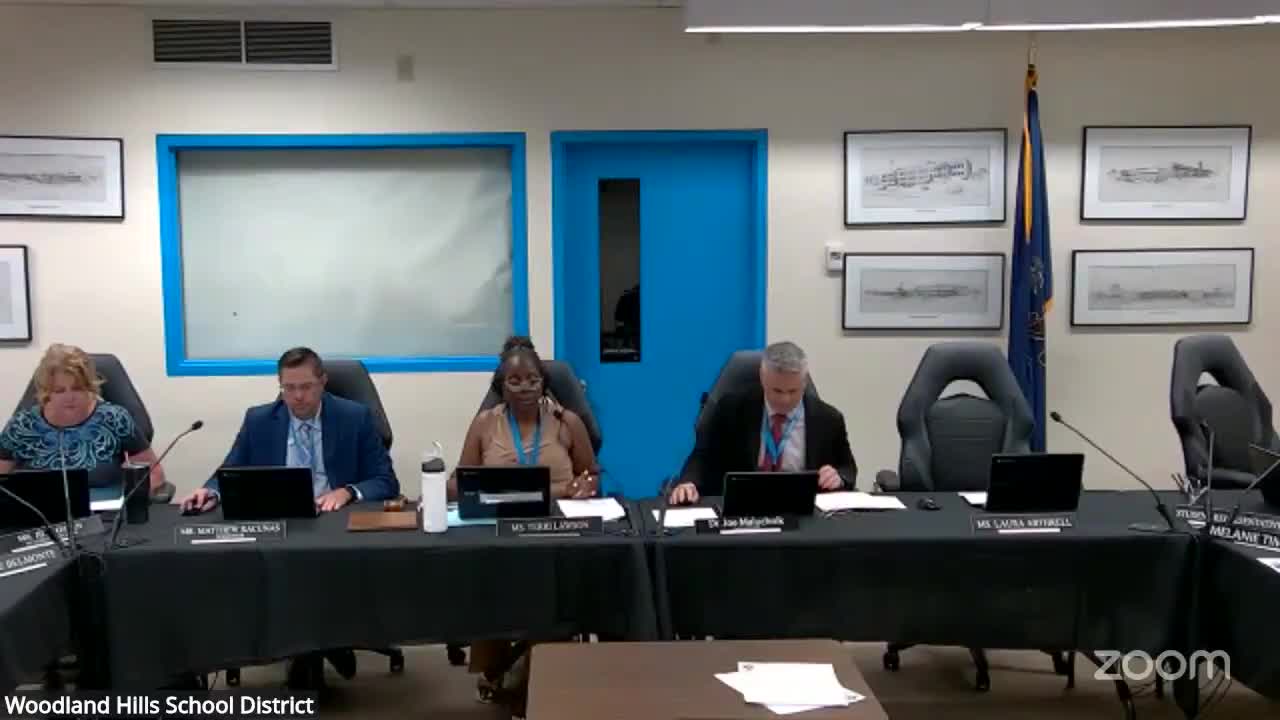
At the June 18, 2025 legislative meeting of the Woodland Hills SD Board of Education, Dr. Pam White, a district staff member, told the board that several outside programs the district relies on are losing grant funding and that some could end by December if they cannot find other grants.
White said the district contracts with a wide range of community and medical providers and that recent grant reductions will reduce staff and direct services to students. "If they can't secure any more, grants, they will be done in December," she said, referring to a community clinic that notified the district it was losing funding.
The programs White named that are funded in whole or part by the district or by grants include Big Brothers Big Sisters; Divas of Peace; Greater Pittsburgh Food Bank (which funded a student food pantry); HSAO (behavioral-health and family-support services); 1 Nation/Turn Up Your Life (mentoring and school-based supports); Justice Discipline Project coordinators; Metro Global Health Clinic; PA Mobile Dentists; DPMC Children's Turtle Creek; Power Up; Teen Outreach; the Cool Zone; STEMstar; and several others. She said the district used multiple grant sources in recent years — including ESSRs, SEEKs and PCCD grants — and that declines in those funds are revealing inequities across districts.
White described program-level impacts the board can expect if funding is not replaced: the district is likely to lose a family engagement specialist identified as Lavonne, an anti‑vaping program, the Justice Discipline Project coordinators (who she said had been in the district about six years), and UPMC-supported "Pool Zone" services that provided supports for high‑need students. She said some organizations had given conflicting notices about funding before ultimately saying they would close unless new grants were found.
White also outlined how the district plans to prioritize limited dollars. She said the administration will focus on providers that have regular student contact, demonstrated student-level outcomes and community or family services beyond consulting. From the list the district currently pays for, she said she intends to present three contracts in August: two with HSAO and one with 1 Nation (West Lions). "I'll have those contracts for you. So I'll put those contracts in August," she said.
White gave operational figures to explain the scope of need: HSAO ran a caseload of about 30 with a waiting list of roughly 30 referrals; a mentoring program she described as "1 Nation" reported more than 462 contacts with students this year and daily lunch support; a West Lions provider served 51 families and met in schools twice monthly in addition to attending care meetings. She said some providers agreed to reduce their requested funding this year to remain in schools while they pursue outside grants.
White said the district is exploring whether existing social workers and counselors can absorb services, whether free or lower-cost alternatives exist, and whether state competitive grants the district plans to apply for can restore some services. She named specific grant streams the district has used and said pursuing CD (unspecified) grants was part of the plan.
The presentation was discussion only; no formal district policy or contract was approved at the meeting. White said she will return to the board in August with the contracts she described for board approval.
Why it matters: These programs provide direct behavioral-health supports, family-engagement work, in-school mentoring and medical services for students without insurance. The district’s description of caseloads and contacts indicates the services reach dozens to hundreds of students; losing them would reduce front-line supports the schools rely on.
Any board action expected next: Staff said it will present contracts for board consideration in August and continue pursuing grant funding.
White said the district contracts with a wide range of community and medical providers and that recent grant reductions will reduce staff and direct services to students. "If they can't secure any more, grants, they will be done in December," she said, referring to a community clinic that notified the district it was losing funding.
The programs White named that are funded in whole or part by the district or by grants include Big Brothers Big Sisters; Divas of Peace; Greater Pittsburgh Food Bank (which funded a student food pantry); HSAO (behavioral-health and family-support services); 1 Nation/Turn Up Your Life (mentoring and school-based supports); Justice Discipline Project coordinators; Metro Global Health Clinic; PA Mobile Dentists; DPMC Children's Turtle Creek; Power Up; Teen Outreach; the Cool Zone; STEMstar; and several others. She said the district used multiple grant sources in recent years — including ESSRs, SEEKs and PCCD grants — and that declines in those funds are revealing inequities across districts.
White described program-level impacts the board can expect if funding is not replaced: the district is likely to lose a family engagement specialist identified as Lavonne, an anti‑vaping program, the Justice Discipline Project coordinators (who she said had been in the district about six years), and UPMC-supported "Pool Zone" services that provided supports for high‑need students. She said some organizations had given conflicting notices about funding before ultimately saying they would close unless new grants were found.
White also outlined how the district plans to prioritize limited dollars. She said the administration will focus on providers that have regular student contact, demonstrated student-level outcomes and community or family services beyond consulting. From the list the district currently pays for, she said she intends to present three contracts in August: two with HSAO and one with 1 Nation (West Lions). "I'll have those contracts for you. So I'll put those contracts in August," she said.
White gave operational figures to explain the scope of need: HSAO ran a caseload of about 30 with a waiting list of roughly 30 referrals; a mentoring program she described as "1 Nation" reported more than 462 contacts with students this year and daily lunch support; a West Lions provider served 51 families and met in schools twice monthly in addition to attending care meetings. She said some providers agreed to reduce their requested funding this year to remain in schools while they pursue outside grants.
White said the district is exploring whether existing social workers and counselors can absorb services, whether free or lower-cost alternatives exist, and whether state competitive grants the district plans to apply for can restore some services. She named specific grant streams the district has used and said pursuing CD (unspecified) grants was part of the plan.
The presentation was discussion only; no formal district policy or contract was approved at the meeting. White said she will return to the board in August with the contracts she described for board approval.
Why it matters: These programs provide direct behavioral-health supports, family-engagement work, in-school mentoring and medical services for students without insurance. The district’s description of caseloads and contacts indicates the services reach dozens to hundreds of students; losing them would reduce front-line supports the schools rely on.
Any board action expected next: Staff said it will present contracts for board consideration in August and continue pursuing grant funding.
Don't Miss a Word: See the Full Meeting!
Go beyond summaries. Unlock every video, transcript, and key insight with a Founder Membership.
✓
Get instant access to full meeting videos
✓
Search and clip any phrase from complete transcripts
✓
Receive AI-powered summaries & custom alerts
✓
Enjoy lifetime, unrestricted access to government data
30-day money-back guarantee
