Pullman board hears plan for low-cost solar energy and community funds under PPA
June 26, 2025 | Pullman School District, School Districts, Washington
This article was created by AI summarizing key points discussed. AI makes mistakes, so for full details and context, please refer to the video of the full meeting. Please report any errors so we can fix them. Report an error »
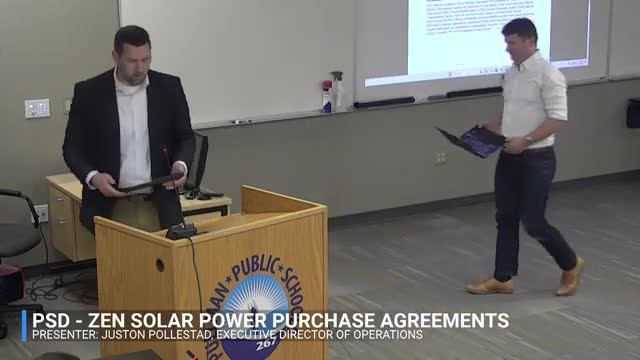
The Pullman Public Schools board of directors on June 25 heard a detailed presentation on a proposed solar power purchase agreement (PPA) that would place solar arrays on four district properties and use state incentives to subsidize low-income community services.
David Funk, an energy consultant with Zen, told the board the company has secured an Avista interconnection approval and a Washington State incentive and is asking the district to consider four separate 100-kilowatt AC PPAs for Kamiak Elementary, the bus depot, Lincoln Middle School and the high school. "There is no cost associated with this for Pullman School District to get up and running for the first 10 years," Funk said, adding the PPA rate for Pullman would be about "3.7¢ per kilowatt hour" with a 2 percent annual escalation.
The nut graf: The proposal pairs up-front incentive dollars with a private developer-operated PPA to generate energy savings for the district while channeling a portion of incentive proceeds into community programs (for example, STEM, workforce development and basic needs). Board members asked technical and operational questions about warranties, aesthetics, monitoring, maintenance response and insurance; Funk said those responsibilities are borne by his company during the contract period.
Funk described the structure: Zen would own and operate the systems for at least the first 10 years, maintain the arrays, and provide remote monitoring and on-call service. At year 10 the district would have a purchase option. "After 10 years, the school district has a purchase option," Funk told the board, and the contract would fix that option price at the time the PPA is signed. He said the projects are sized to maximize financial outcomes and that a majority of the construction and permitting work would be handled by Zen and its partners.
Funk presented project-level and program-level figures: Zen reported it secured $4.6 million in incentives for 14 projects across eastern Washington and estimated the collective projects would save about $15 million over their useful life. For Pullman specifically, Funk said the contract pricing results in an approximately 67 percent discount to Avista retail rates today and a long-term net energy savings for the district.
Board members probed for operational details. On durability and warranties Funk said modern panels have a roughly 30-year useful life and will typically produce about 80 percent of initial output after that time; he also said Zen carries a 10-year workmanship warranty on installation. On-site visibility and repairs are handled via panel-level monitoring: "I would probably notice, but as always, like, I just was at my one of my employees' houses, and I noticed her transformer looked like it was leaking... If you see something, say something," Funk said.
On program money and oversight, Funk said the incentive program is administered in partnership with WSU Energy and Partners for Rural Washington (PRWA). He described the reporting and spending as flexible within broad categories and said the state is focused on housing, energy and food but that school-related uses (for example, covering band fees or summer STEM programs for low-income students) would qualify. "This program is relatively new, so we're going to have to invent what the reporting looks like," he said.
Funk emphasized district control over final design and a staged decision process: if the board wishes to proceed, Zen would return with final engineered site plans and interconnection diagrams for board review before construction. He said there is a two-year window to complete the projects and that Zen prefers to move quickly so incentive and pricing conditions do not change.
The district took no formal action on June 25; board members asked to see final contract language, stamped drawings and a rendering for visible sites before any vote. Board members also requested details on insurance timing, panel replacement strategy and how project savings would be tracked and delivered to community programs.
Looking ahead: Zen indicated it would return with a PPA draft and final designs; the board did not set a decision date at the meeting.
David Funk, an energy consultant with Zen, told the board the company has secured an Avista interconnection approval and a Washington State incentive and is asking the district to consider four separate 100-kilowatt AC PPAs for Kamiak Elementary, the bus depot, Lincoln Middle School and the high school. "There is no cost associated with this for Pullman School District to get up and running for the first 10 years," Funk said, adding the PPA rate for Pullman would be about "3.7¢ per kilowatt hour" with a 2 percent annual escalation.
The nut graf: The proposal pairs up-front incentive dollars with a private developer-operated PPA to generate energy savings for the district while channeling a portion of incentive proceeds into community programs (for example, STEM, workforce development and basic needs). Board members asked technical and operational questions about warranties, aesthetics, monitoring, maintenance response and insurance; Funk said those responsibilities are borne by his company during the contract period.
Funk described the structure: Zen would own and operate the systems for at least the first 10 years, maintain the arrays, and provide remote monitoring and on-call service. At year 10 the district would have a purchase option. "After 10 years, the school district has a purchase option," Funk told the board, and the contract would fix that option price at the time the PPA is signed. He said the projects are sized to maximize financial outcomes and that a majority of the construction and permitting work would be handled by Zen and its partners.
Funk presented project-level and program-level figures: Zen reported it secured $4.6 million in incentives for 14 projects across eastern Washington and estimated the collective projects would save about $15 million over their useful life. For Pullman specifically, Funk said the contract pricing results in an approximately 67 percent discount to Avista retail rates today and a long-term net energy savings for the district.
Board members probed for operational details. On durability and warranties Funk said modern panels have a roughly 30-year useful life and will typically produce about 80 percent of initial output after that time; he also said Zen carries a 10-year workmanship warranty on installation. On-site visibility and repairs are handled via panel-level monitoring: "I would probably notice, but as always, like, I just was at my one of my employees' houses, and I noticed her transformer looked like it was leaking... If you see something, say something," Funk said.
On program money and oversight, Funk said the incentive program is administered in partnership with WSU Energy and Partners for Rural Washington (PRWA). He described the reporting and spending as flexible within broad categories and said the state is focused on housing, energy and food but that school-related uses (for example, covering band fees or summer STEM programs for low-income students) would qualify. "This program is relatively new, so we're going to have to invent what the reporting looks like," he said.
Funk emphasized district control over final design and a staged decision process: if the board wishes to proceed, Zen would return with final engineered site plans and interconnection diagrams for board review before construction. He said there is a two-year window to complete the projects and that Zen prefers to move quickly so incentive and pricing conditions do not change.
The district took no formal action on June 25; board members asked to see final contract language, stamped drawings and a rendering for visible sites before any vote. Board members also requested details on insurance timing, panel replacement strategy and how project savings would be tracked and delivered to community programs.
Looking ahead: Zen indicated it would return with a PPA draft and final designs; the board did not set a decision date at the meeting.
Don't Miss a Word: See the Full Meeting!
Go beyond summaries. Unlock every video, transcript, and key insight with a Founder Membership.
✓
Get instant access to full meeting videos
✓
Search and clip any phrase from complete transcripts
✓
Receive AI-powered summaries & custom alerts
✓
Enjoy lifetime, unrestricted access to government data
30-day money-back guarantee
