CSWD MRF permits advance as design finalizes; board discusses fire suppression technology and schedule
June 26, 2025 | Chittenden County, Vermont
This article was created by AI summarizing key points discussed. AI makes mistakes, so for full details and context, please refer to the video of the full meeting. Please report any errors so we can fix them. Report an error »
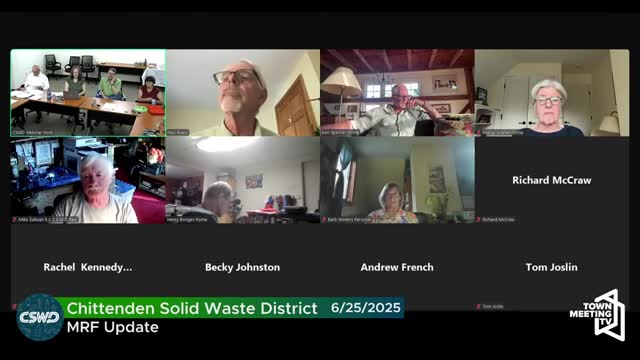
Chittenden Solid Waste District staff told commissioners on June 25 that the district’s new materials‑recovery facility (MRF) design is final, permitting is advancing, and the district remains on an aggressive construction schedule aiming to break ground in September 2025 — subject to remaining permits and approvals.
The board spent substantial time on fire‑suppression design after staff described a proposal to use a monitored heat‑sensing detection and remote‑monitoring system as an alternative to a full automatic sprinkler installation in some areas. Sarah Reeves, executive director, summarized the team’s position: “What we're looking at is something that... uses heat sensing technology to identify potential hot spots, something that might be smoldering, and to more quickly pinpoint where a heat source of fire may be occurring before it even has time to generate additional smoke in flames that would then reach the actual sprinklers.”
Staff said the State Fire Marshal has not rejected the approach but expressed a preference for an automatic sprinkler response. The remote system under consideration uses continuous remote monitoring and a vendor‑operated response center that would activate water if sensors and camera verification indicate a fire. Staff acknowledged the tradeoffs: the remote monitored system may detect smoldering lithium‑ion battery incidents faster when no personnel are on site, while an automatic sprinkler provides an immediate automated water response. Commissioners pressed about reliability, redundancy and cost: the heat‑sensor system carries an estimated cost of roughly $150,000; adding both systems could increase project cost by an estimated additional $150,000 depending on final fire‑pump sizing and sprinkler scope.
Sarah Reeves also reported permitting progress: the project received a jurisdictional opinion that it does not require an Act 250 permit, reducing schedule risk; the DRB and conservation commission reviews were underway with a habitat report due in the weeks after the meeting. Reeves said the new MRF will be roughly 73,000 square feet compared with the existing facility of about 37,000 square feet, providing additional processing and future capacity.
Commissioners noted two financing items. The board approved a resolution authorizing the issuance of a $12 million general obligation bond, to be provided through the Vermont Bond Bank’s pooled loan program, to fund the remaining authorized bond proceeds for the project. Attorney Steve Thomas explained the process and said the Bond Bank pools municipal borrowers to achieve better interest rates; the $12 million draw is the remainder of a voter‑authorized $22 million bond and complements the $10 million previously issued. Thomas noted the bond bank’s statutory “intercept” authority to apply state allocations to cure a municipal borrower’s default; commissioners were advised this is standard for bond bank financings.
Reeves also called attention to a $1.5 million grant from the Agency of Natural Resources that applied to the district’s prior property acquisition costs and reduced the district’s net outlay for site purchase.
On schedule, staff said they are aiming to break ground in September 2025 but remain contingent on the conservation commission, habitat report, and final fire‑marshal determination about acceptable suppression technology. Reeves said the project team anticipates a public groundbreaking event, likely warned as a board meeting so commissioners can attend.
No final change to the design was approved at the meeting; staff said they will pursue the fire‑marshal conversation and permit applications and report back to commissioners as those approvals and bids are finalized.
The board spent substantial time on fire‑suppression design after staff described a proposal to use a monitored heat‑sensing detection and remote‑monitoring system as an alternative to a full automatic sprinkler installation in some areas. Sarah Reeves, executive director, summarized the team’s position: “What we're looking at is something that... uses heat sensing technology to identify potential hot spots, something that might be smoldering, and to more quickly pinpoint where a heat source of fire may be occurring before it even has time to generate additional smoke in flames that would then reach the actual sprinklers.”
Staff said the State Fire Marshal has not rejected the approach but expressed a preference for an automatic sprinkler response. The remote system under consideration uses continuous remote monitoring and a vendor‑operated response center that would activate water if sensors and camera verification indicate a fire. Staff acknowledged the tradeoffs: the remote monitored system may detect smoldering lithium‑ion battery incidents faster when no personnel are on site, while an automatic sprinkler provides an immediate automated water response. Commissioners pressed about reliability, redundancy and cost: the heat‑sensor system carries an estimated cost of roughly $150,000; adding both systems could increase project cost by an estimated additional $150,000 depending on final fire‑pump sizing and sprinkler scope.
Sarah Reeves also reported permitting progress: the project received a jurisdictional opinion that it does not require an Act 250 permit, reducing schedule risk; the DRB and conservation commission reviews were underway with a habitat report due in the weeks after the meeting. Reeves said the new MRF will be roughly 73,000 square feet compared with the existing facility of about 37,000 square feet, providing additional processing and future capacity.
Commissioners noted two financing items. The board approved a resolution authorizing the issuance of a $12 million general obligation bond, to be provided through the Vermont Bond Bank’s pooled loan program, to fund the remaining authorized bond proceeds for the project. Attorney Steve Thomas explained the process and said the Bond Bank pools municipal borrowers to achieve better interest rates; the $12 million draw is the remainder of a voter‑authorized $22 million bond and complements the $10 million previously issued. Thomas noted the bond bank’s statutory “intercept” authority to apply state allocations to cure a municipal borrower’s default; commissioners were advised this is standard for bond bank financings.
Reeves also called attention to a $1.5 million grant from the Agency of Natural Resources that applied to the district’s prior property acquisition costs and reduced the district’s net outlay for site purchase.
On schedule, staff said they are aiming to break ground in September 2025 but remain contingent on the conservation commission, habitat report, and final fire‑marshal determination about acceptable suppression technology. Reeves said the project team anticipates a public groundbreaking event, likely warned as a board meeting so commissioners can attend.
No final change to the design was approved at the meeting; staff said they will pursue the fire‑marshal conversation and permit applications and report back to commissioners as those approvals and bids are finalized.
Don't Miss a Word: See the Full Meeting!
Go beyond summaries. Unlock every video, transcript, and key insight with a Founder Membership.
✓
Get instant access to full meeting videos
✓
Search and clip any phrase from complete transcripts
✓
Receive AI-powered summaries & custom alerts
✓
Enjoy lifetime, unrestricted access to government data
30-day money-back guarantee
