Dakota 911 reports staffing gains, new tech and stronger resiliency after 2024 outage
June 03, 2025 | Dakota County, Minnesota
This article was created by AI summarizing key points discussed. AI makes mistakes, so for full details and context, please refer to the video of the full meeting. Please report any errors so we can fix them. Report an error »
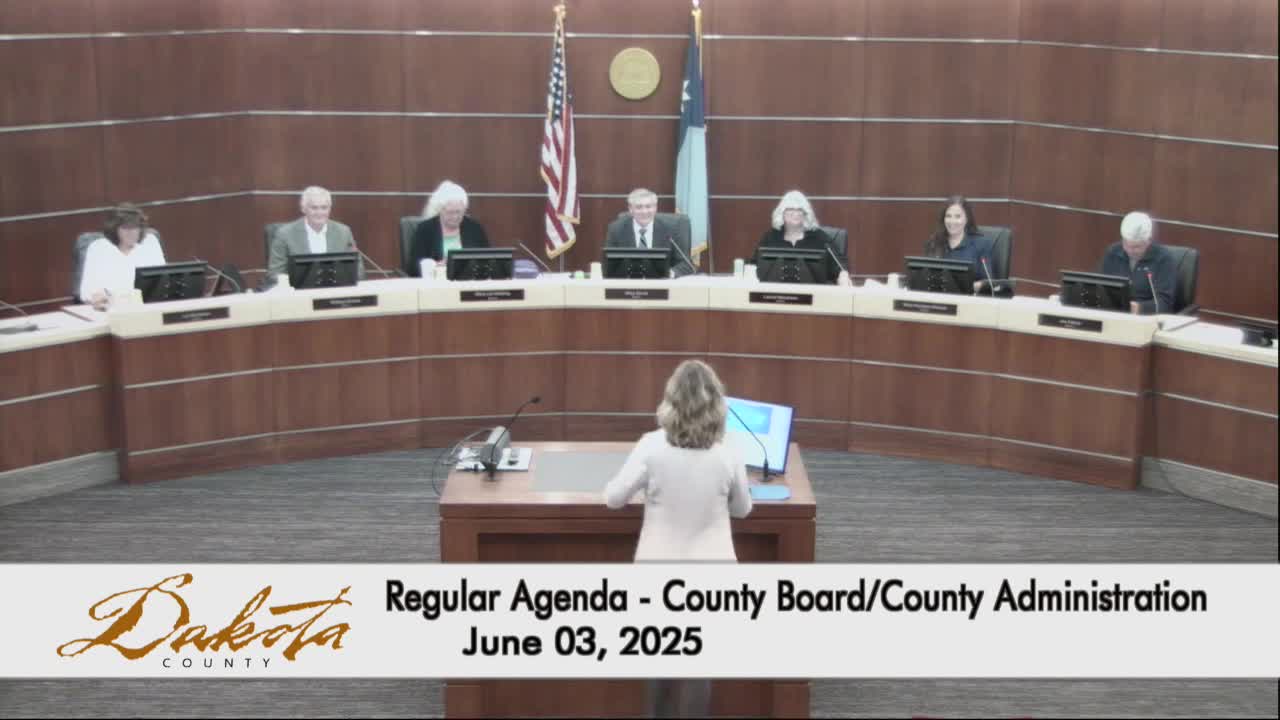
Heidi Heesrick, executive director of Dakota 911, updated the Dakota County Board of Commissioners on June 3 on the emergency communications center’s 2024 activity, staffing and technology initiatives.
Heesrick said Dakota 911 handled just over 291,000 phone calls in 2024, of which 57% were 911 calls, and that the center “processes a little over 800 calls a day.” She told the board the center is meeting national call‑answering standards and exceeded targets for answering 9‑1‑1 calls within the 15‑ to 20‑second windows used in benchmarking.
The presentation highlighted staffing improvements: Dakota 911 onboarded 18 public safety telecommunicators in 2024, a 17% increase in gross staffing, and added a training program manager to accelerate in‑house certifications. Heesrick said net staffing lags gross hires because of the time required to train new telecommunicators to independent duty.
Heesrick described new services and technology rollouts. Dakota 911 launched a non‑emergency online service request late in 2024 and had about 650 online requests in 2024; she said the center has already reached that volume again in 2025. The center also created a peer‑support team guided by a mental health clinician and strengthened continuity‑of‑operations capabilities after a major 9‑1‑1 network disruption in early 2024. Heesrick said local call‑handling failover, network stability improvements and contingency drills with partner centers have reduced the risk of a repeat outage.
Looking ahead, Heesrick said Dakota 911 is testing a virtual attendant to handle non‑emergency traffic during peak hours, and a next‑generation assistive platform that will provide live transcription of 911 calls and live language translation. She described the translation capability as supporting “over 200 different languages,” which she said will shorten delays while arranging interpreters.
On finance, Heesrick told commissioners Dakota 911’s 2024 revenues were just over $11,000,000, primarily from member fee assessments with 9‑1‑1 fees making up about 10–12% of revenue. She said 77% of expenses were personnel costs, capital expenditures were roughly $95,000 in 2024, and about 79% of costs are variable while 21% are fixed.
Commissioner Atkins praised telecommunicators as “the first of the first responders” and asked whether the 245 non‑structure fire categories on Dakota 911’s coding represent fire‑related responses; Heesrick said many are fire‑related (smoke in a home, outside fires, grass fires) but not confirmed structure fires. Commissioner Droste asked about non‑emergency numbers and public messaging; Heesrick said many member agencies maintain their own administrative numbers, while a countywide non‑emergency line is shared and the county will roll out revamped public education this summer to direct non‑emergency traffic to alternatives. When asked about potential volume reductions from AI and virtual assistants, Heesrick cited an example center that reduced call volume by about 40% using a virtual assistant combined with online service requests and said Dakota 911 will “ease into” those tools while monitoring quality.
The presentation and discussion provided commissioners with data on operations, recent investments in training and resiliency, and planned technology deployments aimed at reducing non‑emergency call load and improving response under high volume or degraded network conditions.
The commissioners asked follow‑up questions about call timing, fire‑category coding and the public education campaign, and thanked Heesrick and her staff for the briefing.
Heesrick said Dakota 911 handled just over 291,000 phone calls in 2024, of which 57% were 911 calls, and that the center “processes a little over 800 calls a day.” She told the board the center is meeting national call‑answering standards and exceeded targets for answering 9‑1‑1 calls within the 15‑ to 20‑second windows used in benchmarking.
The presentation highlighted staffing improvements: Dakota 911 onboarded 18 public safety telecommunicators in 2024, a 17% increase in gross staffing, and added a training program manager to accelerate in‑house certifications. Heesrick said net staffing lags gross hires because of the time required to train new telecommunicators to independent duty.
Heesrick described new services and technology rollouts. Dakota 911 launched a non‑emergency online service request late in 2024 and had about 650 online requests in 2024; she said the center has already reached that volume again in 2025. The center also created a peer‑support team guided by a mental health clinician and strengthened continuity‑of‑operations capabilities after a major 9‑1‑1 network disruption in early 2024. Heesrick said local call‑handling failover, network stability improvements and contingency drills with partner centers have reduced the risk of a repeat outage.
Looking ahead, Heesrick said Dakota 911 is testing a virtual attendant to handle non‑emergency traffic during peak hours, and a next‑generation assistive platform that will provide live transcription of 911 calls and live language translation. She described the translation capability as supporting “over 200 different languages,” which she said will shorten delays while arranging interpreters.
On finance, Heesrick told commissioners Dakota 911’s 2024 revenues were just over $11,000,000, primarily from member fee assessments with 9‑1‑1 fees making up about 10–12% of revenue. She said 77% of expenses were personnel costs, capital expenditures were roughly $95,000 in 2024, and about 79% of costs are variable while 21% are fixed.
Commissioner Atkins praised telecommunicators as “the first of the first responders” and asked whether the 245 non‑structure fire categories on Dakota 911’s coding represent fire‑related responses; Heesrick said many are fire‑related (smoke in a home, outside fires, grass fires) but not confirmed structure fires. Commissioner Droste asked about non‑emergency numbers and public messaging; Heesrick said many member agencies maintain their own administrative numbers, while a countywide non‑emergency line is shared and the county will roll out revamped public education this summer to direct non‑emergency traffic to alternatives. When asked about potential volume reductions from AI and virtual assistants, Heesrick cited an example center that reduced call volume by about 40% using a virtual assistant combined with online service requests and said Dakota 911 will “ease into” those tools while monitoring quality.
The presentation and discussion provided commissioners with data on operations, recent investments in training and resiliency, and planned technology deployments aimed at reducing non‑emergency call load and improving response under high volume or degraded network conditions.
The commissioners asked follow‑up questions about call timing, fire‑category coding and the public education campaign, and thanked Heesrick and her staff for the briefing.
View the Full Meeting & All Its Details
This article offers just a summary. Unlock complete video, transcripts, and insights as a Founder Member.
✓
Watch full, unedited meeting videos
✓
Search every word spoken in unlimited transcripts
✓
AI summaries & real-time alerts (all government levels)
✓
Permanent access to expanding government content
30-day money-back guarantee
