Madison council debates three stadium upgrade plans, gives staff direction toward four‑story option
June 26, 2025 | Madison City, Madison County, Alabama
This article was created by AI summarizing key points discussed. AI makes mistakes, so for full details and context, please refer to the video of the full meeting. Please report any errors so we can fix them. Report an error »
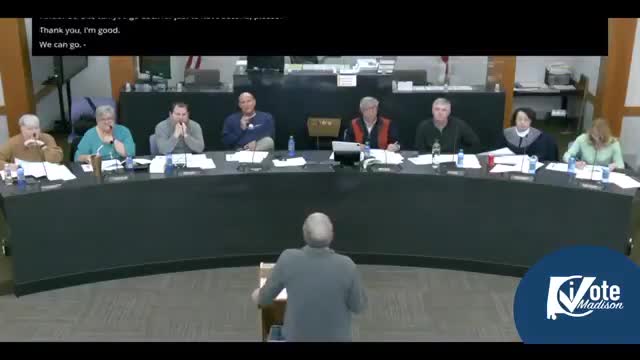
Madison City Council members spent a work‑session meeting reviewing three options to bring the city’s stadium into compliance with Major League Baseball standards and increase event and revenue capacity, and they gave staff direction to continue pursuing the four‑story build while retaining the maintenance‑facility option as a lower‑cost alternative.
The proposals presented included: (1) converting the existing maintenance facility into a visitor locker room and building a new 5,000‑square‑foot maintenance building across the driveway (estimated total $4,000,000, completion April 2026); (2) constructing a one‑story building in left field with provisions for future vertical expansion (estimated $7,000,000, completion April 2026); and (3) a full, four‑story left‑field build including parking improvements (estimated $25,000,000; first‑floor completion April 2026, upper floors January 2027).
Staff member Gerald, who led the project presentation, summarized the three options and the tradeoffs. He said the maintenance‑facility conversion “meets Major League Baseball requirements” while minimizing disruption to stadium events, the one‑story build in left field would allow expanded playing surfaces for football and other events but require working around event schedules, and the full four‑story option would provide the greatest revenue potential but at the highest construction cost.
Why this matters: the council’s decision affects capital spending, the city’s lodging‑tax and bond obligations, future stadium revenue streams and the city’s contractual relationship with the team operator, referred to in the meeting as Ball Corp.
Funding and financial analysis
Staff reviewed how each option could be financed. Staff member Roger presented funding scenarios that rely on a combination of existing bond capacity, projected lodging‑tax receipts and a “backstop” contribution from Ball Corp for the four‑story option. Under the plan described to council, Ball Corp would provide significant early payments in the first years of a bond schedule that reduce the city’s near‑term debt burden; council members were shown an annual schedule in which Ball Corp’s payments start above current annual receipts and taper toward the city’s present level over time. Roger and other staff emphasized the analyses are based on current revenue projections and bond assumptions.
A separate financial modeling spreadsheet, produced with input from Mark and Joel Lamp of the Huntsville‑Madison County Visitors Bureau, compared 25‑year revenue and expense projections. The work session materials showed a long‑term revenue difference between the one‑story and four‑story scenarios in the tens of millions of dollars (staff presented figures of roughly $115 million for the one‑story model and roughly $152–158 million for the four‑story model over 25 years; staff noted growth‑rate assumptions and other inputs affect those totals).
Contract and compliance questions
Council members raised concerns about changes in the venue lease agreement the city is negotiating. Several speakers noted the draft agreement would alter how operating revenues are allocated; the draft presented in the meeting would limit city receipts from many categories of event and venue revenue while guaranteeing a minimum annual venue lease fee (discussed in the meeting as a $1,000,000 minimum under the four‑story arrangement). Staff member Megan said contractual adjustments will be needed under any option, and the city is still negotiating some terms with Ball Corp for options 1 and 2.
Council member Karen pressed staff on the implication for taxpayers, saying, “I do not wanna put an extra burden on them because we're putting wording in here that in the future, they will have to somebody will have to be held accountable for.” Mayor Finley and other council members acknowledged the tradeoffs between minimizing near‑term city spending and investing for longer‑term return.
Parking and site work
Staff described a separately acquired parcel intended for future parking. The land purchase price discussed in the meeting was $4,000,000. Staff said a partial immediate improvement (graveling a portion of the lot) would cost about $1,500,000, while full lighting, landscaping and completion of the lot would be roughly $3,500,000 (staff presented these as site‑development estimates and noted the numbers are programmatic). Gerald also noted electrical and other service relocations in the left‑field footprint would add complexity and that some wiring boxes are “very challenged” and likely will need work regardless of which option is chosen.
Council debate and guidance to staff
Council members split on the preferred approach. Several members argued the four‑story option is an investment that returns substantially more revenue and spurs private investment in surrounding areas; others described the maintenance conversion or one‑story approach as lower‑cost, less risky near‑term choices that preserve flexibility and limit debt exposure given recent flat or declining sales‑tax receipts. Mayor Finley said his personal recommendation was to pursue the maintenance conversion while renegotiating the venue contract to reach an arrangement closer to the $1,000,000 target, but he also said the four‑story plan “is a good investment” for the long term.
After hearing brief statements from members, the mayor and staff said they tallied council sentiment: roughly four council members favored moving forward with the four‑story option and three favored the lower‑cost option (multiple members described their positions on the record). Council did not take a formal recorded vote during the session; instead, members directed staff to continue work on the four‑story path while retaining option 1 as an achievable, lower‑cost fallback and to continue contract negotiations with Ball Corp and Major League Baseball stakeholders.
Next steps
Staff said they will continue contract negotiations, refine cost estimates and schedule, and return to council with final recommendations and the specific contract language required to implement the chosen scope. No final resolution or bond issuance was approved during the work session.
Ending
Council recessed after the work session and instructed staff to proceed with follow‑up items tied to the preferred four‑story direction while preserving the maintenance conversion as an alternative if circumstances change.
The proposals presented included: (1) converting the existing maintenance facility into a visitor locker room and building a new 5,000‑square‑foot maintenance building across the driveway (estimated total $4,000,000, completion April 2026); (2) constructing a one‑story building in left field with provisions for future vertical expansion (estimated $7,000,000, completion April 2026); and (3) a full, four‑story left‑field build including parking improvements (estimated $25,000,000; first‑floor completion April 2026, upper floors January 2027).
Staff member Gerald, who led the project presentation, summarized the three options and the tradeoffs. He said the maintenance‑facility conversion “meets Major League Baseball requirements” while minimizing disruption to stadium events, the one‑story build in left field would allow expanded playing surfaces for football and other events but require working around event schedules, and the full four‑story option would provide the greatest revenue potential but at the highest construction cost.
Why this matters: the council’s decision affects capital spending, the city’s lodging‑tax and bond obligations, future stadium revenue streams and the city’s contractual relationship with the team operator, referred to in the meeting as Ball Corp.
Funding and financial analysis
Staff reviewed how each option could be financed. Staff member Roger presented funding scenarios that rely on a combination of existing bond capacity, projected lodging‑tax receipts and a “backstop” contribution from Ball Corp for the four‑story option. Under the plan described to council, Ball Corp would provide significant early payments in the first years of a bond schedule that reduce the city’s near‑term debt burden; council members were shown an annual schedule in which Ball Corp’s payments start above current annual receipts and taper toward the city’s present level over time. Roger and other staff emphasized the analyses are based on current revenue projections and bond assumptions.
A separate financial modeling spreadsheet, produced with input from Mark and Joel Lamp of the Huntsville‑Madison County Visitors Bureau, compared 25‑year revenue and expense projections. The work session materials showed a long‑term revenue difference between the one‑story and four‑story scenarios in the tens of millions of dollars (staff presented figures of roughly $115 million for the one‑story model and roughly $152–158 million for the four‑story model over 25 years; staff noted growth‑rate assumptions and other inputs affect those totals).
Contract and compliance questions
Council members raised concerns about changes in the venue lease agreement the city is negotiating. Several speakers noted the draft agreement would alter how operating revenues are allocated; the draft presented in the meeting would limit city receipts from many categories of event and venue revenue while guaranteeing a minimum annual venue lease fee (discussed in the meeting as a $1,000,000 minimum under the four‑story arrangement). Staff member Megan said contractual adjustments will be needed under any option, and the city is still negotiating some terms with Ball Corp for options 1 and 2.
Council member Karen pressed staff on the implication for taxpayers, saying, “I do not wanna put an extra burden on them because we're putting wording in here that in the future, they will have to somebody will have to be held accountable for.” Mayor Finley and other council members acknowledged the tradeoffs between minimizing near‑term city spending and investing for longer‑term return.
Parking and site work
Staff described a separately acquired parcel intended for future parking. The land purchase price discussed in the meeting was $4,000,000. Staff said a partial immediate improvement (graveling a portion of the lot) would cost about $1,500,000, while full lighting, landscaping and completion of the lot would be roughly $3,500,000 (staff presented these as site‑development estimates and noted the numbers are programmatic). Gerald also noted electrical and other service relocations in the left‑field footprint would add complexity and that some wiring boxes are “very challenged” and likely will need work regardless of which option is chosen.
Council debate and guidance to staff
Council members split on the preferred approach. Several members argued the four‑story option is an investment that returns substantially more revenue and spurs private investment in surrounding areas; others described the maintenance conversion or one‑story approach as lower‑cost, less risky near‑term choices that preserve flexibility and limit debt exposure given recent flat or declining sales‑tax receipts. Mayor Finley said his personal recommendation was to pursue the maintenance conversion while renegotiating the venue contract to reach an arrangement closer to the $1,000,000 target, but he also said the four‑story plan “is a good investment” for the long term.
After hearing brief statements from members, the mayor and staff said they tallied council sentiment: roughly four council members favored moving forward with the four‑story option and three favored the lower‑cost option (multiple members described their positions on the record). Council did not take a formal recorded vote during the session; instead, members directed staff to continue work on the four‑story path while retaining option 1 as an achievable, lower‑cost fallback and to continue contract negotiations with Ball Corp and Major League Baseball stakeholders.
Next steps
Staff said they will continue contract negotiations, refine cost estimates and schedule, and return to council with final recommendations and the specific contract language required to implement the chosen scope. No final resolution or bond issuance was approved during the work session.
Ending
Council recessed after the work session and instructed staff to proceed with follow‑up items tied to the preferred four‑story direction while preserving the maintenance conversion as an alternative if circumstances change.
View the Full Meeting & All Its Details
This article offers just a summary. Unlock complete video, transcripts, and insights as a Founder Member.
✓
Watch full, unedited meeting videos
✓
Search every word spoken in unlimited transcripts
✓
AI summaries & real-time alerts (all government levels)
✓
Permanent access to expanding government content
30-day money-back guarantee
