Berwyn South SD 100 highlights science curriculum gains, expands hands-on programs
June 26, 2025 | Berwyn South SD 100, School Boards, Illinois
This article was created by AI summarizing key points discussed. AI makes mistakes, so for full details and context, please refer to the video of the full meeting. Please report any errors so we can fix them. Report an error »
School District 100 officials on Tuesday described steady gains on state science assessments and outlined a multi-pronged plan to expand hands-on science instruction across elementary and middle schools.
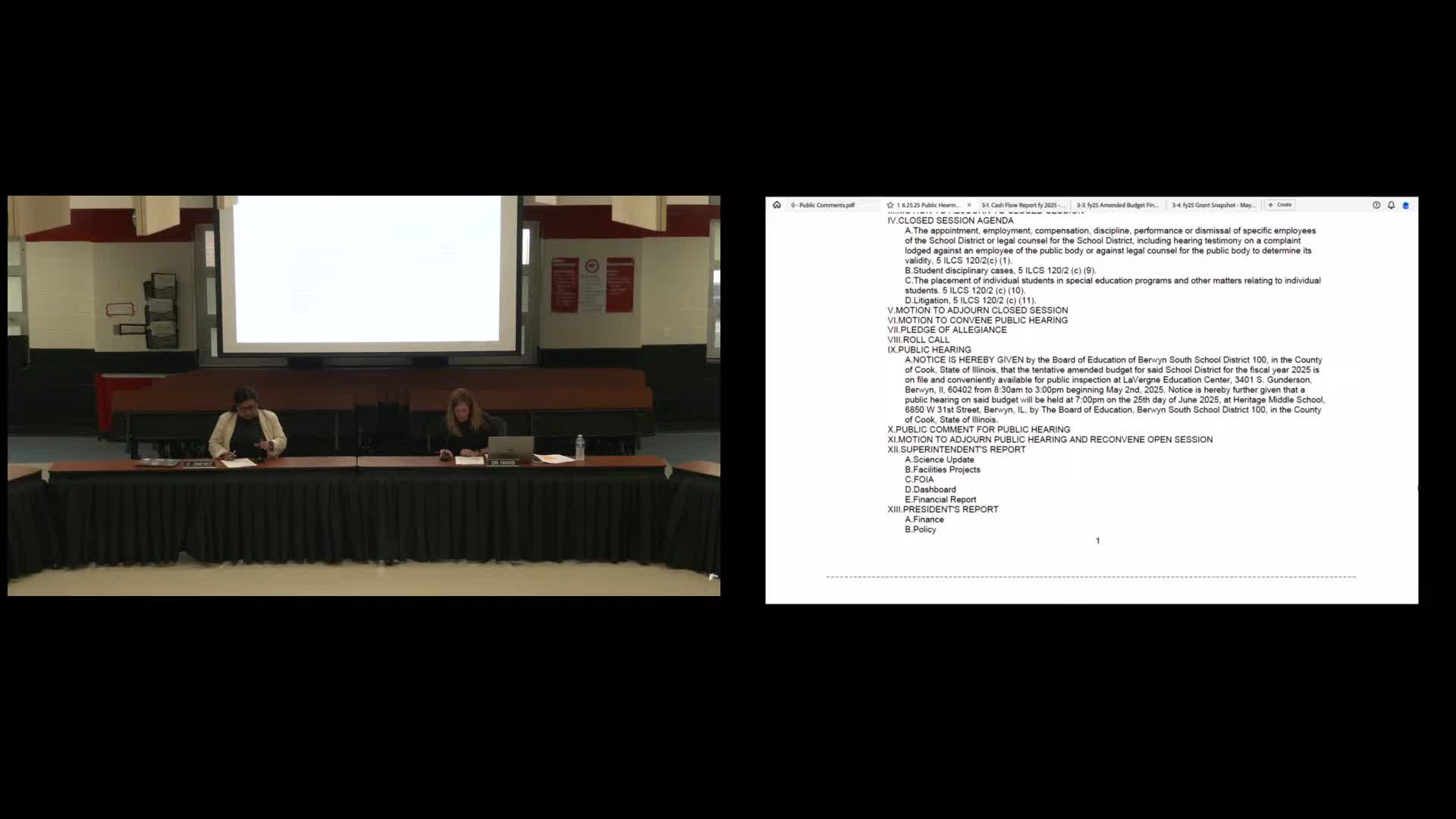
Board President Irene Jimenez convened the public meeting at Heritage Middle School, where district curriculum leaders summarized assessment results, classroom schedules and enrichment programs that leaders said are intended to support literacy-rich, phenomena-based science instruction.
District director of learning management and assessment Lindsay Cindy said the district’s Illinois Science Assessment results show growth since 2021 and noted that the district is “making more gains than the state,” while acknowledging the district remains slightly below the state average overall. Cindy said the assessment is summative only for fifth and eighth grades and that changes to the test scale and item structure since 2021 make long-term comparison difficult.
Theresa Delphia, assistant director of curriculum and instruction, described steps taken this year to make Mystery Science a more systematically paced resource in grades 1–5 and to print teacher binders and order hands-on material kits so all classrooms have the same resources. “Mystery Science is a hands-on program. It really encourages students to discuss what they're learning about,” Delphia said.
Delphia and Cindy said the district has used Amplify Science at the middle-school level for four years. Cindy described Amplify as a literacy-based, phenomena-driven curriculum that combines reading, writing and hands-on engineering projects. She showed examples of projects — including a student-built incubator to demonstrate thermal-energy transfer — that require students to justify choices, do cost analysis and present findings to peers.
Samantha Schuen, director of instructional innovation, said the district has operated a Girls Saturday Science program since about 2013 and has expanded it districtwide for fourth- and fifth-grade girls. The program, she said, is free to families and paid by a grant from the Toronto Baking Company; sessions include experiments, STEM activities and college-student mentors who discuss careers and life on campus. Schuen said 75% of participating fifth graders in one year met or exceeded standards and that participation rose to about 87% in the following year for the cohort she cited.
Cindy and Delphia said the district also offers STEAM exploratory classes using Project Lead The Way (PLTW) — District 100 was recently recognized as a PLTW district — and plans to add Sam Labs, a coding resource, for K–5 STEAM teachers next year. Delphia said Sam Labs lessons align to NGSS and PLTW and will add coding practice to existing STEM units.
Board member Adriana Caballero asked about class length and frequency. Cindy said middle-school science moved from an 88-minute every-other-day block to 42 minutes every day under a new schedule; elementary teachers provide science “at least three times a week” for 20–30 minutes depending on schedules.
Caballero also asked how students are selected for Girls Saturday Science. Schuen said principals and classroom teachers suggest about 20 students initially to keep groups manageable and that there is no formal application or data collection at this time; the district intends to expand access.
Caballero raised outreach and equity concerns, noting that girls of color are often underrepresented in science-related careers. Schuen said organizers are “inviting everyone” and that the district can pursue more strategic outreach to reach girls of color.
Officials told the board both Mystery Science and Amplify Science materials are available in English and Spanish; the Saturday program is currently offered only in English. Delphia said professional development for teachers accompanied the rollouts and that the district is analyzing new ISA (Illinois Science Assessment) reporting to identify trends and instructional needs.
The presentation closed with district leaders linking curriculum work to the board’s Vision 2030 goals for career exploration and equitable curricular access. Board members thanked staff for curriculum investments and instructional work ahead of contract and budget decisions later in the meeting.
Looking ahead, district staff said they will continue to analyze assessment reports, provide targeted professional development, and consider broadened outreach for Saturday enrichment to increase participation by underrepresented groups.
Board President Irene Jimenez convened the public meeting at Heritage Middle School, where district curriculum leaders summarized assessment results, classroom schedules and enrichment programs that leaders said are intended to support literacy-rich, phenomena-based science instruction.
District director of learning management and assessment Lindsay Cindy said the district’s Illinois Science Assessment results show growth since 2021 and noted that the district is “making more gains than the state,” while acknowledging the district remains slightly below the state average overall. Cindy said the assessment is summative only for fifth and eighth grades and that changes to the test scale and item structure since 2021 make long-term comparison difficult.
Theresa Delphia, assistant director of curriculum and instruction, described steps taken this year to make Mystery Science a more systematically paced resource in grades 1–5 and to print teacher binders and order hands-on material kits so all classrooms have the same resources. “Mystery Science is a hands-on program. It really encourages students to discuss what they're learning about,” Delphia said.
Delphia and Cindy said the district has used Amplify Science at the middle-school level for four years. Cindy described Amplify as a literacy-based, phenomena-driven curriculum that combines reading, writing and hands-on engineering projects. She showed examples of projects — including a student-built incubator to demonstrate thermal-energy transfer — that require students to justify choices, do cost analysis and present findings to peers.
Samantha Schuen, director of instructional innovation, said the district has operated a Girls Saturday Science program since about 2013 and has expanded it districtwide for fourth- and fifth-grade girls. The program, she said, is free to families and paid by a grant from the Toronto Baking Company; sessions include experiments, STEM activities and college-student mentors who discuss careers and life on campus. Schuen said 75% of participating fifth graders in one year met or exceeded standards and that participation rose to about 87% in the following year for the cohort she cited.
Cindy and Delphia said the district also offers STEAM exploratory classes using Project Lead The Way (PLTW) — District 100 was recently recognized as a PLTW district — and plans to add Sam Labs, a coding resource, for K–5 STEAM teachers next year. Delphia said Sam Labs lessons align to NGSS and PLTW and will add coding practice to existing STEM units.
Board member Adriana Caballero asked about class length and frequency. Cindy said middle-school science moved from an 88-minute every-other-day block to 42 minutes every day under a new schedule; elementary teachers provide science “at least three times a week” for 20–30 minutes depending on schedules.
Caballero also asked how students are selected for Girls Saturday Science. Schuen said principals and classroom teachers suggest about 20 students initially to keep groups manageable and that there is no formal application or data collection at this time; the district intends to expand access.
Caballero raised outreach and equity concerns, noting that girls of color are often underrepresented in science-related careers. Schuen said organizers are “inviting everyone” and that the district can pursue more strategic outreach to reach girls of color.
Officials told the board both Mystery Science and Amplify Science materials are available in English and Spanish; the Saturday program is currently offered only in English. Delphia said professional development for teachers accompanied the rollouts and that the district is analyzing new ISA (Illinois Science Assessment) reporting to identify trends and instructional needs.
The presentation closed with district leaders linking curriculum work to the board’s Vision 2030 goals for career exploration and equitable curricular access. Board members thanked staff for curriculum investments and instructional work ahead of contract and budget decisions later in the meeting.
Looking ahead, district staff said they will continue to analyze assessment reports, provide targeted professional development, and consider broadened outreach for Saturday enrichment to increase participation by underrepresented groups.
Don't Miss a Word: See the Full Meeting!
Go beyond summaries. Unlock every video, transcript, and key insight with a Founder Membership.
✓
Get instant access to full meeting videos
✓
Search and clip any phrase from complete transcripts
✓
Receive AI-powered summaries & custom alerts
✓
Enjoy lifetime, unrestricted access to government data
30-day money-back guarantee
