County elections staff request new election administrator and budget buffers as state changes loom
June 27, 2025 | Van Zandt County, Texas
This article was created by AI summarizing key points discussed. AI makes mistakes, so for full details and context, please refer to the video of the full meeting. Please report any errors so we can fix them. Report an error »
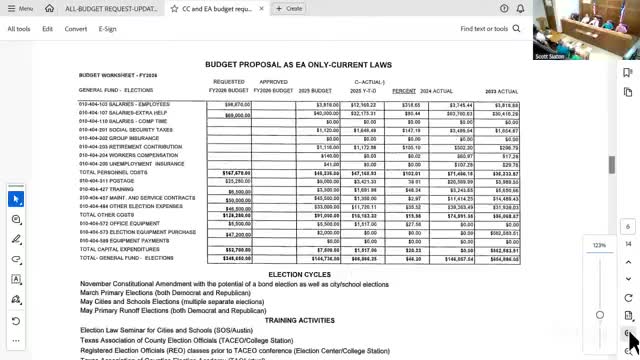
Elections staff told the Van Zandt County commissioners court on Friday that recent state legislation and pending administrative rules could substantially increase local election staffing and equipment costs, and asked the court to create a new election-administrator position and approve several equipment purchases.
Shannon, an elections official, said multiple election-law changes that took effect this year — and another state change that could take effect if state rulemaking completes — would expand the county’s required voting hours and staffing demands. “One bill… will eliminate early voting and create an election period, which starts 12 days before the election and goes straight through to election day,” Shannon said, adding that if that change fully takes effect the county could face two full weekends of additional hours and an expansion of staffing needs for every current polling location.
Because of the scope of the new work, elections staff proposed creating a dedicated election-administrator position. Staff said Shannon would step into the administrator role and that an existing clerk in the county clerk’s office would move into the elections staffing pool; commissioners were told the personnel shift would reduce one department’s budget while creating a modest net increase for elections this year. Shannon said she has a candidate who could start in July to begin administration tasks.
Elections staff also requested hardware and equipment funds: the packet lists about $45,650 for 40 iPad-based polling units (they stated this covers 40 “poll pads” with a metal case and integrated printer), additional hotspots for precincts without reliable Internet, and continued funding for ballot-on-demand paper and maintenance contracts. Shannon noted the county currently supports 18 polling locations and that state guidance is unclear whether all 18 would have to remain open for the proposed extended “election period.” “If we have to have all 18 open for that election period, it will definitely increase our costs tremendously,” she said.
Staff described an increase in registered voters in recent years — from about 14,524 in June 2018 to roughly 41,367 at the time of the workshop — and projected further growth before the 2026 governor’s race. Elections staff argued that consolidation to a countywide voting model, which allows larger voting centers instead of dozens of precincts, would reduce long-term costs but requires an administrator and a multi-step application to the state.
Discussion only: Commissioners asked about the timeline for state rules and whether the law would apply during the next budget year; staff said the new law’s implementation depends on whether the state completes required rulemaking by a summer deadline and that the county’s budget year (Oct–Sep) may or may not overlap the new rules. The court did not take a formal vote but agreed staff should fold the requested position and equipment needs into the budget for further consideration.
Shannon, an elections official, said multiple election-law changes that took effect this year — and another state change that could take effect if state rulemaking completes — would expand the county’s required voting hours and staffing demands. “One bill… will eliminate early voting and create an election period, which starts 12 days before the election and goes straight through to election day,” Shannon said, adding that if that change fully takes effect the county could face two full weekends of additional hours and an expansion of staffing needs for every current polling location.
Because of the scope of the new work, elections staff proposed creating a dedicated election-administrator position. Staff said Shannon would step into the administrator role and that an existing clerk in the county clerk’s office would move into the elections staffing pool; commissioners were told the personnel shift would reduce one department’s budget while creating a modest net increase for elections this year. Shannon said she has a candidate who could start in July to begin administration tasks.
Elections staff also requested hardware and equipment funds: the packet lists about $45,650 for 40 iPad-based polling units (they stated this covers 40 “poll pads” with a metal case and integrated printer), additional hotspots for precincts without reliable Internet, and continued funding for ballot-on-demand paper and maintenance contracts. Shannon noted the county currently supports 18 polling locations and that state guidance is unclear whether all 18 would have to remain open for the proposed extended “election period.” “If we have to have all 18 open for that election period, it will definitely increase our costs tremendously,” she said.
Staff described an increase in registered voters in recent years — from about 14,524 in June 2018 to roughly 41,367 at the time of the workshop — and projected further growth before the 2026 governor’s race. Elections staff argued that consolidation to a countywide voting model, which allows larger voting centers instead of dozens of precincts, would reduce long-term costs but requires an administrator and a multi-step application to the state.
Discussion only: Commissioners asked about the timeline for state rules and whether the law would apply during the next budget year; staff said the new law’s implementation depends on whether the state completes required rulemaking by a summer deadline and that the county’s budget year (Oct–Sep) may or may not overlap the new rules. The court did not take a formal vote but agreed staff should fold the requested position and equipment needs into the budget for further consideration.
Don't Miss a Word: See the Full Meeting!
Go beyond summaries. Unlock every video, transcript, and key insight with a Founder Membership.
✓
Get instant access to full meeting videos
✓
Search and clip any phrase from complete transcripts
✓
Receive AI-powered summaries & custom alerts
✓
Enjoy lifetime, unrestricted access to government data
30-day money-back guarantee
