Local expert urges Van Zandt County to consider groundwater district as commercial pumping plans advance
June 27, 2025 | Van Zandt County, Texas
This article was created by AI summarizing key points discussed. AI makes mistakes, so for full details and context, please refer to the video of the full meeting. Please report any errors so we can fix them. Report an error »
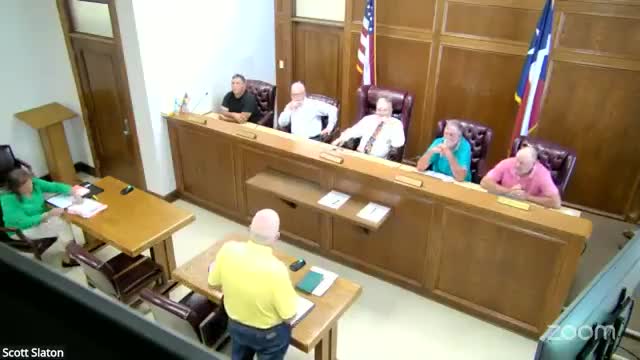
Jackie Reisner, who described herself as a former general manager of a groundwater conservation district, urged the Van Zandt County commissioners court on Friday to consider early action to protect the county’s groundwater supply as commercial pumping projects proceed in nearby counties.
Reisner described the region’s hydrogeology, noting that the Carrizo-Wilcox aquifer system is extensive and that recharge occurs slowly and in some cases far from where water is pumped. “If we don't do something and all of a sudden that company comes to VanZandt County and pumps 21, it is gonna affect us,” Reisner said.
She advised commissioners that forming or joining a Groundwater Conservation District (GCD) provides monitoring tools and regulatory options that a county would otherwise lack. A GCD can require permits, set spacing and pumping rules, install monitoring wells, and — if rules allow — charge export or production fees when water is pumped out of the district for use elsewhere. Reisner cautioned that districts need stable funding for legal and technical work and that a robust public-education campaign is critical: “You gotta educate the people because there’ll be so much misinformation floating around out there.”
Reisner also noted that GCDs vary widely in resources and effectiveness; she described examples where districts with sufficient staff and monitoring programs have been able to measure impacts and, if necessary, reduce permitted pumping levels based on measured drawdown. She said that without a district, property owners have limited recourse if nearby commercial pumping causes their wells to decline.
Discussion only: Commissioners and staff asked technical questions about the feasibility and cost of monitoring wells, funding options (ad valorem tax versus fee-based structures) and timing. No formal action or vote was taken. Reisner offered to provide additional information and to meet with local officials and stakeholders for a public education effort.
Reisner described the region’s hydrogeology, noting that the Carrizo-Wilcox aquifer system is extensive and that recharge occurs slowly and in some cases far from where water is pumped. “If we don't do something and all of a sudden that company comes to VanZandt County and pumps 21, it is gonna affect us,” Reisner said.
She advised commissioners that forming or joining a Groundwater Conservation District (GCD) provides monitoring tools and regulatory options that a county would otherwise lack. A GCD can require permits, set spacing and pumping rules, install monitoring wells, and — if rules allow — charge export or production fees when water is pumped out of the district for use elsewhere. Reisner cautioned that districts need stable funding for legal and technical work and that a robust public-education campaign is critical: “You gotta educate the people because there’ll be so much misinformation floating around out there.”
Reisner also noted that GCDs vary widely in resources and effectiveness; she described examples where districts with sufficient staff and monitoring programs have been able to measure impacts and, if necessary, reduce permitted pumping levels based on measured drawdown. She said that without a district, property owners have limited recourse if nearby commercial pumping causes their wells to decline.
Discussion only: Commissioners and staff asked technical questions about the feasibility and cost of monitoring wells, funding options (ad valorem tax versus fee-based structures) and timing. No formal action or vote was taken. Reisner offered to provide additional information and to meet with local officials and stakeholders for a public education effort.
View the Full Meeting & All Its Details
This article offers just a summary. Unlock complete video, transcripts, and insights as a Founder Member.
✓
Watch full, unedited meeting videos
✓
Search every word spoken in unlimited transcripts
✓
AI summaries & real-time alerts (all government levels)
✓
Permanent access to expanding government content
30-day money-back guarantee
