Senators and Air Force officials clash over FY26 request, warn reconciliation split risks programs
June 26, 2025 | Appropriations: Senate Committee, Standing Committees - House & Senate, Congressional Hearings Compilation, Legislative, Federal
This article was created by AI summarizing key points discussed. AI makes mistakes, so for full details and context, please refer to the video of the full meeting. Please report any errors so we can fix them. Report an error »
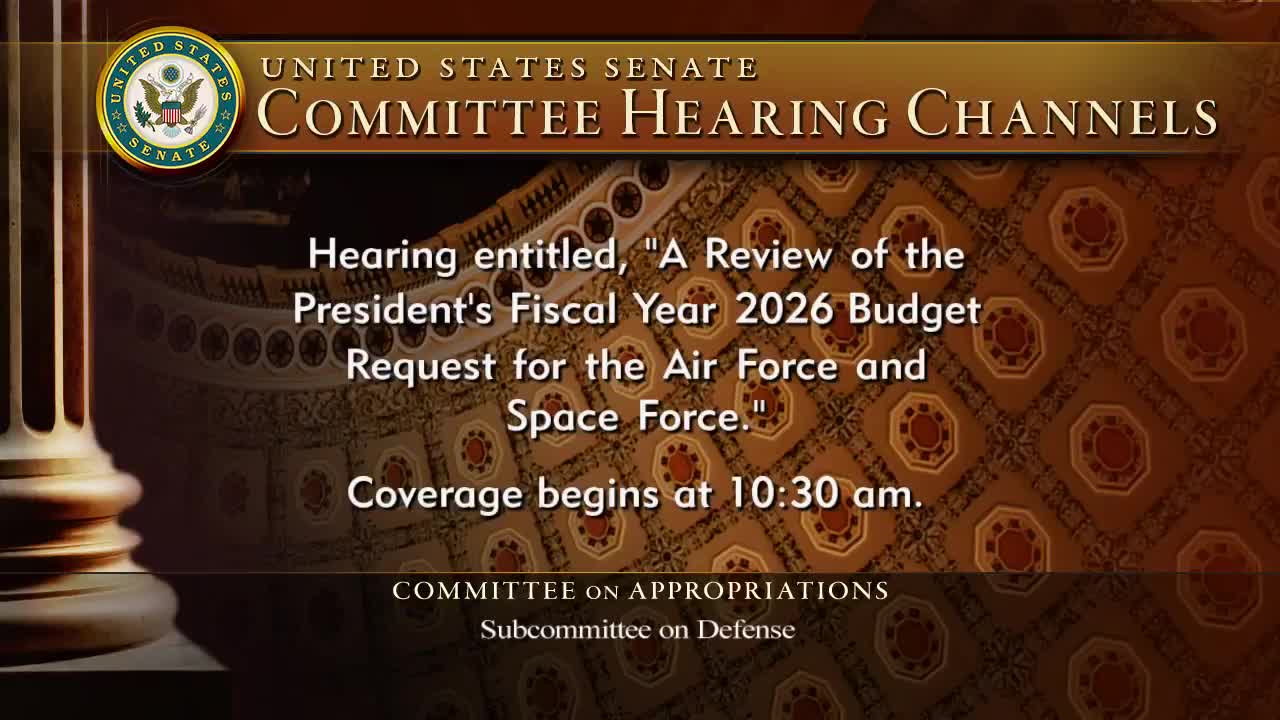
Chairman McConnell opened the subcommittee hearing by saying the president's FY26 defense request “falls well short of meeting the requirements imposed by today's threat landscape” and warned that splitting major procurement funding between the base budget and a reconciliation bill risks a “shell game” for long‑term investments.
The hearing focused on the Department of the Air Force's fiscal priorities for FY26 and whether the requested topline is sufficient to sustain modernization and readiness. Secretary of the Air Force Troy Mink told the committee the department is “at an inflection point” and that China remains the department's pacing threat; he said the Air Force must balance generating readiness today with investments that deter adversaries in the future.
Ranking members and other senators repeatedly pressed service leaders about specific shortfalls in the FY26 base request. Senators noted that the FY25 continuing resolution (CR) provided funding to procure 62 fighter aircraft, while the FY26 base request included funding only for the FY24 buy. Senator Shaheen and others said the administration had moved billions in nuclear modernization spending for programs such as Sentinel and B‑21 to reconciliation rather than the base budget.
Secretary Mink, Gen. David Allen (chief of staff of the Air Force) and Gen. Saltzman (chief of Space Force operations) all told senators the department views the totality of the administration's request (base plus reconciliation) as necessary. Mink testified the Air Force needs a “comparable top line going forward” to execute all missions requested of it. Saltzman agreed that the Space Force will require “a new level of resources” to meet expanding mission sets.
Several senators warned that reliance on reconciliation to fund long‑lead procurements undermines industry certainty and could affect production stability. Chairman McConnell said programs with broad bipartisan support should be funded in the base budget so industry can plan for “stable production of aircraft” year to year.
Committee members also asked whether a supplemental appropriation would be necessary given recent operations and support provided to partners; service leaders said they would notify the committee if additional resources became necessary.
Nut graf: The hearing centered on whether the FY26 request—split between the annual base budget and a reconciliation package—adequately funds the Air Force and Space Force to sustain near‑term readiness while modernizing for China as the pacing threat. Multiple senators and the services warned the split could create execution and production risk if Congress does not follow through on reconciliation funding.
Key details include: the services view the combined request as required to execute programs; senators pressed for base budget funding for certain long‑lead items; and leaders said a sustained topline, not short‑term infusions, is necessary to maintain force structure and industrial capacity.
Discussion vs. decisions: The hearing produced substantive discussion and follow‑up requests but no formal committee decisions or votes. Senators asked for additional briefings and for the services to provide details and proposed legislative fixes. Service leaders pledged to submit follow‑up information and to work with the committee.
Ending: Senators may submit additional written questions for the record over the coming week; the services committed to respond. The primary unresolved issues are whether Congress will provide the reconciliation funds the services count on and whether program funding should be moved into the base budget to reduce production risk.
The hearing focused on the Department of the Air Force's fiscal priorities for FY26 and whether the requested topline is sufficient to sustain modernization and readiness. Secretary of the Air Force Troy Mink told the committee the department is “at an inflection point” and that China remains the department's pacing threat; he said the Air Force must balance generating readiness today with investments that deter adversaries in the future.
Ranking members and other senators repeatedly pressed service leaders about specific shortfalls in the FY26 base request. Senators noted that the FY25 continuing resolution (CR) provided funding to procure 62 fighter aircraft, while the FY26 base request included funding only for the FY24 buy. Senator Shaheen and others said the administration had moved billions in nuclear modernization spending for programs such as Sentinel and B‑21 to reconciliation rather than the base budget.
Secretary Mink, Gen. David Allen (chief of staff of the Air Force) and Gen. Saltzman (chief of Space Force operations) all told senators the department views the totality of the administration's request (base plus reconciliation) as necessary. Mink testified the Air Force needs a “comparable top line going forward” to execute all missions requested of it. Saltzman agreed that the Space Force will require “a new level of resources” to meet expanding mission sets.
Several senators warned that reliance on reconciliation to fund long‑lead procurements undermines industry certainty and could affect production stability. Chairman McConnell said programs with broad bipartisan support should be funded in the base budget so industry can plan for “stable production of aircraft” year to year.
Committee members also asked whether a supplemental appropriation would be necessary given recent operations and support provided to partners; service leaders said they would notify the committee if additional resources became necessary.
Nut graf: The hearing centered on whether the FY26 request—split between the annual base budget and a reconciliation package—adequately funds the Air Force and Space Force to sustain near‑term readiness while modernizing for China as the pacing threat. Multiple senators and the services warned the split could create execution and production risk if Congress does not follow through on reconciliation funding.
Key details include: the services view the combined request as required to execute programs; senators pressed for base budget funding for certain long‑lead items; and leaders said a sustained topline, not short‑term infusions, is necessary to maintain force structure and industrial capacity.
Discussion vs. decisions: The hearing produced substantive discussion and follow‑up requests but no formal committee decisions or votes. Senators asked for additional briefings and for the services to provide details and proposed legislative fixes. Service leaders pledged to submit follow‑up information and to work with the committee.
Ending: Senators may submit additional written questions for the record over the coming week; the services committed to respond. The primary unresolved issues are whether Congress will provide the reconciliation funds the services count on and whether program funding should be moved into the base budget to reduce production risk.
Don't Miss a Word: See the Full Meeting!
Go beyond summaries. Unlock every video, transcript, and key insight with a Founder Membership.
✓
Get instant access to full meeting videos
✓
Search and clip any phrase from complete transcripts
✓
Receive AI-powered summaries & custom alerts
✓
Enjoy lifetime, unrestricted access to government data
30-day money-back guarantee
