House updates groundwater law to prompt earlier action and local‑agency coordination; passes on third reading
June 27, 2025 | House of Representatives, Committees, Legislative, Oregon
This article was created by AI summarizing key points discussed. AI makes mistakes, so for full details and context, please refer to the video of the full meeting. Please report any errors so we can fix them. Report an error »
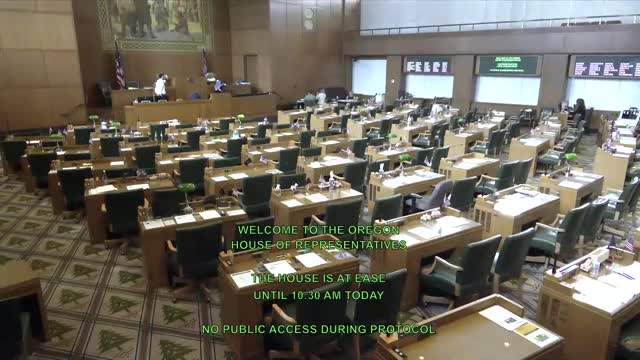
The Oregon House passed Senate Bill 11 54 on third reading, a measure described by sponsors as an update to the state’s Groundwater Quality Management Act to prompt earlier, locally led and agency‑informed responses to groundwater contamination.
Representative Helm, who carried the bill onto the floor, said more than 80% of Oregonians rely on groundwater for drinking water and that aquifer contamination is costly and difficult to remediate. The bill requires development of agency assessments and preliminary public‑health response plans, clarifies roles for agencies and local partners, and establishes a “green/yellow/red” planning framework: monitoring in “green,” voluntary early action in “yellow,” and, where contamination reaches critical levels, coordinated actions in “red.” The bill also requires the governor to appoint a lead agency and an interagency team, gives the Environmental Quality Commission (EQC) final decision authority on designations based on agency recommendation, requires biennial reporting to governing boards and the Legislature, and directs resource requests be submitted to the Legislature for plan implementation.
Representative Bobby Levy rose to place on the record assurances she said she had received from the governor’s office that SB 11 54 is not intended to disrupt the existing, locally driven Lower Umatilla Basin Groundwater Management Area process (referred to on the floor as an ongoing, collaborative structure led by DEQ and local stakeholders). Levy said she had written assurances and conversations with the governor’s office that the bill would not change the locally established organizational framework, designated lead agency or the citizen advisory committee, and that the governor would consider a signing letter for additional clarity if the bill passed.
Supporters urged passage, saying the approach would provide clearer steps, improved data collection and accountability, and better coordination between state agencies and local communities facing contamination risks. The House voted and the clerk declared Senate Bill 11 54 passed after it received the constitutional majority.
Why it matters: Sponsors framed SB 11 54 as a modernization of a 1989 statutory framework to give agencies and communities earlier tools for monitoring, outreach, and targeted action before contamination reaches critical levels. Representative Helm emphasized accountability, interagency roles and publicly available information to guide local and state responses.
What’s next: The bill directs agency rule‑making and requires biennial reporting and resource requests to enable implementation; the governor’s office may issue a signing letter clarifying legislative intent for specific, ongoing local management areas as requested by Representative Levy.
Representative Helm, who carried the bill onto the floor, said more than 80% of Oregonians rely on groundwater for drinking water and that aquifer contamination is costly and difficult to remediate. The bill requires development of agency assessments and preliminary public‑health response plans, clarifies roles for agencies and local partners, and establishes a “green/yellow/red” planning framework: monitoring in “green,” voluntary early action in “yellow,” and, where contamination reaches critical levels, coordinated actions in “red.” The bill also requires the governor to appoint a lead agency and an interagency team, gives the Environmental Quality Commission (EQC) final decision authority on designations based on agency recommendation, requires biennial reporting to governing boards and the Legislature, and directs resource requests be submitted to the Legislature for plan implementation.
Representative Bobby Levy rose to place on the record assurances she said she had received from the governor’s office that SB 11 54 is not intended to disrupt the existing, locally driven Lower Umatilla Basin Groundwater Management Area process (referred to on the floor as an ongoing, collaborative structure led by DEQ and local stakeholders). Levy said she had written assurances and conversations with the governor’s office that the bill would not change the locally established organizational framework, designated lead agency or the citizen advisory committee, and that the governor would consider a signing letter for additional clarity if the bill passed.
Supporters urged passage, saying the approach would provide clearer steps, improved data collection and accountability, and better coordination between state agencies and local communities facing contamination risks. The House voted and the clerk declared Senate Bill 11 54 passed after it received the constitutional majority.
Why it matters: Sponsors framed SB 11 54 as a modernization of a 1989 statutory framework to give agencies and communities earlier tools for monitoring, outreach, and targeted action before contamination reaches critical levels. Representative Helm emphasized accountability, interagency roles and publicly available information to guide local and state responses.
What’s next: The bill directs agency rule‑making and requires biennial reporting and resource requests to enable implementation; the governor’s office may issue a signing letter clarifying legislative intent for specific, ongoing local management areas as requested by Representative Levy.
Don't Miss a Word: See the Full Meeting!
Go beyond summaries. Unlock every video, transcript, and key insight with a Founder Membership.
✓
Get instant access to full meeting videos
✓
Search and clip any phrase from complete transcripts
✓
Receive AI-powered summaries & custom alerts
✓
Enjoy lifetime, unrestricted access to government data
30-day money-back guarantee
