Battle Creek commission rejects rezoning after residents raise noise, air and water concerns
June 18, 2025 | Battle Creek City, Calhoun County, Michigan
This article was created by AI summarizing key points discussed. AI makes mistakes, so for full details and context, please refer to the video of the full meeting. Please report any errors so we can fix them. Report an error »
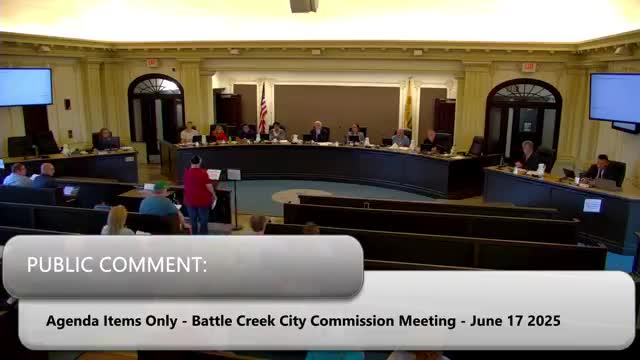
The Battle Creek City Commission on June 17 defeated the introduction of an ordinance that would rezone a parcel along West Columbia Avenue — between Robertson Avenue and Independence Avenue — from R‑1 single‑family residential to I‑2 heavy industrial after sustained public comment and commissioner concern.
Residents who live directly behind the site told commissioners they have endured constant asphalt odors, around‑the‑clock noise and dust from an uncontained asphalt crushing/stockpiling operation that they said sits within yards of private properties. "We get the smell of asphalt constantly. There's no sense of fresh air," said Jamie Stanislaw, 280 Newtown Avenue. Sheryl Doust, 251 Newtown Avenue, told the commission she was unsure whether the site had ever been permitted and asked, "Who is responsible for cleanup if the EPA comes in and says it's unhealthy and shouldn't be in a residential area?" Charlie Keegan, 250 Newtown Avenue, a former DOD safety specialist, raised stormwater runoff concerns and said contaminants from asphalt could reach groundwater if proper controls are not in place.
Commissioners aired similar concerns about compatibility with surrounding homes and gaps in the planning record. "Heavy industrial use is something I don't believe is harmonious," said Commissioner Patrick O'Donnell during discussion. Another commissioner said residents' questions about noise and environmental impacts were not fully answered at previous Planning Commission hearings. After discussion, the commission voted that the ordinance introduction be defeated.
Why it matters: The rezoning would have allowed heavier industrial uses next to established residential areas; residents said the site already operates in a way they find incompatible with housing, and they asked the city to clarify permitting, enforcement and responsibility for any contamination or nuisance. Opponents emphasized the proximity of stockpiles to backyards — one speaker said the asphalt pile is about 40 feet from her bedroom window — and the potential effect on property values and sleep.
What happened at the meeting: Commissioners declined to move the rezoning forward at introduction, effectively halting the immediate change in zoning. No adoption vote took place; the motion to introduce the ordinance was defeated.
Discussion vs. decision: The meeting record separates public comment (residents describing ongoing impacts) from the commission action (defeat of the ordinance introduction). Residents sought enforcement and clarification about permits and stormwater controls; commissioners cited unanswered planning questions and neighborhood harmony as reasons to oppose the rezoning.
Next steps/remaining questions: Residents repeatedly asked whether the property operator had permits, whether stormwater controls or an EPA review exist, and which party would be responsible for remediation if contamination were found. Those questions were raised during public comment but were not resolved on the record at the June 17 meeting.
Residents who live directly behind the site told commissioners they have endured constant asphalt odors, around‑the‑clock noise and dust from an uncontained asphalt crushing/stockpiling operation that they said sits within yards of private properties. "We get the smell of asphalt constantly. There's no sense of fresh air," said Jamie Stanislaw, 280 Newtown Avenue. Sheryl Doust, 251 Newtown Avenue, told the commission she was unsure whether the site had ever been permitted and asked, "Who is responsible for cleanup if the EPA comes in and says it's unhealthy and shouldn't be in a residential area?" Charlie Keegan, 250 Newtown Avenue, a former DOD safety specialist, raised stormwater runoff concerns and said contaminants from asphalt could reach groundwater if proper controls are not in place.
Commissioners aired similar concerns about compatibility with surrounding homes and gaps in the planning record. "Heavy industrial use is something I don't believe is harmonious," said Commissioner Patrick O'Donnell during discussion. Another commissioner said residents' questions about noise and environmental impacts were not fully answered at previous Planning Commission hearings. After discussion, the commission voted that the ordinance introduction be defeated.
Why it matters: The rezoning would have allowed heavier industrial uses next to established residential areas; residents said the site already operates in a way they find incompatible with housing, and they asked the city to clarify permitting, enforcement and responsibility for any contamination or nuisance. Opponents emphasized the proximity of stockpiles to backyards — one speaker said the asphalt pile is about 40 feet from her bedroom window — and the potential effect on property values and sleep.
What happened at the meeting: Commissioners declined to move the rezoning forward at introduction, effectively halting the immediate change in zoning. No adoption vote took place; the motion to introduce the ordinance was defeated.
Discussion vs. decision: The meeting record separates public comment (residents describing ongoing impacts) from the commission action (defeat of the ordinance introduction). Residents sought enforcement and clarification about permits and stormwater controls; commissioners cited unanswered planning questions and neighborhood harmony as reasons to oppose the rezoning.
Next steps/remaining questions: Residents repeatedly asked whether the property operator had permits, whether stormwater controls or an EPA review exist, and which party would be responsible for remediation if contamination were found. Those questions were raised during public comment but were not resolved on the record at the June 17 meeting.
Don't Miss a Word: See the Full Meeting!
Go beyond summaries. Unlock every video, transcript, and key insight with a Founder Membership.
✓
Get instant access to full meeting videos
✓
Search and clip any phrase from complete transcripts
✓
Receive AI-powered summaries & custom alerts
✓
Enjoy lifetime, unrestricted access to government data
30-day money-back guarantee
