Vine property manager urges clearer window and contractor guidance from Kalamazoo historic commission
June 18, 2025 | Kalamazoo City, Kalamazoo County, Michigan
This article was created by AI summarizing key points discussed. AI makes mistakes, so for full details and context, please refer to the video of the full meeting. Please report any errors so we can fix them. Report an error »
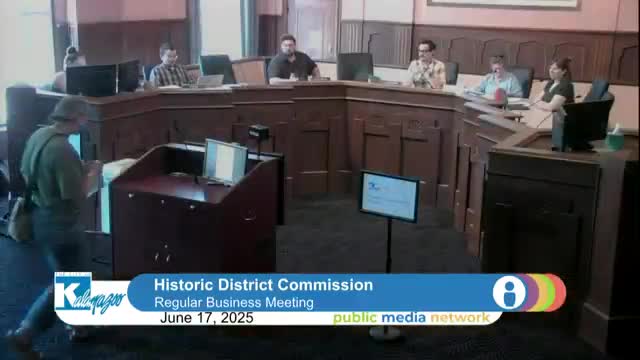
Jen, the property manager for the Vine Neighborhood Association, told the Kalamazoo Historic District Commission that inconsistent historic-window approvals and an outdated contractors list are making it difficult for building owners to maintain properties.
"That's a big deal to me, and it's a big deal in maintaining the integrity of a building that I think is the staple for the neighborhood," Jen said during the commission's public-comment period, describing a unit where replacing two windows cost about $11,000.
The commission’s comments and staff responses explained limits on the commission’s authority and existing procedures but did not offer an immediate change to product guidance. Commissioner Luis (staff) and others said the commission does not currently maintain an official list of recommended window products or a regularly updated contractors roster, and that creating and maintaining such a list would carry implications for administrative capacity and perceived endorsements.
Why it matters: property owners in Kalamazoo’s local historic districts must comply with both the City of Kalamazoo ordinances and the Local Historic Districts Act when altering exterior features. Jen said the commission allowed a different applicant to use an Andersen 100 window in a recent case, while her building was required to use an Andersen 400 because the opening could not be changed; she estimated the difference works out to roughly $1,300 per window ($2,600 on one project) and suggested replacing all windows in her building could save about $71,000 if lower-cost products were consistently allowed.
Commissioners and staff said the historic-district guidelines and certificates of appropriateness are applied case-by-case and that earlier staff members had maintained a contractor list that has not been updated. "We don't, per your point, we don't have a list of recommended products," a commissioner said, adding that owners who bring proposals that are "in the spirit" of preservation are typically approved. Staff (Luis) advised the public comment period is not the time for back-and-forth technical discussion but invited the commenter to follow up with staff and to submit the written letter she prepared.
Supporting details: the commission’s disclaimer read aloud at the meeting cited Chapter 16, Section 22 of the City of Kalamazoo code of ordinances and the Local Historic Districts Act (as referenced in the meeting materials). Staff noted that some procedural practices (for example, stipulating final approvals or delegations on certificates of appropriateness) were used under a previous director but are not standard practice for larger projects under current staff processes.
What was not decided: the commission did not adopt a new list of approved window products or a refreshed contractors list during the meeting. Staff advised the commenter to follow up by submitting the written request and working with the planning office.
Community follow-up: Jen asked to submit her letter and to meet with Luis and the commission for follow-up; staff invited her to contact the community planning and economic development department for next steps.
"That's a big deal to me, and it's a big deal in maintaining the integrity of a building that I think is the staple for the neighborhood," Jen said during the commission's public-comment period, describing a unit where replacing two windows cost about $11,000.
The commission’s comments and staff responses explained limits on the commission’s authority and existing procedures but did not offer an immediate change to product guidance. Commissioner Luis (staff) and others said the commission does not currently maintain an official list of recommended window products or a regularly updated contractors roster, and that creating and maintaining such a list would carry implications for administrative capacity and perceived endorsements.
Why it matters: property owners in Kalamazoo’s local historic districts must comply with both the City of Kalamazoo ordinances and the Local Historic Districts Act when altering exterior features. Jen said the commission allowed a different applicant to use an Andersen 100 window in a recent case, while her building was required to use an Andersen 400 because the opening could not be changed; she estimated the difference works out to roughly $1,300 per window ($2,600 on one project) and suggested replacing all windows in her building could save about $71,000 if lower-cost products were consistently allowed.
Commissioners and staff said the historic-district guidelines and certificates of appropriateness are applied case-by-case and that earlier staff members had maintained a contractor list that has not been updated. "We don't, per your point, we don't have a list of recommended products," a commissioner said, adding that owners who bring proposals that are "in the spirit" of preservation are typically approved. Staff (Luis) advised the public comment period is not the time for back-and-forth technical discussion but invited the commenter to follow up with staff and to submit the written letter she prepared.
Supporting details: the commission’s disclaimer read aloud at the meeting cited Chapter 16, Section 22 of the City of Kalamazoo code of ordinances and the Local Historic Districts Act (as referenced in the meeting materials). Staff noted that some procedural practices (for example, stipulating final approvals or delegations on certificates of appropriateness) were used under a previous director but are not standard practice for larger projects under current staff processes.
What was not decided: the commission did not adopt a new list of approved window products or a refreshed contractors list during the meeting. Staff advised the commenter to follow up by submitting the written request and working with the planning office.
Community follow-up: Jen asked to submit her letter and to meet with Luis and the commission for follow-up; staff invited her to contact the community planning and economic development department for next steps.
View the Full Meeting & All Its Details
This article offers just a summary. Unlock complete video, transcripts, and insights as a Founder Member.
✓
Watch full, unedited meeting videos
✓
Search every word spoken in unlimited transcripts
✓
AI summaries & real-time alerts (all government levels)
✓
Permanent access to expanding government content
30-day money-back guarantee
