Bothell studies area‑based and affordable‑housing discounts as it updates transportation impact fees
July 02, 2025 | Bothell, King County, Washington
This article was created by AI summarizing key points discussed. AI makes mistakes, so for full details and context, please refer to the video of the full meeting. Please report any errors so we can fix them. Report an error »
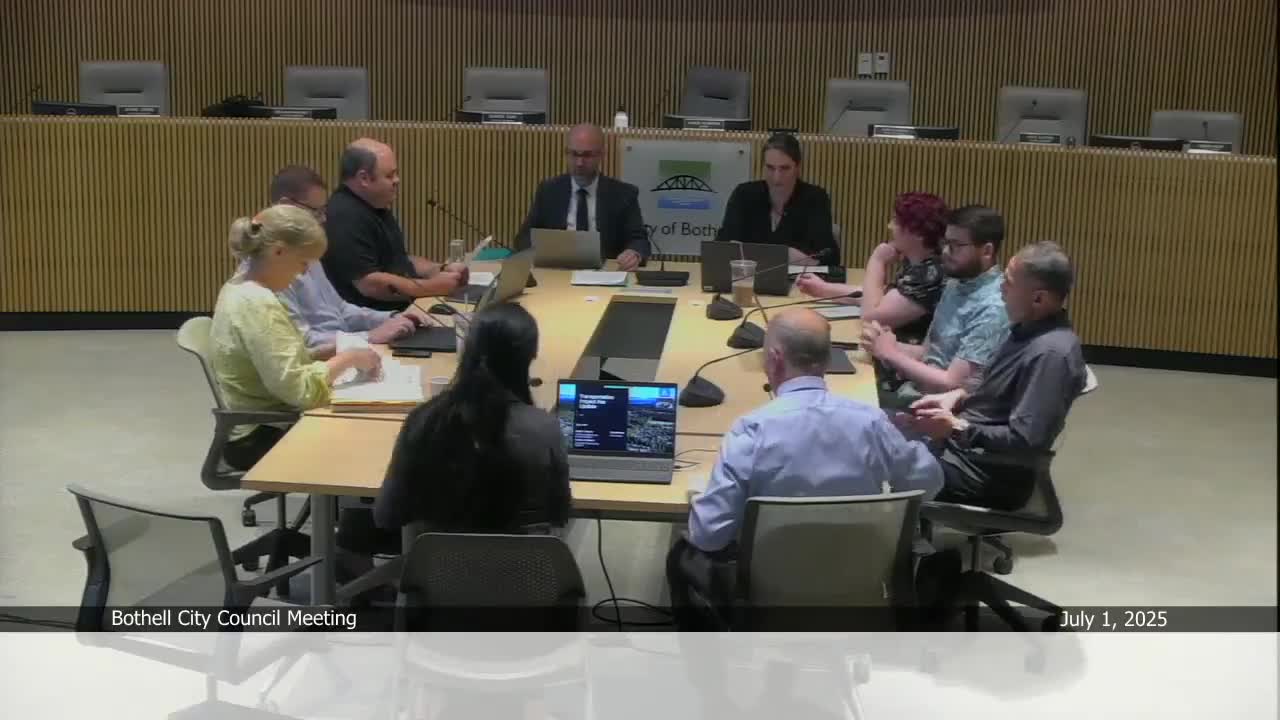
Bothell City Council spent extensive discussion time July 1 on a staff briefing and consultant overview of a transportation impact fee update, asking staff to return with policy options, technical models and example cases before any fee changes are adopted.
The city’s consultants summarized the standard impact‑fee calculation: identify growth‑related capacity projects, estimate new person‑trips, divide eligible costs by trips to calculate a cost per trip, then translate that cost into a schedule of fees by land use. Fehr & Peers consultant Carmen Kwan and city staff reported preliminary figures from the existing study: a sample eligible project list totaling about $61 million divided by roughly 6,000 person‑trips produced about $10,000 per person‑trip; the city’s current per‑unit comparisons showed single‑family rates in the midrange of peer cities and multifamily rates substantially lower (example figures presented in packet: roughly $12,000 for single‑family and about $6,000 for multifamily units in the illustrative table).
Why it matters: The 2024 Comprehensive Plan transportation element identifies a 20‑year multimodal project list estimated at roughly $850 million. Staff said grants and other sources are expected to fund the majority of that list (about 70% in the presentation) while transportation impact fees were estimated at about 12% of the 20‑year funding need; council members emphasized the fee’s role as seed and match funding for grants and noted trade‑offs between reducing fees and jeopardizing grant leverage.
Council questions and direction: Council members repeatedly asked staff to return with options and trade‑offs rather than a single proposal. Two specific policy questions posed by staff were the focus: 1) should the city consider varying impact fee rates by geographic area (for example, lower rates within a quarter‑mile or half‑mile walk shed of rapid transit), and 2) should the city consider reduced fees for affordable housing citywide? Council members offered a range of perspectives:
• Some members favored area‑based reductions to incentivize development near transit and the regional growth center, while urging that any approach be simple and predictable so it does not add prohibitive complexity to permitting.
• Several members supported reduced fees for smaller infill and ADU development and emphasized preserving incentives for affordable housing; staff noted some reductions already exist in code and that state law (House Bill 1491) includes statutory reductions in certain cases.
• Members asked staff to model alternative approaches, including (a) a hybrid fee that applies a base charge plus parking‑space surcharges, (b) smoothing area boundaries (for example using transit corridors rather than strict quarter‑mile radii), and (c) case studies showing how recent downtown projects paid impact fees and what infrastructure those funds supported.
Staff timeline and constraints: Staff and consultants said the next steps are to produce preliminary numeric models and return in the fall with concrete options and an updated fee schedule; they said a public hearing and formal adoption are planned to aim for an effective date of January 1, 2026. Staff cautioned that legal defensibility requires a technical fee study consistent with Washington RCW requirements and that some legislative changes (e.g., HB 1491 multifamily tax exemption rules) already affect potential reductions.
What was not decided: Council did not change rates at the meeting and made no binding financial commitments. Members asked staff to analyze trade‑offs, return with example scenarios, and identify the grant‑match implications if fee revenue were reduced.
Next steps: Staff and Fehr & Peers will produce math, test cases and a set of policy options for council review in the fall; a public hearing and adoption process is planned before any changes would take effect.
The city’s consultants summarized the standard impact‑fee calculation: identify growth‑related capacity projects, estimate new person‑trips, divide eligible costs by trips to calculate a cost per trip, then translate that cost into a schedule of fees by land use. Fehr & Peers consultant Carmen Kwan and city staff reported preliminary figures from the existing study: a sample eligible project list totaling about $61 million divided by roughly 6,000 person‑trips produced about $10,000 per person‑trip; the city’s current per‑unit comparisons showed single‑family rates in the midrange of peer cities and multifamily rates substantially lower (example figures presented in packet: roughly $12,000 for single‑family and about $6,000 for multifamily units in the illustrative table).
Why it matters: The 2024 Comprehensive Plan transportation element identifies a 20‑year multimodal project list estimated at roughly $850 million. Staff said grants and other sources are expected to fund the majority of that list (about 70% in the presentation) while transportation impact fees were estimated at about 12% of the 20‑year funding need; council members emphasized the fee’s role as seed and match funding for grants and noted trade‑offs between reducing fees and jeopardizing grant leverage.
Council questions and direction: Council members repeatedly asked staff to return with options and trade‑offs rather than a single proposal. Two specific policy questions posed by staff were the focus: 1) should the city consider varying impact fee rates by geographic area (for example, lower rates within a quarter‑mile or half‑mile walk shed of rapid transit), and 2) should the city consider reduced fees for affordable housing citywide? Council members offered a range of perspectives:
• Some members favored area‑based reductions to incentivize development near transit and the regional growth center, while urging that any approach be simple and predictable so it does not add prohibitive complexity to permitting.
• Several members supported reduced fees for smaller infill and ADU development and emphasized preserving incentives for affordable housing; staff noted some reductions already exist in code and that state law (House Bill 1491) includes statutory reductions in certain cases.
• Members asked staff to model alternative approaches, including (a) a hybrid fee that applies a base charge plus parking‑space surcharges, (b) smoothing area boundaries (for example using transit corridors rather than strict quarter‑mile radii), and (c) case studies showing how recent downtown projects paid impact fees and what infrastructure those funds supported.
Staff timeline and constraints: Staff and consultants said the next steps are to produce preliminary numeric models and return in the fall with concrete options and an updated fee schedule; they said a public hearing and formal adoption are planned to aim for an effective date of January 1, 2026. Staff cautioned that legal defensibility requires a technical fee study consistent with Washington RCW requirements and that some legislative changes (e.g., HB 1491 multifamily tax exemption rules) already affect potential reductions.
What was not decided: Council did not change rates at the meeting and made no binding financial commitments. Members asked staff to analyze trade‑offs, return with example scenarios, and identify the grant‑match implications if fee revenue were reduced.
Next steps: Staff and Fehr & Peers will produce math, test cases and a set of policy options for council review in the fall; a public hearing and adoption process is planned before any changes would take effect.
View the Full Meeting & All Its Details
This article offers just a summary. Unlock complete video, transcripts, and insights as a Founder Member.
✓
Watch full, unedited meeting videos
✓
Search every word spoken in unlimited transcripts
✓
AI summaries & real-time alerts (all government levels)
✓
Permanent access to expanding government content
30-day money-back guarantee
