Judge Boyd orders 3-year prison term for Terrell Allen after probation violation; earlier mental-health staffing led to temporary release plan
July 07, 2025 | Judge Stephanie Boyd 187th District, District Court Judges, Judicial, Texas
This article was created by AI summarizing key points discussed. AI makes mistakes, so for full details and context, please refer to the video of the full meeting. Please report any errors so we can fix them. Report an error »
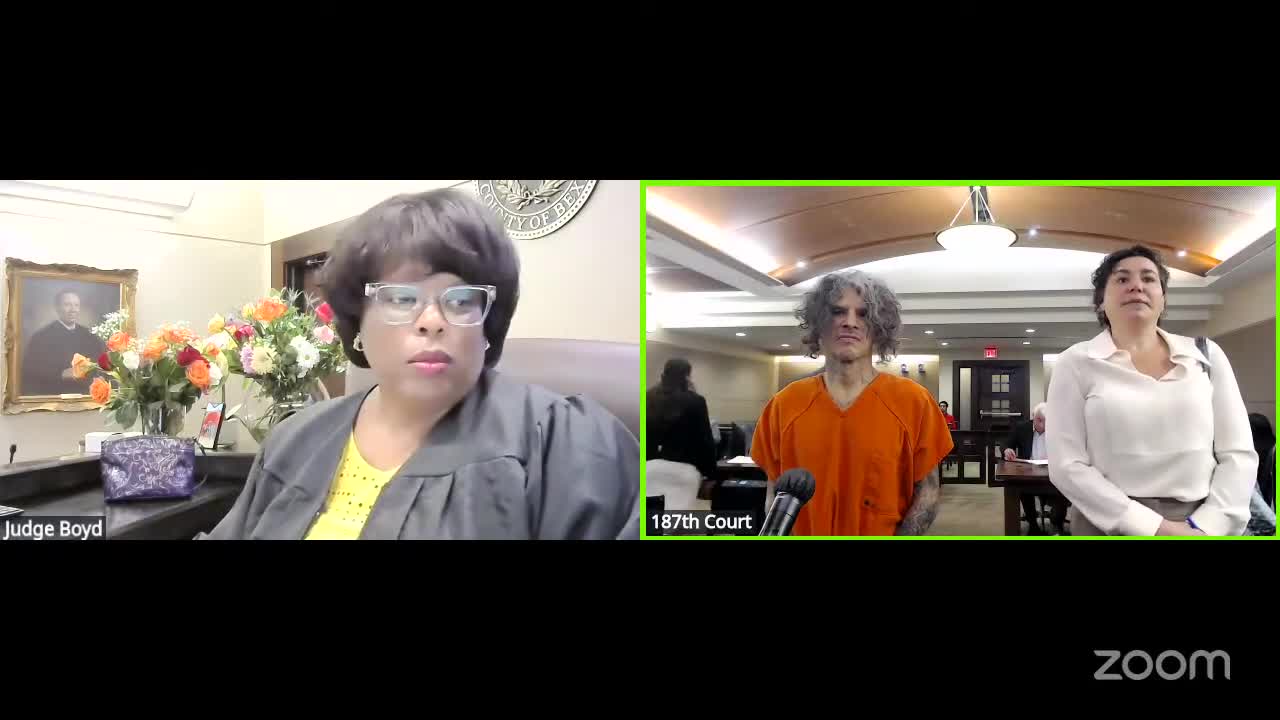
Judge Stephanie Boyd ordered a three‑year prison sentence for Terrell Allen after finding a probation violation true, following earlier court consideration of his eligibility for mental‑health treatment.
At an earlier hearing the court reported that Allen had been evaluated and that a mental‑health court staffing was scheduled; court staff said the staffing was expected to make a placement decision and the plan discussed returning Allen to his brother’s care with in‑home behavioral‑health services and an in‑home specialist to begin treatment immediately upon release. The court set a follow‑up date to track that placement.
Later, the state proceeded on a motion to revoke community supervision, reading violation number 2 — a failure to submit to drug testing on Feb. 24, 2022 — and Allen pleaded true to that allegation. The court found the violation true. For the earlier cause (2015CR3927) the court recorded termination “unsatisfactory.” For the later cause the court announced a sentence of three years in prison, with credit for any time served, and the court said it would request placement in a therapeutic community program.
Judge Boyd told Allen the court had previously offered treatment options, including felony drug court and other wraparound services, and said decisions in revocation hearings follow the record presented. The judge also confirmed the procedural protections and the limited grounds for appeal that apply after a revocation proceeding.
The court set follow‑up administrative dates tied to custodial processing and credit for time served; the transcript records no additional conditions beyond the sentence and the court’s request for therapeutic community placement.
Ending
The case record shows two distinct outcomes: an earlier clinical staffing that recommended a home‑based plan and a later formal revocation that resulted in a three‑year prison term. The court scheduled the matters it retained for administrative follow‑up and credit calculation.
At an earlier hearing the court reported that Allen had been evaluated and that a mental‑health court staffing was scheduled; court staff said the staffing was expected to make a placement decision and the plan discussed returning Allen to his brother’s care with in‑home behavioral‑health services and an in‑home specialist to begin treatment immediately upon release. The court set a follow‑up date to track that placement.
Later, the state proceeded on a motion to revoke community supervision, reading violation number 2 — a failure to submit to drug testing on Feb. 24, 2022 — and Allen pleaded true to that allegation. The court found the violation true. For the earlier cause (2015CR3927) the court recorded termination “unsatisfactory.” For the later cause the court announced a sentence of three years in prison, with credit for any time served, and the court said it would request placement in a therapeutic community program.
Judge Boyd told Allen the court had previously offered treatment options, including felony drug court and other wraparound services, and said decisions in revocation hearings follow the record presented. The judge also confirmed the procedural protections and the limited grounds for appeal that apply after a revocation proceeding.
The court set follow‑up administrative dates tied to custodial processing and credit for time served; the transcript records no additional conditions beyond the sentence and the court’s request for therapeutic community placement.
Ending
The case record shows two distinct outcomes: an earlier clinical staffing that recommended a home‑based plan and a later formal revocation that resulted in a three‑year prison term. The court scheduled the matters it retained for administrative follow‑up and credit calculation.
Don't Miss a Word: See the Full Meeting!
Go beyond summaries. Unlock every video, transcript, and key insight with a Founder Membership.
✓
Get instant access to full meeting videos
✓
Search and clip any phrase from complete transcripts
✓
Receive AI-powered summaries & custom alerts
✓
Enjoy lifetime, unrestricted access to government data
30-day money-back guarantee
