Lake City Council weighs returning women's club deed as private restoration offers surface
July 07, 2025 | Lake City, Columbia County, Florida
This article was created by AI summarizing key points discussed. AI makes mistakes, so for full details and context, please refer to the video of the full meeting. Please report any errors so we can fix them. Report an error »
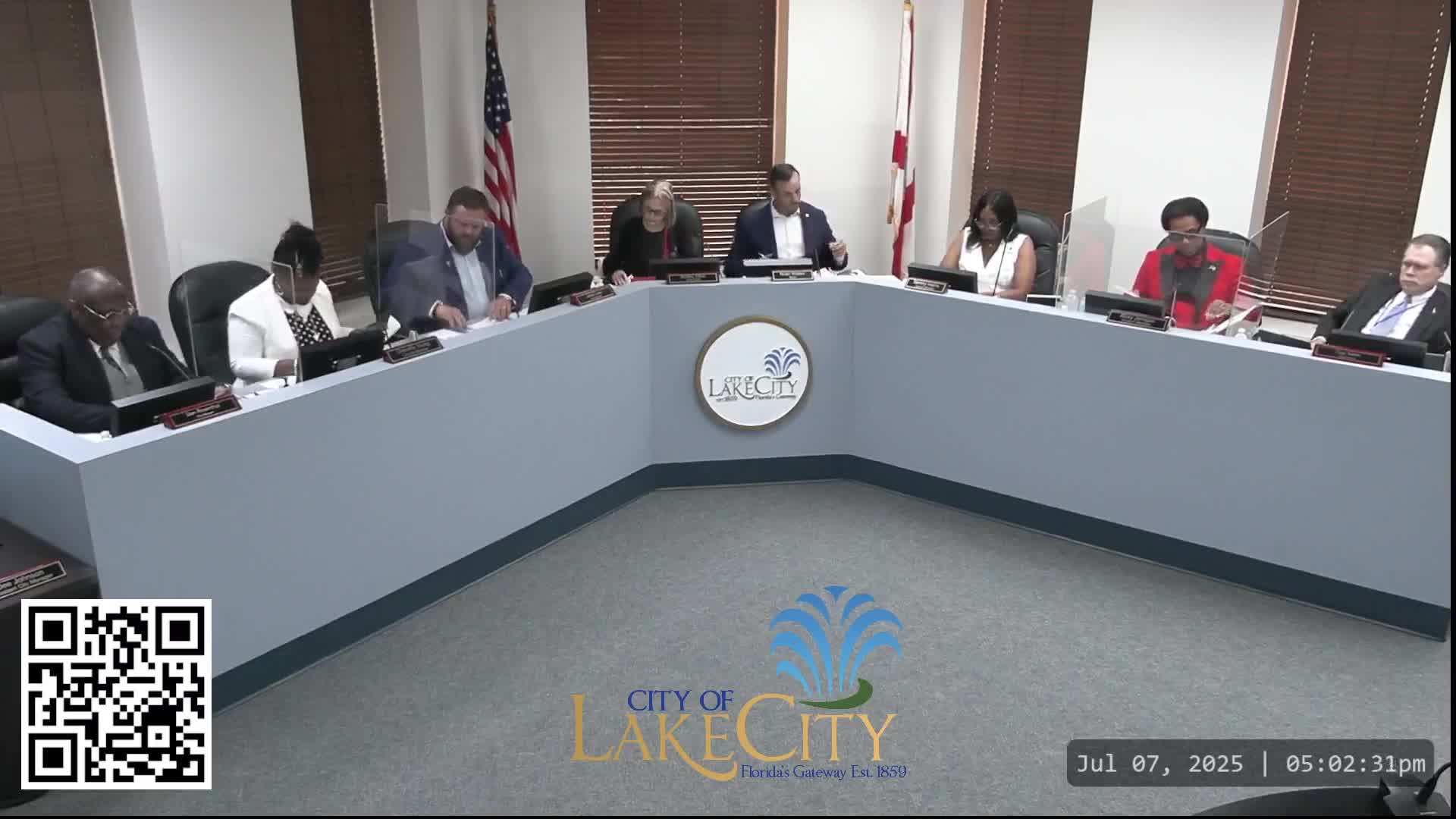
The Lake City Council met in a June workshop to discuss the future of the historic Women’s Club building after city staff told the council multiple contractor evaluations found the structure "was not structurally sound" and that repair estimates exceed $200,000.
City Manager Rosenthal summarized the technical findings, saying, "the cost that we've been getting on repairing this structure has been over $200,000." That assessment, the council heard, included a structural survey performed for the city’s insurer by Nova and follow‑up contractor proposals that varied widely.
The council opened the meeting for public comment, where residents and users of the building urged preservation and offered options. Resident Debbie Griffin proposed a private capital campaign with tiered donor levels, saying, "create a capital campaign... Legacy Circle would be at a $50,000 mark." Longtime rental agent Marilyn Hamm explained the building’s wartime history and the club’s long role in managing rentals, and said rental income historically was reinvested in maintenance.
Local contractor Josh Sparks, who reviewed the roof structure in person, said the damage was substantial and estimated a higher repair price. "The first time I went out there, I was like, this is at least probably $300,000 minimum to repair it," he said, and offered an alternative: if the city transfers ownership, his group would undertake restoration and continue to provide public access and rentals.
Council members debated whether the city should retain ownership or convey the building back to the Women’s Club or a private party. City Attorney Martin advised the council that the city’s existing surplus‑property rules address only personal property and recommended drafting an ordinance governing disposal of real property: "our surplus property ordinance addresses only tangible, personal property," he said, and suggested the council adopt an ordinance that could build in historic‑preservation conditions or give preference to the original conveying entity.
Martin also noted legal constraints tied to the existing lease: the building was conveyed decades ago with a 99‑year lease at a nominal $1 annual payment, and there is no automatic reverter clause in that conveyance; any change of ownership would have to address the lease. He recommended two readings of an ordinance and estimated the earliest path for formal disposition would be late August if the council moved quickly.
Council members and public speakers emphasized time was a critical factor because of the building's condition. Several council members suggested special meetings to accelerate the legal process; others cautioned against bypassing required procedures. Mayor Walker summarized the outcome of the workshop: "I believe that we've come to the consensus to work toward conveying that deed back to the women's club so that they can do expeditiously what they need to do to preserve that building."
No formal motion or vote was taken at the workshop. The council directed staff and the city attorney to draft options for the disposition of surplus real property (including an ordinance and possible lease amendment adding reversion criteria) and to return with a recommended path and timeline. Council members discussed using special meetings if stakeholders agree, but the attorney said the minimum legal process would still require two readings to adopt an ordinance unless the council pursues emergency or alternate measures.
The discussion also surfaced fundraising and operational proposals: residents asked the Women’s Club, the Garden Club and other users to hold an internal decision meeting about accepting a deed if the council elects to transfer title; speakers proposed a capital campaign to offset restoration costs; and the contractor proposed operating the site as an event venue while preserving club access.
Next steps the council identified were (1) counsel will draft an ordinance and, if requested, a lease amendment to add reversionary language; (2) council and staff will explore an expedited schedule that could include special meetings; and (3) the Women’s Club will be asked to consider an emergency board decision to accept deeded title if that becomes the chosen path. No final disposition occurred at the workshop.
For the public and stakeholders, the immediate priorities are clarifying the exact repair estimate, confirming the insurance/assessment documentation from FMIT/Nova, and deciding whether the Women’s Club can meet and take formal action to accept title or to authorize the city to pursue an alternate disposition path.
City Manager Rosenthal summarized the technical findings, saying, "the cost that we've been getting on repairing this structure has been over $200,000." That assessment, the council heard, included a structural survey performed for the city’s insurer by Nova and follow‑up contractor proposals that varied widely.
The council opened the meeting for public comment, where residents and users of the building urged preservation and offered options. Resident Debbie Griffin proposed a private capital campaign with tiered donor levels, saying, "create a capital campaign... Legacy Circle would be at a $50,000 mark." Longtime rental agent Marilyn Hamm explained the building’s wartime history and the club’s long role in managing rentals, and said rental income historically was reinvested in maintenance.
Local contractor Josh Sparks, who reviewed the roof structure in person, said the damage was substantial and estimated a higher repair price. "The first time I went out there, I was like, this is at least probably $300,000 minimum to repair it," he said, and offered an alternative: if the city transfers ownership, his group would undertake restoration and continue to provide public access and rentals.
Council members debated whether the city should retain ownership or convey the building back to the Women’s Club or a private party. City Attorney Martin advised the council that the city’s existing surplus‑property rules address only personal property and recommended drafting an ordinance governing disposal of real property: "our surplus property ordinance addresses only tangible, personal property," he said, and suggested the council adopt an ordinance that could build in historic‑preservation conditions or give preference to the original conveying entity.
Martin also noted legal constraints tied to the existing lease: the building was conveyed decades ago with a 99‑year lease at a nominal $1 annual payment, and there is no automatic reverter clause in that conveyance; any change of ownership would have to address the lease. He recommended two readings of an ordinance and estimated the earliest path for formal disposition would be late August if the council moved quickly.
Council members and public speakers emphasized time was a critical factor because of the building's condition. Several council members suggested special meetings to accelerate the legal process; others cautioned against bypassing required procedures. Mayor Walker summarized the outcome of the workshop: "I believe that we've come to the consensus to work toward conveying that deed back to the women's club so that they can do expeditiously what they need to do to preserve that building."
No formal motion or vote was taken at the workshop. The council directed staff and the city attorney to draft options for the disposition of surplus real property (including an ordinance and possible lease amendment adding reversion criteria) and to return with a recommended path and timeline. Council members discussed using special meetings if stakeholders agree, but the attorney said the minimum legal process would still require two readings to adopt an ordinance unless the council pursues emergency or alternate measures.
The discussion also surfaced fundraising and operational proposals: residents asked the Women’s Club, the Garden Club and other users to hold an internal decision meeting about accepting a deed if the council elects to transfer title; speakers proposed a capital campaign to offset restoration costs; and the contractor proposed operating the site as an event venue while preserving club access.
Next steps the council identified were (1) counsel will draft an ordinance and, if requested, a lease amendment to add reversionary language; (2) council and staff will explore an expedited schedule that could include special meetings; and (3) the Women’s Club will be asked to consider an emergency board decision to accept deeded title if that becomes the chosen path. No final disposition occurred at the workshop.
For the public and stakeholders, the immediate priorities are clarifying the exact repair estimate, confirming the insurance/assessment documentation from FMIT/Nova, and deciding whether the Women’s Club can meet and take formal action to accept title or to authorize the city to pursue an alternate disposition path.
View the Full Meeting & All Its Details
This article offers just a summary. Unlock complete video, transcripts, and insights as a Founder Member.
✓
Watch full, unedited meeting videos
✓
Search every word spoken in unlimited transcripts
✓
AI summaries & real-time alerts (all government levels)
✓
Permanent access to expanding government content
30-day money-back guarantee
