Pontiac council approves 10-year community solar agreement promising about 20% discount on electric spend
July 07, 2025 | Pontiac, Pontiac, Livingston County, Illinois
This article was created by AI summarizing key points discussed. AI makes mistakes, so for full details and context, please refer to the video of the full meeting. Please report any errors so we can fix them. Report an error »
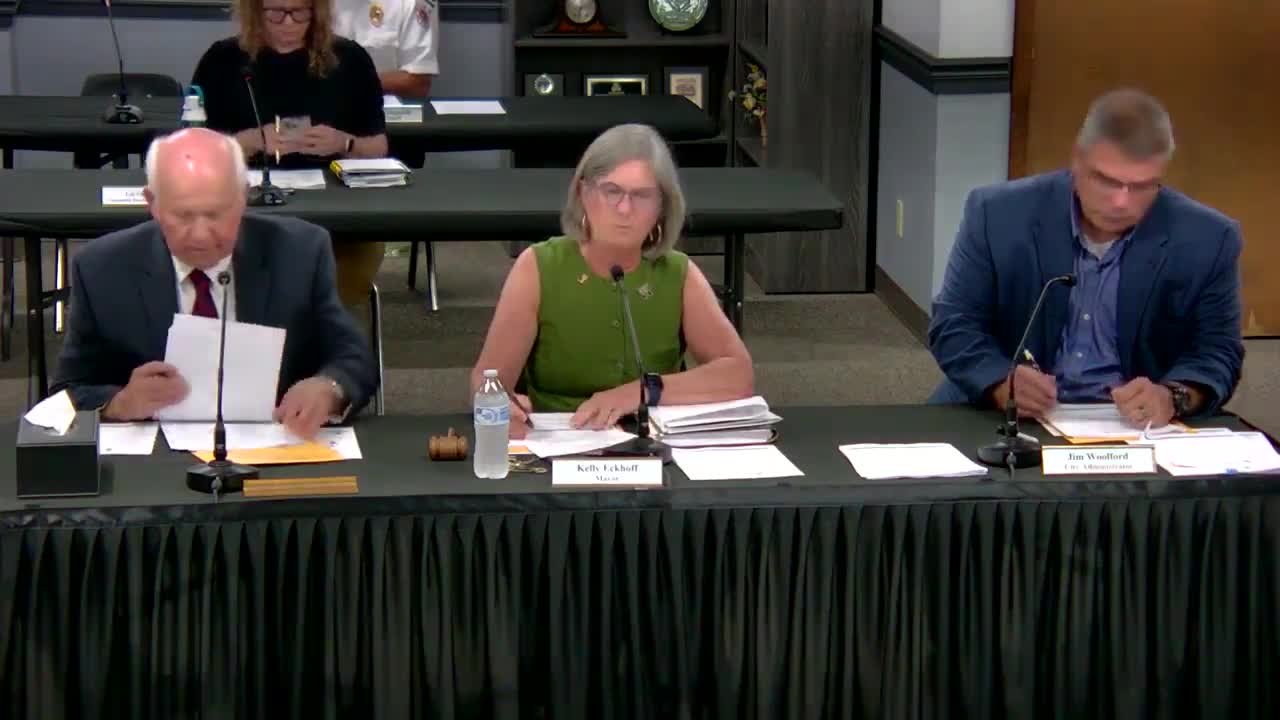
Pontiac’s city council voted to authorize the mayor to execute an anchor subscription agreement with Solar 1 Earth that city staff and the company said would deliver a 20% discount on the city’s credited community-solar amount.
The move, made Wednesday after more than an hour of technical and financial questions from council members, passed on a 7-3 roll call. Councilmembers Willie, Giovinetti, Mike Barr, S. Horner, Chan Gill, A. Horner and Jerry Causer voted yes; Scott Cranford, Bradshaw and Howard voted no.
The company’s presenter, Nathan (Solar 1 Earth), told the council the agreement would apply community-solar credits to most of the city’s meters and, based on the meters that qualify today, would cover about 93% of the city’s present electric spending. City staff said the city’s relevant billed usage equates to roughly $377,000 annually (the presenter also said the total city spend may be closer to $440,000 when lighting meters excluded from the program are counted). Nathan identified the water-treatment plant as the single largest electric user, accounting for about $181,000 of the current bill.
Why it matters: Council members said the savings would be budgetary relief and would support other city services. City staff and the company said the subscription also yields greenhouse-gas reductions and that participation would not prevent the city from installing private solar on city property later.
Key terms and mechanics: According to the presentation and follow-up discussion, (1) Solar 1 Earth would place a dollar credit on the city’s electric bill equal to the agreed share of community-solar production; (2) 40 days after the credit appears the company bills the city 80% of that credited amount (yielding a net 20% discount); (3) the agreement includes a 180-day notice right for the city to reduce or terminate credits without a termination fee while the company seeks a replacement subscriber; (4) the initial term described in the discussion is 10 years with two automatic five-year renewals, and company representatives said the LaSalle municipal project they reviewed contains no termination penalties.
Schedule, reliability and grid issues: Nathan said Solar 1 Earth expects the project that would carry Pontiac’s credits to be built and operational sometime in the next construction season — he estimated “around August of next summer” but acknowledged energization depends on interconnection timelines with Ameren/ComEd. He described that some projects are built but not energized until the local utility completes interconnection work, which can delay the flow of credits.
Council questions focused on fiscal risk and grid reliability. Nathan said the company screens anchor customers on audited financials and credit risk (he described running a Moody’s-shadow analysis and looking for investment-grade results) and that the 20% discount for Pontiac reflects low perceived risk. He told the council community-solar projects are typically capped at roughly 50 acres per parcel in Illinois, and that some projects will include battery storage and substation upgrades to manage intermittency and provide emergency-power adders for critical uses such as hospitals.
Limitations and exclusions discussed: The presenter noted the state’s program currently excludes certain lighting meters from community-solar participation; those meters could not be credited. He also said credits decline if the project underperforms or is offline (for example, after storm damage) — in that case Pontiac would simply receive no credits while that project is affected and the company may not have immediate replacement capacity.
Next steps: The motion approved by council authorized the mayor to execute the necessary agreements “subject to approval of the form of that agreement by Mr. Wolford and the city attorney,” and staff indicated the final contract would be returned for signature after that legal review.
Council vote: Motion passed 7-3. The council instructed staff to complete legal review and return the final agreement for execution.
The move, made Wednesday after more than an hour of technical and financial questions from council members, passed on a 7-3 roll call. Councilmembers Willie, Giovinetti, Mike Barr, S. Horner, Chan Gill, A. Horner and Jerry Causer voted yes; Scott Cranford, Bradshaw and Howard voted no.
The company’s presenter, Nathan (Solar 1 Earth), told the council the agreement would apply community-solar credits to most of the city’s meters and, based on the meters that qualify today, would cover about 93% of the city’s present electric spending. City staff said the city’s relevant billed usage equates to roughly $377,000 annually (the presenter also said the total city spend may be closer to $440,000 when lighting meters excluded from the program are counted). Nathan identified the water-treatment plant as the single largest electric user, accounting for about $181,000 of the current bill.
Why it matters: Council members said the savings would be budgetary relief and would support other city services. City staff and the company said the subscription also yields greenhouse-gas reductions and that participation would not prevent the city from installing private solar on city property later.
Key terms and mechanics: According to the presentation and follow-up discussion, (1) Solar 1 Earth would place a dollar credit on the city’s electric bill equal to the agreed share of community-solar production; (2) 40 days after the credit appears the company bills the city 80% of that credited amount (yielding a net 20% discount); (3) the agreement includes a 180-day notice right for the city to reduce or terminate credits without a termination fee while the company seeks a replacement subscriber; (4) the initial term described in the discussion is 10 years with two automatic five-year renewals, and company representatives said the LaSalle municipal project they reviewed contains no termination penalties.
Schedule, reliability and grid issues: Nathan said Solar 1 Earth expects the project that would carry Pontiac’s credits to be built and operational sometime in the next construction season — he estimated “around August of next summer” but acknowledged energization depends on interconnection timelines with Ameren/ComEd. He described that some projects are built but not energized until the local utility completes interconnection work, which can delay the flow of credits.
Council questions focused on fiscal risk and grid reliability. Nathan said the company screens anchor customers on audited financials and credit risk (he described running a Moody’s-shadow analysis and looking for investment-grade results) and that the 20% discount for Pontiac reflects low perceived risk. He told the council community-solar projects are typically capped at roughly 50 acres per parcel in Illinois, and that some projects will include battery storage and substation upgrades to manage intermittency and provide emergency-power adders for critical uses such as hospitals.
Limitations and exclusions discussed: The presenter noted the state’s program currently excludes certain lighting meters from community-solar participation; those meters could not be credited. He also said credits decline if the project underperforms or is offline (for example, after storm damage) — in that case Pontiac would simply receive no credits while that project is affected and the company may not have immediate replacement capacity.
Next steps: The motion approved by council authorized the mayor to execute the necessary agreements “subject to approval of the form of that agreement by Mr. Wolford and the city attorney,” and staff indicated the final contract would be returned for signature after that legal review.
Council vote: Motion passed 7-3. The council instructed staff to complete legal review and return the final agreement for execution.
Don't Miss a Word: See the Full Meeting!
Go beyond summaries. Unlock every video, transcript, and key insight with a Founder Membership.
✓
Get instant access to full meeting videos
✓
Search and clip any phrase from complete transcripts
✓
Receive AI-powered summaries & custom alerts
✓
Enjoy lifetime, unrestricted access to government data
30-day money-back guarantee
