Clay County sets $75 fee for judge address-protection notices and approves recorder budget items
July 09, 2025 | Clay County, Minnesota
This article was created by AI summarizing key points discussed. AI makes mistakes, so for full details and context, please refer to the video of the full meeting. Please report any errors so we can fix them. Report an error »
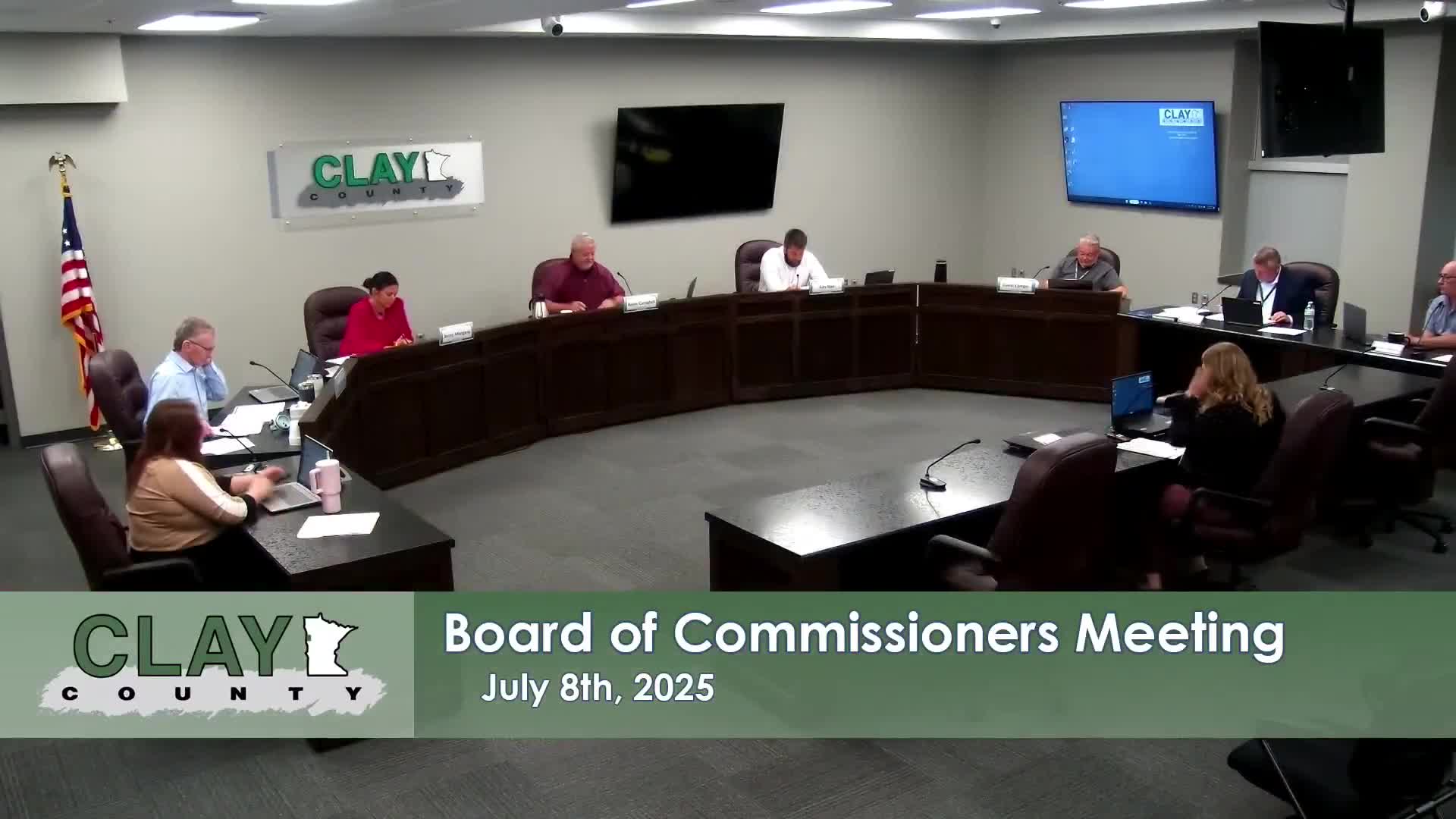
The Clay County Board of Commissioners on July 8 approved a package of land-records actions: $105,000 in expenses from the recorder’s compliance fund for 2026, a $75 fee per judicial address-protection notice authorized by a 2025 state law, and revised online real-estate access charges.
Kimberly, Clay County Recorder, told the board the $105,000 request comes from the recorder’s compliance fund and is routinely approved to cover maintenance of the tax system, corner remonumentation, information services and assessor software. Kimberly said the compliance fund is financed from a portion of recording fees; the county collected $91,278 from that surcharge in 2024, and the fund balance currently sits at about $100,000.
On new judicial address protection, Kimberly said recent state legislation creates an address-protection program for district court judges and allows a fee up to $75 per notice; she asked the board to set the fee at the maximum allowed. Kimberly warned the $75 fee “is not going to cover that” work, saying implementation will require substantial, ongoing county labor and new software to track redactions and future recordings. Commissioners discussed that broader expansions of protected parties could reduce public access revenues generated by online records.
The board also approved a change to online real-estate access fees: a single overage rate of $0.20 per minute for any plan and an increase in per-page print cost from $0.35 to $0.40; the recorder noted prints have been charged $0.35 since 2003 and storage and hosting costs have risen following a county-wide document-scanning project. Kimberly said software subscription and hosting costs are increasing and that the recorder’s 2026 budget projects higher computer-software expenses offset by the anticipated fee revenue.
Commissioners approved the compliance-fund expenses and the fee changes by voice votes (motions by Commissioner Ebinger and Commissioner Mogile, among others). Kimberly said the county will form internal policies and that department heads such as information services, assessor and auditor-treasurer will be involved in implementation because the statute affects documents in multiple offices.
Kimberly, Clay County Recorder, told the board the $105,000 request comes from the recorder’s compliance fund and is routinely approved to cover maintenance of the tax system, corner remonumentation, information services and assessor software. Kimberly said the compliance fund is financed from a portion of recording fees; the county collected $91,278 from that surcharge in 2024, and the fund balance currently sits at about $100,000.
On new judicial address protection, Kimberly said recent state legislation creates an address-protection program for district court judges and allows a fee up to $75 per notice; she asked the board to set the fee at the maximum allowed. Kimberly warned the $75 fee “is not going to cover that” work, saying implementation will require substantial, ongoing county labor and new software to track redactions and future recordings. Commissioners discussed that broader expansions of protected parties could reduce public access revenues generated by online records.
The board also approved a change to online real-estate access fees: a single overage rate of $0.20 per minute for any plan and an increase in per-page print cost from $0.35 to $0.40; the recorder noted prints have been charged $0.35 since 2003 and storage and hosting costs have risen following a county-wide document-scanning project. Kimberly said software subscription and hosting costs are increasing and that the recorder’s 2026 budget projects higher computer-software expenses offset by the anticipated fee revenue.
Commissioners approved the compliance-fund expenses and the fee changes by voice votes (motions by Commissioner Ebinger and Commissioner Mogile, among others). Kimberly said the county will form internal policies and that department heads such as information services, assessor and auditor-treasurer will be involved in implementation because the statute affects documents in multiple offices.
Don't Miss a Word: See the Full Meeting!
Go beyond summaries. Unlock every video, transcript, and key insight with a Founder Membership.
✓
Get instant access to full meeting videos
✓
Search and clip any phrase from complete transcripts
✓
Receive AI-powered summaries & custom alerts
✓
Enjoy lifetime, unrestricted access to government data
30-day money-back guarantee
