Tennessee appellate panel hears challenge to identification in Jenkins shooting convictions
July 09, 2025 | Judicial, Tennessee
This article was created by AI summarizing key points discussed. AI makes mistakes, so for full details and context, please refer to the video of the full meeting. Please report any errors so we can fix them. Report an error »
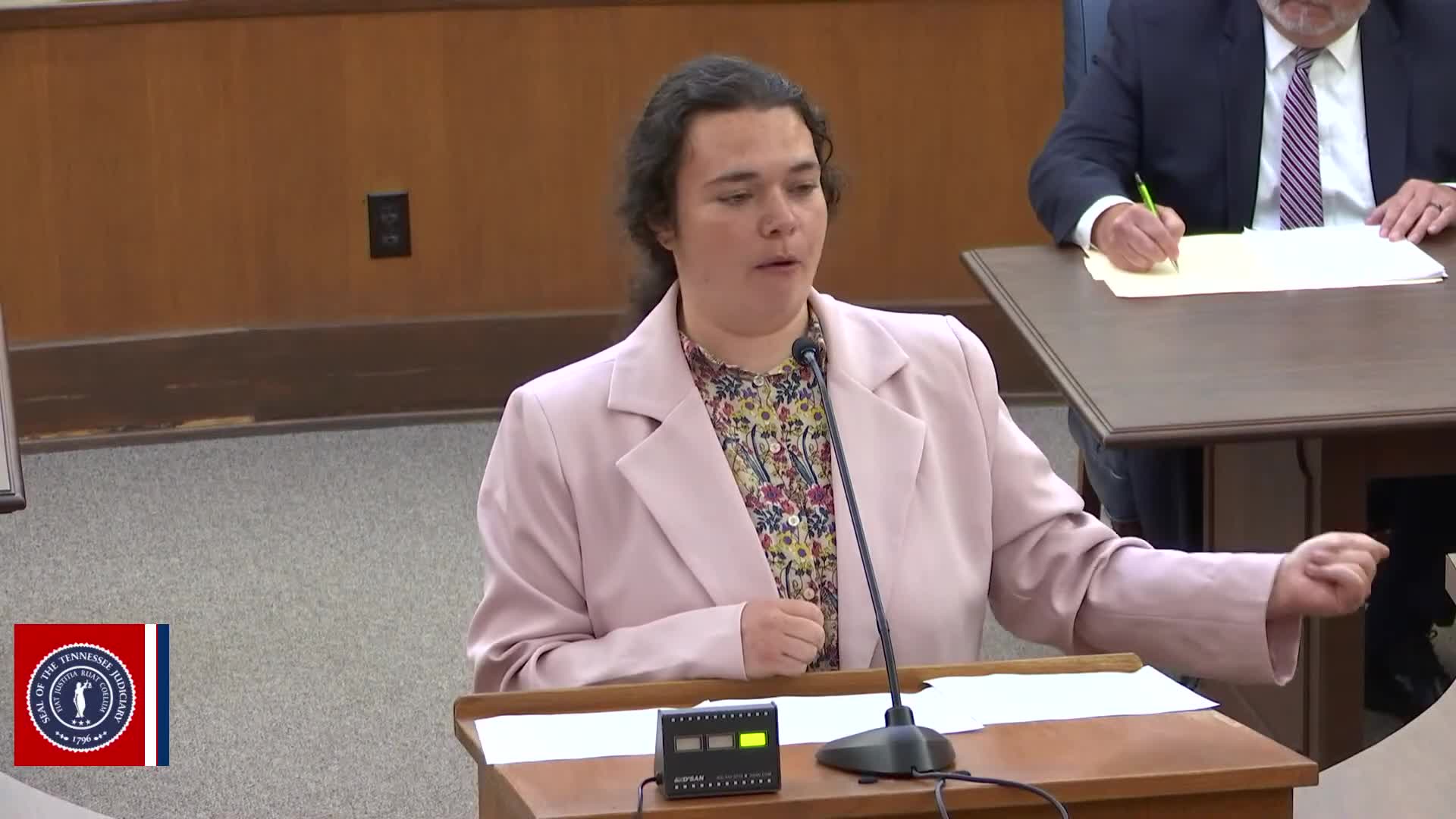
A Tennessee appellate panel on Tuesday heard oral arguments in the appeal of Reginald Jenkins, who was convicted on four counts arising from a shooting: two counts of attempted first-degree murder and two counts of employing a firearm during the commission of a first-degree murder.
Appellant counsel Ashton Jones, an attorney with Denati Law representing Jenkins, told the panel that the sufficiency challenge centers on identification. "The the main problem here is that what we're contesting is that the prosecution did not prove this case beyond a reasonable doubt," Jones said, arguing that witnesses did not reliably place Jenkins at the scene and that investigative evidence had gaps.
Jones said the vehicle identification at the center of the case shifted during the investigation—initial reports variously described a black SUV as a Tahoe and later a GMC Terrain after video review—and that the defendant's then-wife initially identified Jenkins but later recanted at trial. Jones also emphasized that no firearm was recovered, forensic examiners could not date when casings were fired, and the record did not establish the requisite intent tied specifically to Jenkins.
Ray Lupone, arguing for the State of Tennessee, urged the court to affirm the trial verdict. "This court should affirm, the judgment of the trial court. It should absolutely not take this verdict away from the jury," Lupone said, stressing the jury viewed the video evidence, heard witness testimony and that circumstantial evidence supported identity and premeditation. The state noted an expert linked a shell casing found on the SUV’s windshield to casings from the scene and pointed to video, an interactive map introduced at trial and testimony showing the vehicle followed the victims and shots were fired.
Counsel for Jenkins requested three minutes for rebuttal and reserved that time with the panel. Defense counsel also asked the court to consider recusal of the Shelby County District Attorney's Office after the post-brief death of witness Ricky Floyd, but the panel declined to address recusal at that stage, saying such questions could be raised later if the case is remanded.
The panel heard extended questioning about the credibility of identifications, the quality of the surveillance video (defense counsel called it “blurry” in places), the presence of shell casings (officers recovered 10 casings at the intersection and the record includes a possible additional casing on the windshield), and whether the cumulative circumstantial evidence could support a rational jury’s verdict under Jackson v. Virginia and Tennessee appellate standards. No ruling was issued from the bench; the court took the matter under advisement.
The appeal raises legal questions about when circumstantial evidence is sufficient to support convictions for attempted first-degree murder and related firearm offenses under Tennessee law (Tennessee Code Annotated § 39-13-202(a)(1)), and it will return to a lower court if the panel orders a remand.
Appellant counsel Ashton Jones, an attorney with Denati Law representing Jenkins, told the panel that the sufficiency challenge centers on identification. "The the main problem here is that what we're contesting is that the prosecution did not prove this case beyond a reasonable doubt," Jones said, arguing that witnesses did not reliably place Jenkins at the scene and that investigative evidence had gaps.
Jones said the vehicle identification at the center of the case shifted during the investigation—initial reports variously described a black SUV as a Tahoe and later a GMC Terrain after video review—and that the defendant's then-wife initially identified Jenkins but later recanted at trial. Jones also emphasized that no firearm was recovered, forensic examiners could not date when casings were fired, and the record did not establish the requisite intent tied specifically to Jenkins.
Ray Lupone, arguing for the State of Tennessee, urged the court to affirm the trial verdict. "This court should affirm, the judgment of the trial court. It should absolutely not take this verdict away from the jury," Lupone said, stressing the jury viewed the video evidence, heard witness testimony and that circumstantial evidence supported identity and premeditation. The state noted an expert linked a shell casing found on the SUV’s windshield to casings from the scene and pointed to video, an interactive map introduced at trial and testimony showing the vehicle followed the victims and shots were fired.
Counsel for Jenkins requested three minutes for rebuttal and reserved that time with the panel. Defense counsel also asked the court to consider recusal of the Shelby County District Attorney's Office after the post-brief death of witness Ricky Floyd, but the panel declined to address recusal at that stage, saying such questions could be raised later if the case is remanded.
The panel heard extended questioning about the credibility of identifications, the quality of the surveillance video (defense counsel called it “blurry” in places), the presence of shell casings (officers recovered 10 casings at the intersection and the record includes a possible additional casing on the windshield), and whether the cumulative circumstantial evidence could support a rational jury’s verdict under Jackson v. Virginia and Tennessee appellate standards. No ruling was issued from the bench; the court took the matter under advisement.
The appeal raises legal questions about when circumstantial evidence is sufficient to support convictions for attempted first-degree murder and related firearm offenses under Tennessee law (Tennessee Code Annotated § 39-13-202(a)(1)), and it will return to a lower court if the panel orders a remand.
View the Full Meeting & All Its Details
This article offers just a summary. Unlock complete video, transcripts, and insights as a Founder Member.
✓
Watch full, unedited meeting videos
✓
Search every word spoken in unlimited transcripts
✓
AI summaries & real-time alerts (all government levels)
✓
Permanent access to expanding government content
30-day money-back guarantee
