Appeals court hears challenge to extended DUI detention of Jackson officer
July 09, 2025 | Judicial, Tennessee
This article was created by AI summarizing key points discussed. AI makes mistakes, so for full details and context, please refer to the video of the full meeting. Please report any errors so we can fix them. Report an error »
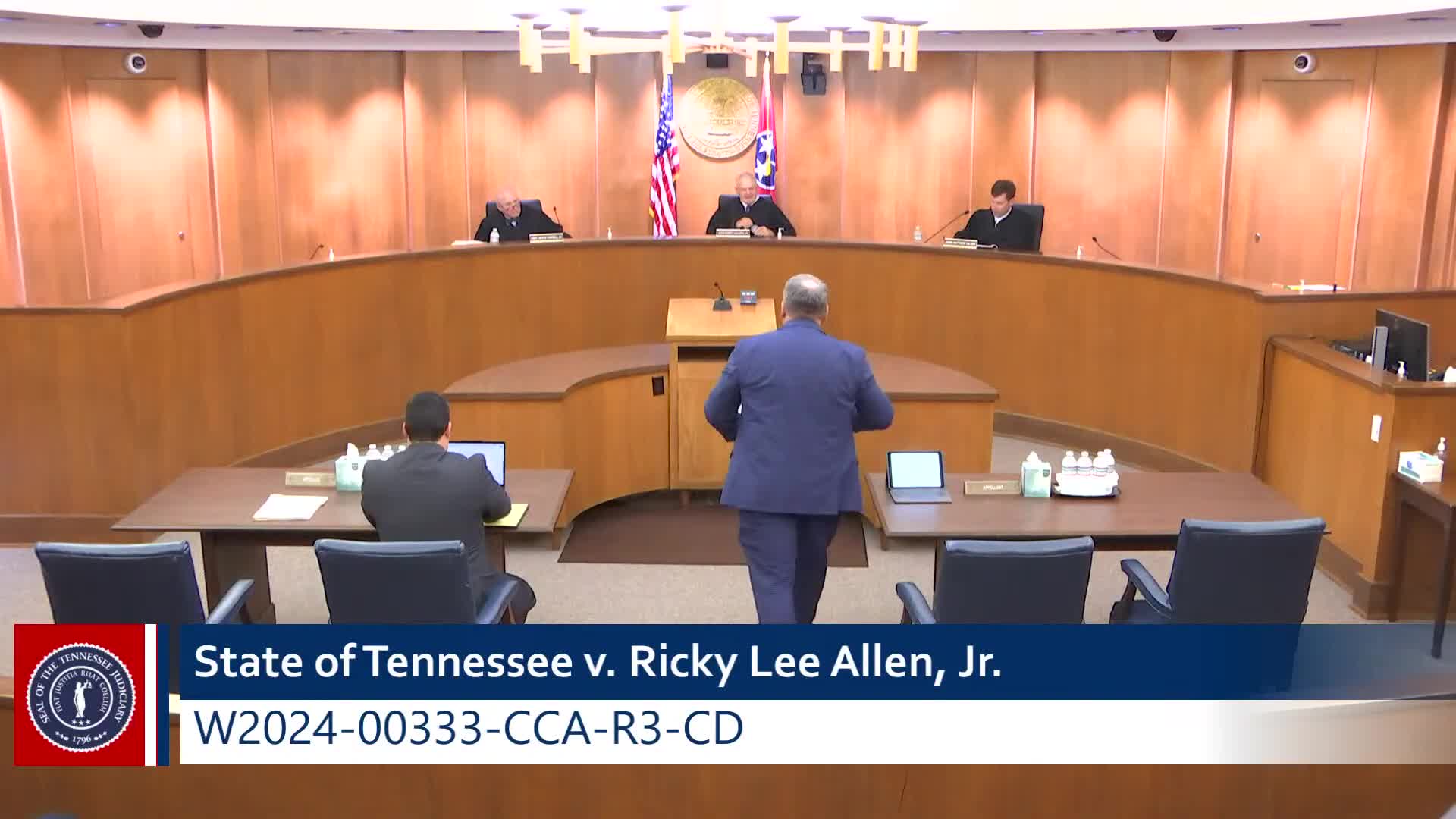
At an appellate oral argument, attorneys debated whether a roughly two‑hour detention of Jackson Police Department officer Ricky Allen during a traffic stop violated the Fourth Amendment.
The issue centered on whether the encounter became an arrest — and therefore required probable cause — long before an independent Tennessee Highway Patrol trooper arrived. Defense counsel Mark Donahoe argued the delay was objectively unreasonable; a prosecutor for the State, Ronald Coleman, told the court officers had probable cause and placed Allen under arrest within about 20 minutes.
Donahoe said the initial stop began at about 11:12 p.m. and that after an officer approached Allen’s vehicle and returned to his patrol car, “for 18 minutes, nothing happens.” He argued video and trial testimony show little observable impairment early in the encounter, that the officer who made the stop did not note slurred speech or bloodshot eyes, and that officers repeatedly called for other personnel rather than conducting field sobriety tests on scene. Donahoe described the timeline in detail and said officers waited for an independent investigator from the Tennessee Highway Patrol; he argued that the cumulative delay — which he described as roughly two hours from initial stop to formal arrest procedures — was “objectively unreasonable, thus unconstitutional.”
Coleman, arguing for the State, said the record supports the trial court’s denial of suppression because the defendant was effectively placed under arrest within about 20 minutes of the stop. Coleman listed objective observations he said supported probable cause: driving with headlights off, swerving between lanes, difficulty making turns, and, when Sergeant Wright arrived, the odor of alcohol and the defendant’s admission that he had had “a few drinks.” Coleman told the court Sergeant Wright testified Allen was not free to leave and that officers restrained his movement, and he said those facts support a finding of arrest and probable cause.
Both sides addressed why Tennessee Highway Patrol (THP) troopers were called. Donahoe criticized the decision to wait for THP and the sequence of officers conferring among themselves before an independent investigator contacted Allen, arguing that the pattern of calls and delays produced an unconstitutional detention. Coleman said calling an independent agency was reasonable because it addressed concerns about an appearance of bias: several officers on scene were members of the same department as Allen and one witness described familiarity between Allen and Sergeant Wright.
No immediate ruling was issued. The panel told counsel it would take the case under advisement.
The oral argument record includes references to the officers involved (Officer Hughley, Sergeant Wright, Lieutenant Story, and a Tennessee Highway Patrol trooper identified in the record as Trooper Faizan), and both counsel discussed field sobriety testing, the implied consent process, and Miranda warnings as milestones in the timeline of the encounter.
The issue centered on whether the encounter became an arrest — and therefore required probable cause — long before an independent Tennessee Highway Patrol trooper arrived. Defense counsel Mark Donahoe argued the delay was objectively unreasonable; a prosecutor for the State, Ronald Coleman, told the court officers had probable cause and placed Allen under arrest within about 20 minutes.
Donahoe said the initial stop began at about 11:12 p.m. and that after an officer approached Allen’s vehicle and returned to his patrol car, “for 18 minutes, nothing happens.” He argued video and trial testimony show little observable impairment early in the encounter, that the officer who made the stop did not note slurred speech or bloodshot eyes, and that officers repeatedly called for other personnel rather than conducting field sobriety tests on scene. Donahoe described the timeline in detail and said officers waited for an independent investigator from the Tennessee Highway Patrol; he argued that the cumulative delay — which he described as roughly two hours from initial stop to formal arrest procedures — was “objectively unreasonable, thus unconstitutional.”
Coleman, arguing for the State, said the record supports the trial court’s denial of suppression because the defendant was effectively placed under arrest within about 20 minutes of the stop. Coleman listed objective observations he said supported probable cause: driving with headlights off, swerving between lanes, difficulty making turns, and, when Sergeant Wright arrived, the odor of alcohol and the defendant’s admission that he had had “a few drinks.” Coleman told the court Sergeant Wright testified Allen was not free to leave and that officers restrained his movement, and he said those facts support a finding of arrest and probable cause.
Both sides addressed why Tennessee Highway Patrol (THP) troopers were called. Donahoe criticized the decision to wait for THP and the sequence of officers conferring among themselves before an independent investigator contacted Allen, arguing that the pattern of calls and delays produced an unconstitutional detention. Coleman said calling an independent agency was reasonable because it addressed concerns about an appearance of bias: several officers on scene were members of the same department as Allen and one witness described familiarity between Allen and Sergeant Wright.
No immediate ruling was issued. The panel told counsel it would take the case under advisement.
The oral argument record includes references to the officers involved (Officer Hughley, Sergeant Wright, Lieutenant Story, and a Tennessee Highway Patrol trooper identified in the record as Trooper Faizan), and both counsel discussed field sobriety testing, the implied consent process, and Miranda warnings as milestones in the timeline of the encounter.
View the Full Meeting & All Its Details
This article offers just a summary. Unlock complete video, transcripts, and insights as a Founder Member.
✓
Watch full, unedited meeting videos
✓
Search every word spoken in unlimited transcripts
✓
AI summaries & real-time alerts (all government levels)
✓
Permanent access to expanding government content
30-day money-back guarantee
