City engineer updates council on Go Bond projects, highlights cost pressures and timelines
July 09, 2025 | Mesa, Maricopa County, Arizona
This article was created by AI summarizing key points discussed. AI makes mistakes, so for full details and context, please refer to the video of the full meeting. Please report any errors so we can fix them. Report an error »
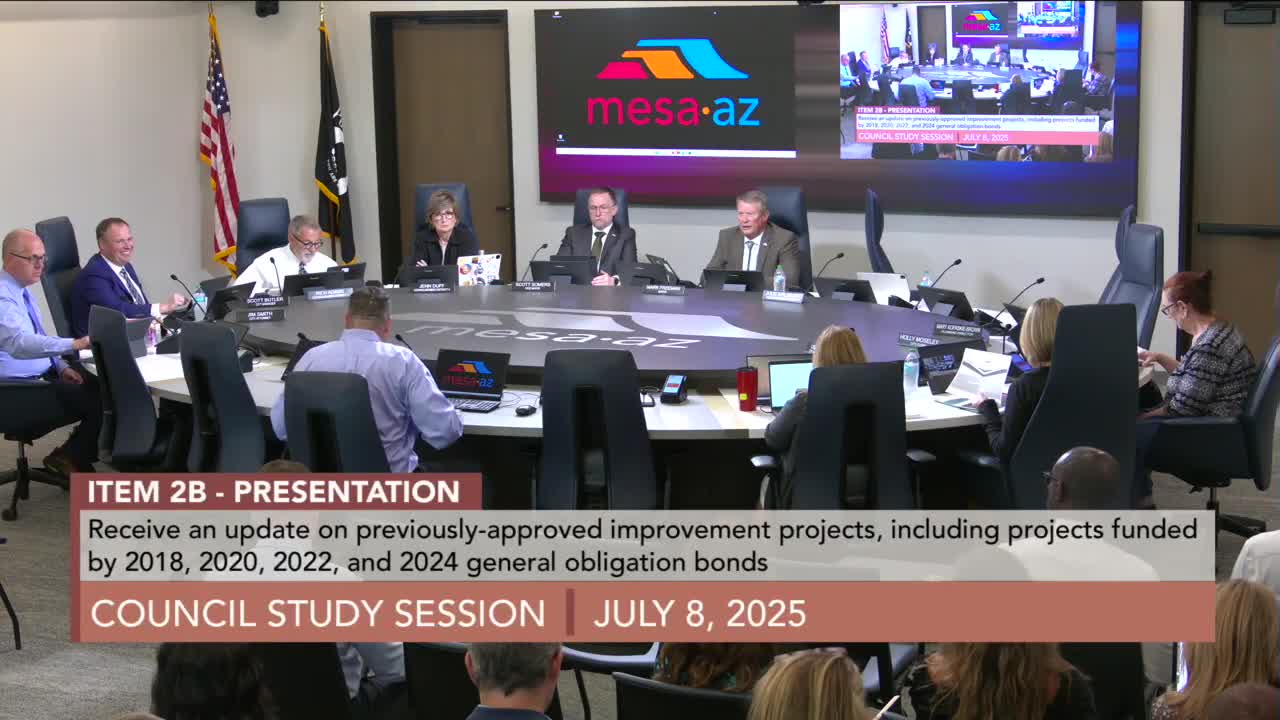
City Engineer Lance Webb briefed the Mesa City Council on July 8 about the status of Go Bond projects approved in 2018, 2020, 2022 and 2024, laying out progress on parks, libraries, transportation and public-safety projects and the effects of construction-cost inflation on scheduling and scope.
Webb said projects associated with the 2018 bond are at various stages: some are complete and closed out, some remain in design and others are in construction. He reported Gateway Library as under construction (about 28,000 square feet) and anticipated to open in late 2025, with November cited as the current target window. Signal Butte Park phase 2 has executed an initial GMP (guaranteed maximum price) and Webb told council that a second GMP was before council for consideration so construction could begin in summer 2025 with roughly a one-year construction schedule.
Webb described the Lehigh Crossing shared-use path: the pathway portion is complete and SRP is relocating electrical infrastructure to permit construction of a tunnel under Val Vista; the tunnel work began the week of the presentation with final tunnel construction expected later this year after JOC contractor work. Council members raised safety and lighting considerations for tunnels and asked about cameras tied to the real-time crime center; Webb and others confirmed lighting will be installed and said additional security measures have been requested for similar underpass crossings.
Nut graf: Webb framed the update around three themes: (1) active project schedules across bond packages, (2) persistent inflation and material-cost increases that have driven cost overruns and required scope or schedule adjustments, and (3) progress on projects with federal or MAG (Maricopa Association of Governments) reimbursement implications that affect cash flow and project sequencing.
On transportation, Webb highlighted that the 2020 transportation bond encountered significant cost volatility: an original $162 million projection from earlier planning was presented alongside a recalculated, higher estimate of roughly $305 million to complete that slate of projects at recent cost levels. He said the Central Mesa reuse pipeline grew substantially in cost (discussed as having moved from about $90 million in earlier projections to roughly $205 million) and praised early procurement of some long-lead equipment (for example HVAC for Gateway Library) as helpful to keep schedules on track.
Webb outlined other timelines and issues: the Eastern Canal shared-use path (Brown Road to Broadway Road) is expected to start construction in August 2025 with final completion in spring 2026; Broadway Road (Mesa Drive to Stapley) has completed design and will come to council for approval to proceed to construction; Elliot Road (Sossaman to Ellsworth) is delayed by federal funding clearances and ADOT approvals, with construction now anticipated to begin in fall 2026 and complete in summer 2028; Ellsworth Road (Germaine to Ray) design is complete and construction is expected to start shortly and finish fall 2026; Ray Road improvements and Val Vista Drive (U.S. 60 to Pueblo) were listed with expected starts and completions in 2026.
Webb also summarized 2022 public-safety projects: Fire Station 205 is near completion with construction continuing toward late 2025 and completion in winter 2026; Fire Station 223 has encountered site remediation and utility/ingress-egress issues that delayed its schedule, and staff said they are coordinating site remediation with shared utilities for both the station and the proposed public-safety communications building. Webb said staff plans to select a design consultant for the communications center in December 2025 and anticipates construction beginning in January 2027.
On public-safety facilities, council and staff described a multiphase approach to the public-safety training facility: Webb and the chief said the plan is to build a police-focused training building first, expand parking and repurpose existing police space for fire training later, and to carry out a master-plan-level assessment of technology, utilities and space needs before construction. Police headquarters was noted to begin construction in August 2025 with an expected completion in fall 2027.
On parks and culture funded by the 2024 bond, Webb said five of six playground-renovation sites are near procurement and scheduled to start construction in early fall 2025 with estimated completion in summer 2026; the IDEA Museum renovation has a negotiated contract and is scheduled for construction in fall 2026 with phased renovations through fall 2028. He said the Northeast Mesa Regional Trail feasibility study is nearly complete and that the bond funding would cover trailhead improvements but most corridor access currently exists informally and would require coordination with other jurisdictions for crossings and connectivity.
Council members asked about budgeting for future cost escalations. Councilmember Adams asked whether future bond packages should include larger contingencies; Webb and the city manager said the city has historically built contingencies but that the cost spikes from 2021'023 were unprecedented and that 2022 and 2024 bond packages reflect greater consideration of escalation and early procurements to lock in prices where possible.
Several council members, including Councilmember Spilsbury, urged robust community outreach on projects that will materially affect neighborhoods (for example the proposed indoor recreation center site at Countryside Park and roadway reconstruction on Val Vista and Southern). Staff agreed to increase outreach and to provide quarterly status updates to council so members can answer constituent questions about timing and impacts.
Ending: Webb said staff will continue to refine schedules, pursue MAG reimbursements where eligible and coordinate sequencing to minimize simultaneous impacts at critical intersections. No formal council votes on bond-program changes were recorded during the study session; staff said selected actions (GMP approvals and design selections) will return to council for formal action as those items reach decision points.
Webb said projects associated with the 2018 bond are at various stages: some are complete and closed out, some remain in design and others are in construction. He reported Gateway Library as under construction (about 28,000 square feet) and anticipated to open in late 2025, with November cited as the current target window. Signal Butte Park phase 2 has executed an initial GMP (guaranteed maximum price) and Webb told council that a second GMP was before council for consideration so construction could begin in summer 2025 with roughly a one-year construction schedule.
Webb described the Lehigh Crossing shared-use path: the pathway portion is complete and SRP is relocating electrical infrastructure to permit construction of a tunnel under Val Vista; the tunnel work began the week of the presentation with final tunnel construction expected later this year after JOC contractor work. Council members raised safety and lighting considerations for tunnels and asked about cameras tied to the real-time crime center; Webb and others confirmed lighting will be installed and said additional security measures have been requested for similar underpass crossings.
Nut graf: Webb framed the update around three themes: (1) active project schedules across bond packages, (2) persistent inflation and material-cost increases that have driven cost overruns and required scope or schedule adjustments, and (3) progress on projects with federal or MAG (Maricopa Association of Governments) reimbursement implications that affect cash flow and project sequencing.
On transportation, Webb highlighted that the 2020 transportation bond encountered significant cost volatility: an original $162 million projection from earlier planning was presented alongside a recalculated, higher estimate of roughly $305 million to complete that slate of projects at recent cost levels. He said the Central Mesa reuse pipeline grew substantially in cost (discussed as having moved from about $90 million in earlier projections to roughly $205 million) and praised early procurement of some long-lead equipment (for example HVAC for Gateway Library) as helpful to keep schedules on track.
Webb outlined other timelines and issues: the Eastern Canal shared-use path (Brown Road to Broadway Road) is expected to start construction in August 2025 with final completion in spring 2026; Broadway Road (Mesa Drive to Stapley) has completed design and will come to council for approval to proceed to construction; Elliot Road (Sossaman to Ellsworth) is delayed by federal funding clearances and ADOT approvals, with construction now anticipated to begin in fall 2026 and complete in summer 2028; Ellsworth Road (Germaine to Ray) design is complete and construction is expected to start shortly and finish fall 2026; Ray Road improvements and Val Vista Drive (U.S. 60 to Pueblo) were listed with expected starts and completions in 2026.
Webb also summarized 2022 public-safety projects: Fire Station 205 is near completion with construction continuing toward late 2025 and completion in winter 2026; Fire Station 223 has encountered site remediation and utility/ingress-egress issues that delayed its schedule, and staff said they are coordinating site remediation with shared utilities for both the station and the proposed public-safety communications building. Webb said staff plans to select a design consultant for the communications center in December 2025 and anticipates construction beginning in January 2027.
On public-safety facilities, council and staff described a multiphase approach to the public-safety training facility: Webb and the chief said the plan is to build a police-focused training building first, expand parking and repurpose existing police space for fire training later, and to carry out a master-plan-level assessment of technology, utilities and space needs before construction. Police headquarters was noted to begin construction in August 2025 with an expected completion in fall 2027.
On parks and culture funded by the 2024 bond, Webb said five of six playground-renovation sites are near procurement and scheduled to start construction in early fall 2025 with estimated completion in summer 2026; the IDEA Museum renovation has a negotiated contract and is scheduled for construction in fall 2026 with phased renovations through fall 2028. He said the Northeast Mesa Regional Trail feasibility study is nearly complete and that the bond funding would cover trailhead improvements but most corridor access currently exists informally and would require coordination with other jurisdictions for crossings and connectivity.
Council members asked about budgeting for future cost escalations. Councilmember Adams asked whether future bond packages should include larger contingencies; Webb and the city manager said the city has historically built contingencies but that the cost spikes from 2021'023 were unprecedented and that 2022 and 2024 bond packages reflect greater consideration of escalation and early procurements to lock in prices where possible.
Several council members, including Councilmember Spilsbury, urged robust community outreach on projects that will materially affect neighborhoods (for example the proposed indoor recreation center site at Countryside Park and roadway reconstruction on Val Vista and Southern). Staff agreed to increase outreach and to provide quarterly status updates to council so members can answer constituent questions about timing and impacts.
Ending: Webb said staff will continue to refine schedules, pursue MAG reimbursements where eligible and coordinate sequencing to minimize simultaneous impacts at critical intersections. No formal council votes on bond-program changes were recorded during the study session; staff said selected actions (GMP approvals and design selections) will return to council for formal action as those items reach decision points.
Don't Miss a Word: See the Full Meeting!
Go beyond summaries. Unlock every video, transcript, and key insight with a Founder Membership.
✓
Get instant access to full meeting videos
✓
Search and clip any phrase from complete transcripts
✓
Receive AI-powered summaries & custom alerts
✓
Enjoy lifetime, unrestricted access to government data
30-day money-back guarantee
