Richland County moves to adopt state-local BRIC agreement; emergency management outlines mitigation plan and IPAWS alerting
July 09, 2025 | Richland County, Ohio
This article was created by AI summarizing key points discussed. AI makes mistakes, so for full details and context, please refer to the video of the full meeting. Please report any errors so we can fix them. Report an error »
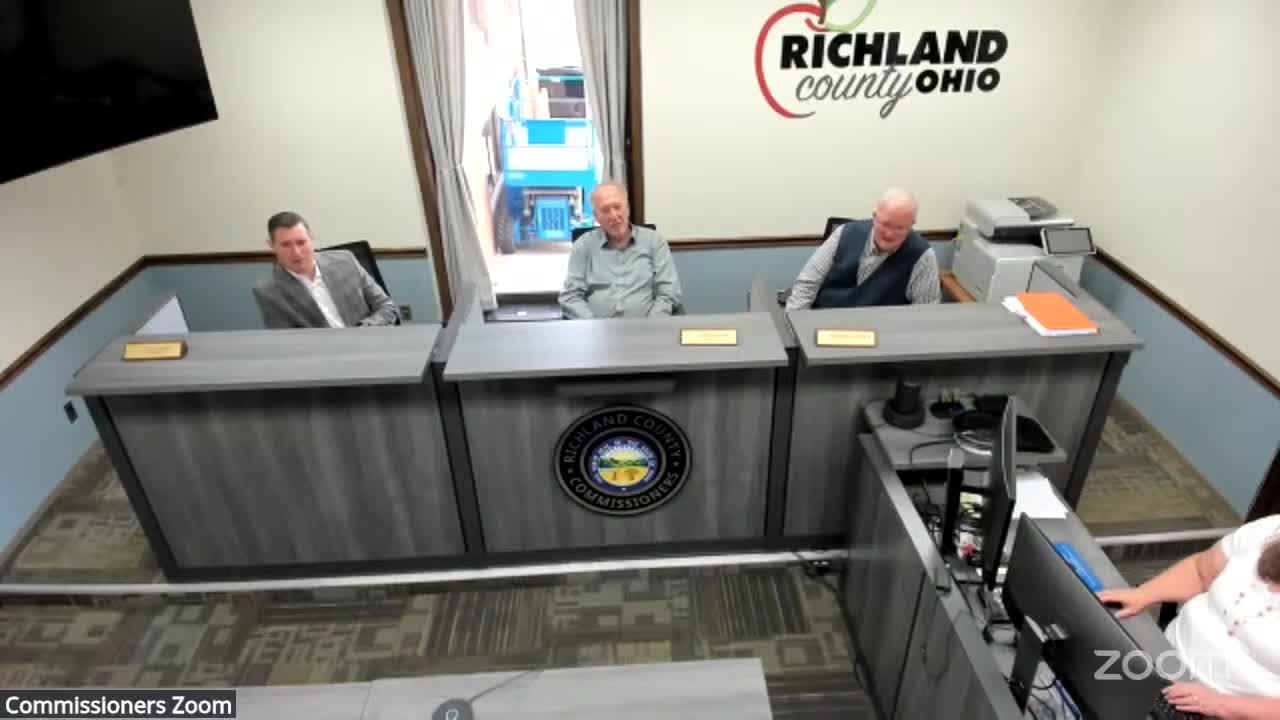
The Richland County Board of Commissioners on July 8, 2025 moved to approve a state-local agreement tied to a BRIC grant to update the county’s hazard mitigation plan, and Emergency Management staff described how the plan will be developed, publicized and could be paired with the county’s ability to send geo-targeted emergency alerts through IPAWS.
County Emergency Management Director Sarah Potts told commissioners the mitigation plan update will bring municipalities, townships, utilities and other partners together to identify the county’s biggest hazards and potential mitigation projects; the plan must be submitted to the state by late June 2026 and could make future mitigation funding available.
The agreement presented on the agenda lists an effective period beginning Sept. 25, 2024 and ending Jan. 15, 2026; Potts said the grant funds derive from fiscal year 2023 deobligated funds and that the performance period and plan-submission timeline align with June 2026, and that an extension may be possible.
Potts said the mitigation plan is primarily a multi-jurisdictional planning effort that “bring[s] everyone together to collaborate and identify these threats” and noted the county updates the plan every five years. She cited past mitigation-funded work in Shelby that converted a flood-prone area into green space and community use.
Commissioner Aidan asked how the hazard mitigation plan helps prevent or respond to fast-onset flooding and tornadoes and whether the county has alerting options beyond standard messaging. Potts explained that mitigation planning is distinct from the Emergency Operations Plan (which guides response) and described the county’s capability to use the Integrated Public Alert and Warning System (IPAWS) to send wireless emergency alerts targeted to people inside the county’s area based on cell towers. “If we activated IPAWS, you should get a message saying, hey. There's a massive flood on State Route 13 North or State Route 13 South near Belleville. Please avoid the area,” Potts said.
Potts said procedures for when to activate IPAWS are still under discussion and that the county has not used IPAWS in the past; she said staff will work on activation procedures and on scheduling several public meetings where stakeholders and residents can participate in the mitigation-plan update.
The agenda contained a motion to approve the state-local BRIC agreement and that motion was moved and seconded. The transcript does not provide a definitive roll-call vote tally in the record provided; commissioners proceeded to subsequent agenda items.
Next steps outlined at the meeting: staff will schedule multiple planning meetings open to the public, continue work on the mitigation-plan update to meet the June 2026 submission window (with potential for extension), and develop written procedures for IPAWS activation.
County Emergency Management Director Sarah Potts told commissioners the mitigation plan update will bring municipalities, townships, utilities and other partners together to identify the county’s biggest hazards and potential mitigation projects; the plan must be submitted to the state by late June 2026 and could make future mitigation funding available.
The agreement presented on the agenda lists an effective period beginning Sept. 25, 2024 and ending Jan. 15, 2026; Potts said the grant funds derive from fiscal year 2023 deobligated funds and that the performance period and plan-submission timeline align with June 2026, and that an extension may be possible.
Potts said the mitigation plan is primarily a multi-jurisdictional planning effort that “bring[s] everyone together to collaborate and identify these threats” and noted the county updates the plan every five years. She cited past mitigation-funded work in Shelby that converted a flood-prone area into green space and community use.
Commissioner Aidan asked how the hazard mitigation plan helps prevent or respond to fast-onset flooding and tornadoes and whether the county has alerting options beyond standard messaging. Potts explained that mitigation planning is distinct from the Emergency Operations Plan (which guides response) and described the county’s capability to use the Integrated Public Alert and Warning System (IPAWS) to send wireless emergency alerts targeted to people inside the county’s area based on cell towers. “If we activated IPAWS, you should get a message saying, hey. There's a massive flood on State Route 13 North or State Route 13 South near Belleville. Please avoid the area,” Potts said.
Potts said procedures for when to activate IPAWS are still under discussion and that the county has not used IPAWS in the past; she said staff will work on activation procedures and on scheduling several public meetings where stakeholders and residents can participate in the mitigation-plan update.
The agenda contained a motion to approve the state-local BRIC agreement and that motion was moved and seconded. The transcript does not provide a definitive roll-call vote tally in the record provided; commissioners proceeded to subsequent agenda items.
Next steps outlined at the meeting: staff will schedule multiple planning meetings open to the public, continue work on the mitigation-plan update to meet the June 2026 submission window (with potential for extension), and develop written procedures for IPAWS activation.
Don't Miss a Word: See the Full Meeting!
Go beyond summaries. Unlock every video, transcript, and key insight with a Founder Membership.
✓
Get instant access to full meeting videos
✓
Search and clip any phrase from complete transcripts
✓
Receive AI-powered summaries & custom alerts
✓
Enjoy lifetime, unrestricted access to government data
30-day money-back guarantee
