Bridgeport community forum urges more funding, stable leadership, and local hires as board begins strategic-plan outreach
July 09, 2025 | Bridgeport School District, School Districts, Connecticut
This article was created by AI summarizing key points discussed. AI makes mistakes, so for full details and context, please refer to the video of the full meeting. Please report any errors so we can fix them. Report an error »
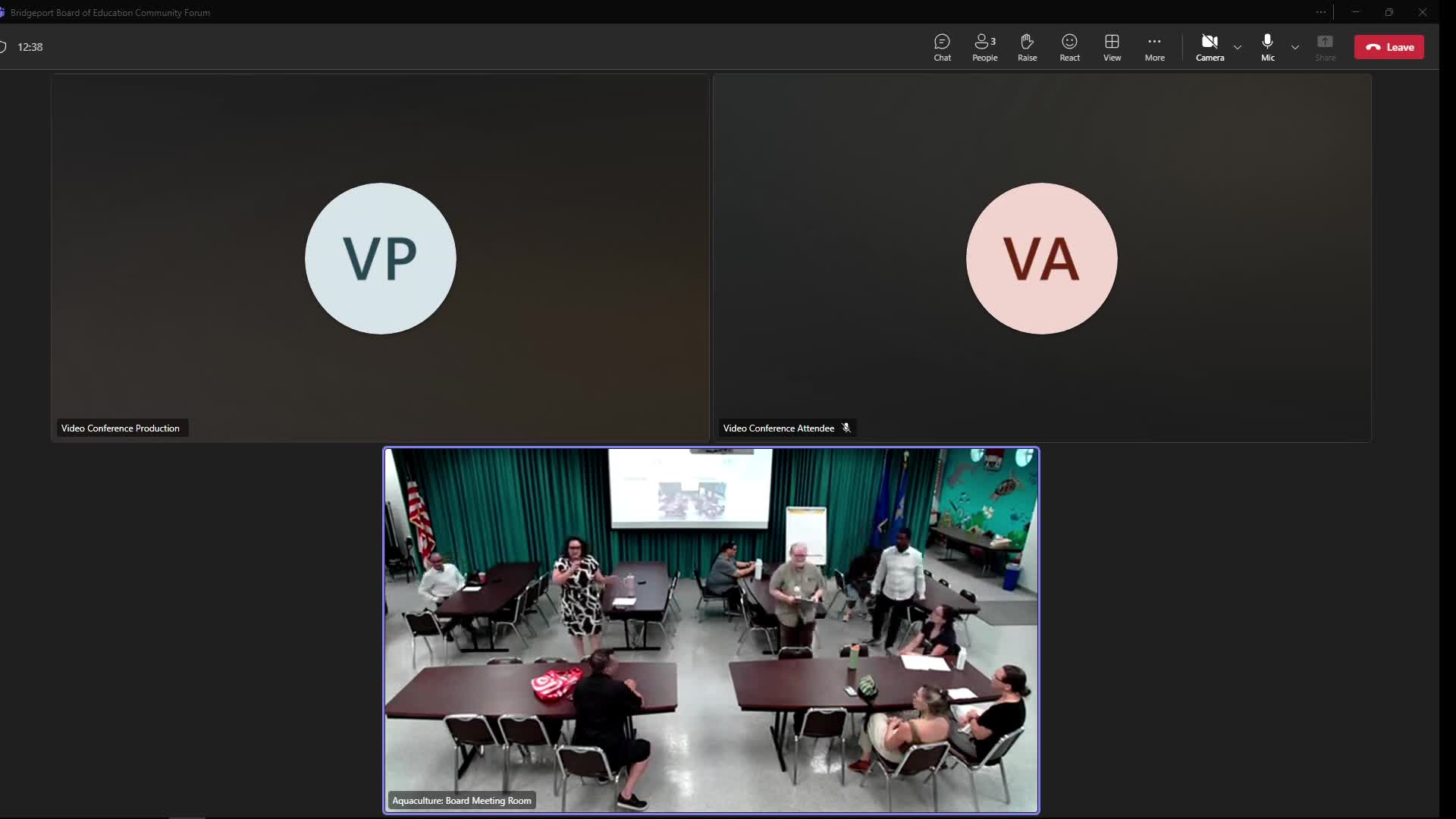
BRIDGEPORT, Conn. — The Bridgeport Board of Education hosted a community forum on July 9 to gather public input for a forthcoming district strategic plan, and attendees repeatedly urged more stable leadership, increased funding for classroom programs, and a stronger focus on hiring certified teachers who live in the city.
The forum, one of four the board plans this month, opened at 6:06 p.m. with board chair Jennifer Perez and a facilitator from the Bridgeport Public Education Fund explaining that community feedback will inform the superintendent's office as it develops the strategic plan. Faith Villegas, executive director of the Bridgeport Public Education Fund, told the assembled residents the event’s purpose was to “bring community together to really think about what is the best direction forward for our students.”
Participants organized around six tables with a board member at each table and reported common themes during a group summary. Recurrent priorities were better funding and fiscal transparency, a consistent and rigorous curriculum with less reliance on screen‑based programs, hiring and retaining certified teachers (including more teachers of color and more teachers who live in Bridgeport), improved assessment and supports for English‑learner and special‑education students, and expanded exposure to trades and mentorship programs.
Community member Al Ramirez urged adults and educators to model belief in students: “If no one believes in us, how can we expect you to believe in yourself?” Ramirez reported his table’s recommendations to hire more teachers of color and to reintroduce financial‑literacy and entrepreneurial coursework.
Several tables flagged the use of temporary substitute teachers as a barrier to consistent instruction and said the district should prioritize permanent placements and a baseline staffing level at every school "that they refuse to go under." Participants also criticized frequent curriculum changes tied to superintendent turnover and said they want a multi‑year commitment to curriculum so students experience stable, scaffolded instruction.
Tables concerned about multilingual learners and neurodiverse students asked for better ESL assessment and for the district to avoid conflating second‑language status with special‑education needs. Multiple speakers said extracurriculars, building conditions and visible school spirit affect student engagement and recommended protecting after‑school and arts programs when budgets are constrained.
Several groups urged the district to expand career and technical education pathways, pointing to trade unions and mentor programs as models to expose middle‑ and high‑school students earlier to career options. One table recommended expanding awareness of programs like AQUA and of trade apprenticeships so students can consider alternatives to a four‑year college path.
A table that discussed state funding asked the board to advocate for changes to the pilot reimbursement formula so Bridgeport, New Haven and Hartford receive more equitable reimbursements from the state. Participants also referenced the state “rainy day” fund as a source for advocacy but did not specify an amount or a legislative path for change.
Board members and staff said the district will hold three additional forums in July: July 16 at Blackham School, and two forums the last week of July at locations to be announced (one at JFK and one in the Dunbar/Rafael Taylor area). Spanish interpretation was provided by Eunice Rosa for Spanish‑speaking attendees.
The forum focused on collecting resident priorities rather than producing formal board action. No motions or votes were taken. Organizers asked volunteers to serve as table note takers so board staff can compile the feedback for the strategic‑plan process.
Community members interested in submitting additional comments or materials were invited to give them to a board representative at the close of the meeting or to attend one of the remaining forums.
The forum, one of four the board plans this month, opened at 6:06 p.m. with board chair Jennifer Perez and a facilitator from the Bridgeport Public Education Fund explaining that community feedback will inform the superintendent's office as it develops the strategic plan. Faith Villegas, executive director of the Bridgeport Public Education Fund, told the assembled residents the event’s purpose was to “bring community together to really think about what is the best direction forward for our students.”
Participants organized around six tables with a board member at each table and reported common themes during a group summary. Recurrent priorities were better funding and fiscal transparency, a consistent and rigorous curriculum with less reliance on screen‑based programs, hiring and retaining certified teachers (including more teachers of color and more teachers who live in Bridgeport), improved assessment and supports for English‑learner and special‑education students, and expanded exposure to trades and mentorship programs.
Community member Al Ramirez urged adults and educators to model belief in students: “If no one believes in us, how can we expect you to believe in yourself?” Ramirez reported his table’s recommendations to hire more teachers of color and to reintroduce financial‑literacy and entrepreneurial coursework.
Several tables flagged the use of temporary substitute teachers as a barrier to consistent instruction and said the district should prioritize permanent placements and a baseline staffing level at every school "that they refuse to go under." Participants also criticized frequent curriculum changes tied to superintendent turnover and said they want a multi‑year commitment to curriculum so students experience stable, scaffolded instruction.
Tables concerned about multilingual learners and neurodiverse students asked for better ESL assessment and for the district to avoid conflating second‑language status with special‑education needs. Multiple speakers said extracurriculars, building conditions and visible school spirit affect student engagement and recommended protecting after‑school and arts programs when budgets are constrained.
Several groups urged the district to expand career and technical education pathways, pointing to trade unions and mentor programs as models to expose middle‑ and high‑school students earlier to career options. One table recommended expanding awareness of programs like AQUA and of trade apprenticeships so students can consider alternatives to a four‑year college path.
A table that discussed state funding asked the board to advocate for changes to the pilot reimbursement formula so Bridgeport, New Haven and Hartford receive more equitable reimbursements from the state. Participants also referenced the state “rainy day” fund as a source for advocacy but did not specify an amount or a legislative path for change.
Board members and staff said the district will hold three additional forums in July: July 16 at Blackham School, and two forums the last week of July at locations to be announced (one at JFK and one in the Dunbar/Rafael Taylor area). Spanish interpretation was provided by Eunice Rosa for Spanish‑speaking attendees.
The forum focused on collecting resident priorities rather than producing formal board action. No motions or votes were taken. Organizers asked volunteers to serve as table note takers so board staff can compile the feedback for the strategic‑plan process.
Community members interested in submitting additional comments or materials were invited to give them to a board representative at the close of the meeting or to attend one of the remaining forums.
Don't Miss a Word: See the Full Meeting!
Go beyond summaries. Unlock every video, transcript, and key insight with a Founder Membership.
✓
Get instant access to full meeting videos
✓
Search and clip any phrase from complete transcripts
✓
Receive AI-powered summaries & custom alerts
✓
Enjoy lifetime, unrestricted access to government data
30-day money-back guarantee
