University Place to move 20 Seventh Street business-district plan to a resolution vote
July 08, 2025 | University Place, Pierce County, Washington
This article was created by AI summarizing key points discussed. AI makes mistakes, so for full details and context, please refer to the video of the full meeting. Please report any errors so we can fix them. Report an error »
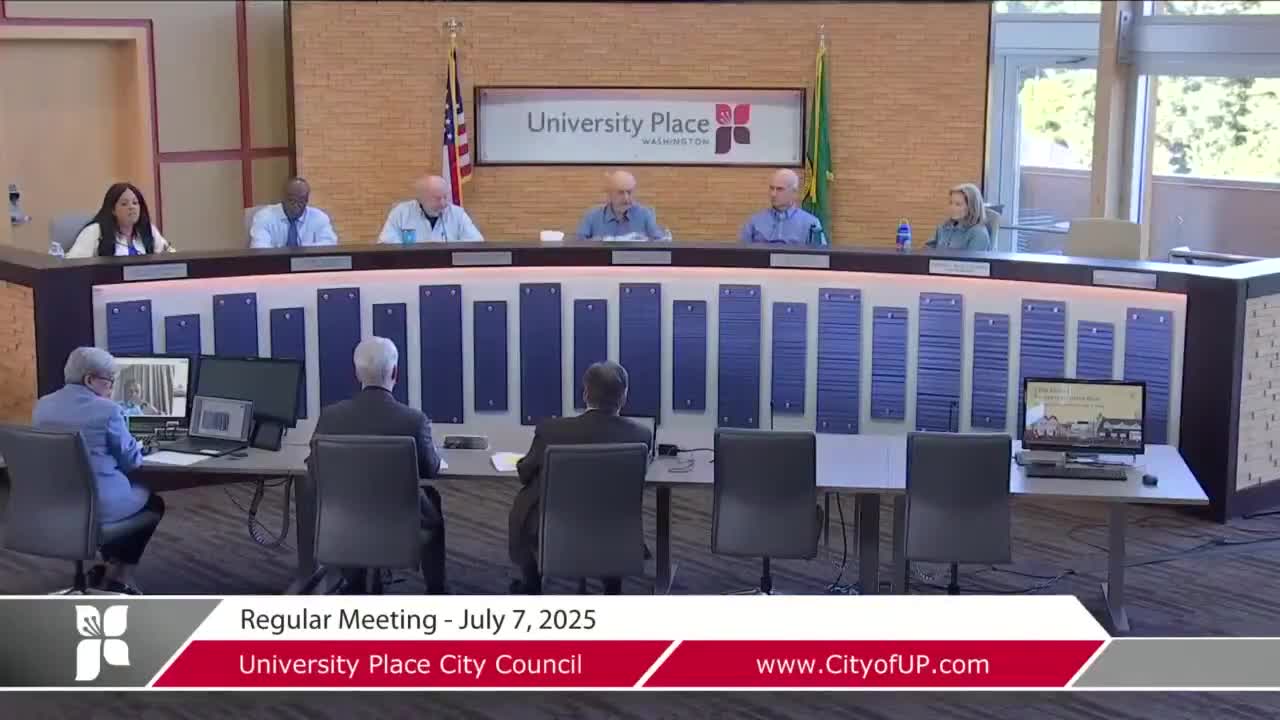
The University Place City Council on Tuesday completed a second study session on the 20 Seventh Street Business District plan and directed staff to return with a resolution for adoption, with no council member objecting.
The draft plan, prepared by city staff and consultants and summarized by Kevin Bridal, the city’s community and economic development director, lays out seven recommended action areas — regional collaboration; environment and climate-change strategy; land use and development patterns; housing; placemaking; economic development; and transportation and utilities. Bridal told the council the plan document and an appendix include a market analysis and that staff collected 681 survey and flash-vote responses during outreach.
Why it matters: The plan is meant to guide future redevelopment along 20 Seventh Street — a corridor the city and the Puget Sound Regional Council designated as part of a regional growth center — by recommending zoning tools, public investments and design standards intended to generate private reinvestment, address safety and improve multimodal access.
The plan’s process and scope
Bridal said an advisory group of local property and business owners met four times while the planning commission held two review sessions and a public hearing before forwarding a recommendation to council. Bridal described the plan as a policy-level document that would require later implementing actions or ordinances to change development standards.
Key recommendations and council concerns
- Pedestrian safety and intersections: Staff recommended staged public investments to improve pedestrian crossings and calm traffic. Public works director Jack Eklund flagged the skewed Sunset Avenue intersection as a major safety and design challenge: “To correct the offset, you would either have to condemn the auto business and take up a fair amount … or you would need to demolish a good chunk of the Presbyterian Church,” he said, noting both options are costly and politically difficult. Council members and staff discussed signalization, split phasing and the potential for phased signal/safety upgrades as volumes rise.
- Environment and climate: The plan recommends improving trail access (including links to Adriana Hesse), low-impact-development stormwater techniques, expanded walking and bicycling options, green building incentives and an EV-charging strategy for the district.
- Land use, housing and parking: Staff proposed using the city’s form-based code, encouraging small-footprint storefronts and exploring finer-grained block connectivity where property depth allows. The plan suggests expanding housing typologies near the corridor — “missing middle” and townhomes — and evaluating a multifamily tax-exemption (MFTE) for parts of the district. Bridal said the council previously used MFTEs elsewhere and estimated — approximately — that MFTE-related actions have leveraged about $180,000,000 in private investment citywide; he described the Grandview Plaza area (including the Grandview Senior Living project) as a redevelopment priority.
- Placemaking and economic development: The draft calls for public-art installations, gateway and wayfinding signage, pocket plazas, street trees and median plantings, and a facade-improvement/street-activation program. Staff recommended restarting a business association for 20 Seventh Street and pursuing façade grants or design support to help existing business owners.
- Transportation: Consultant traffic data presented by Jordan Martin showed that recent (2024) daily traffic volumes on some 20 Seventh segments are lower than earlier counts and that a medium-growth scenario covering 20 years would degrade some signalized intersections but not exceed historic peak volumes. Staff used the Institute of Transportation Engineers trip-generation approach for projections and noted regional trends (post-pandemic travel-pattern changes) that reduce vehicle volumes relative to earlier expectations. Bridgeport/20 Seventh, currently operating at a mid-range level of service, would decline under the scenario to a lower level of service without mitigation; staff said project-specific SEPA review and any major redevelopment proposals would trigger mitigation requirements.
Council direction and next steps
Councilmembers asked staff to bring the plan back as a resolution for formal consideration; the meeting record shows no objections when the mayor asked whether staff should proceed to a resolution. Staff said implementation would require further council direction — for example, to ask the planning commission to draft ordinances changing parking or development standards, or to pursue grant funding and targeted capital projects.
The council’s forthcoming action will be procedural: a resolution adopting the policy framework. Specific regulatory changes, funding decisions or capital projects would be separate actions returned to council for consideration.
The draft plan, prepared by city staff and consultants and summarized by Kevin Bridal, the city’s community and economic development director, lays out seven recommended action areas — regional collaboration; environment and climate-change strategy; land use and development patterns; housing; placemaking; economic development; and transportation and utilities. Bridal told the council the plan document and an appendix include a market analysis and that staff collected 681 survey and flash-vote responses during outreach.
Why it matters: The plan is meant to guide future redevelopment along 20 Seventh Street — a corridor the city and the Puget Sound Regional Council designated as part of a regional growth center — by recommending zoning tools, public investments and design standards intended to generate private reinvestment, address safety and improve multimodal access.
The plan’s process and scope
Bridal said an advisory group of local property and business owners met four times while the planning commission held two review sessions and a public hearing before forwarding a recommendation to council. Bridal described the plan as a policy-level document that would require later implementing actions or ordinances to change development standards.
Key recommendations and council concerns
- Pedestrian safety and intersections: Staff recommended staged public investments to improve pedestrian crossings and calm traffic. Public works director Jack Eklund flagged the skewed Sunset Avenue intersection as a major safety and design challenge: “To correct the offset, you would either have to condemn the auto business and take up a fair amount … or you would need to demolish a good chunk of the Presbyterian Church,” he said, noting both options are costly and politically difficult. Council members and staff discussed signalization, split phasing and the potential for phased signal/safety upgrades as volumes rise.
- Environment and climate: The plan recommends improving trail access (including links to Adriana Hesse), low-impact-development stormwater techniques, expanded walking and bicycling options, green building incentives and an EV-charging strategy for the district.
- Land use, housing and parking: Staff proposed using the city’s form-based code, encouraging small-footprint storefronts and exploring finer-grained block connectivity where property depth allows. The plan suggests expanding housing typologies near the corridor — “missing middle” and townhomes — and evaluating a multifamily tax-exemption (MFTE) for parts of the district. Bridal said the council previously used MFTEs elsewhere and estimated — approximately — that MFTE-related actions have leveraged about $180,000,000 in private investment citywide; he described the Grandview Plaza area (including the Grandview Senior Living project) as a redevelopment priority.
- Placemaking and economic development: The draft calls for public-art installations, gateway and wayfinding signage, pocket plazas, street trees and median plantings, and a facade-improvement/street-activation program. Staff recommended restarting a business association for 20 Seventh Street and pursuing façade grants or design support to help existing business owners.
- Transportation: Consultant traffic data presented by Jordan Martin showed that recent (2024) daily traffic volumes on some 20 Seventh segments are lower than earlier counts and that a medium-growth scenario covering 20 years would degrade some signalized intersections but not exceed historic peak volumes. Staff used the Institute of Transportation Engineers trip-generation approach for projections and noted regional trends (post-pandemic travel-pattern changes) that reduce vehicle volumes relative to earlier expectations. Bridgeport/20 Seventh, currently operating at a mid-range level of service, would decline under the scenario to a lower level of service without mitigation; staff said project-specific SEPA review and any major redevelopment proposals would trigger mitigation requirements.
Council direction and next steps
Councilmembers asked staff to bring the plan back as a resolution for formal consideration; the meeting record shows no objections when the mayor asked whether staff should proceed to a resolution. Staff said implementation would require further council direction — for example, to ask the planning commission to draft ordinances changing parking or development standards, or to pursue grant funding and targeted capital projects.
The council’s forthcoming action will be procedural: a resolution adopting the policy framework. Specific regulatory changes, funding decisions or capital projects would be separate actions returned to council for consideration.
View the Full Meeting & All Its Details
This article offers just a summary. Unlock complete video, transcripts, and insights as a Founder Member.
✓
Watch full, unedited meeting videos
✓
Search every word spoken in unlimited transcripts
✓
AI summaries & real-time alerts (all government levels)
✓
Permanent access to expanding government content
30-day money-back guarantee
