Citywide funding review could expand parks property tax but would broaden eligible public-realm uses
July 10, 2025 | Boulder, Boulder County, Colorado
This article was created by AI summarizing key points discussed. AI makes mistakes, so for full details and context, please refer to the video of the full meeting. Please report any errors so we can fix them. Report an error »
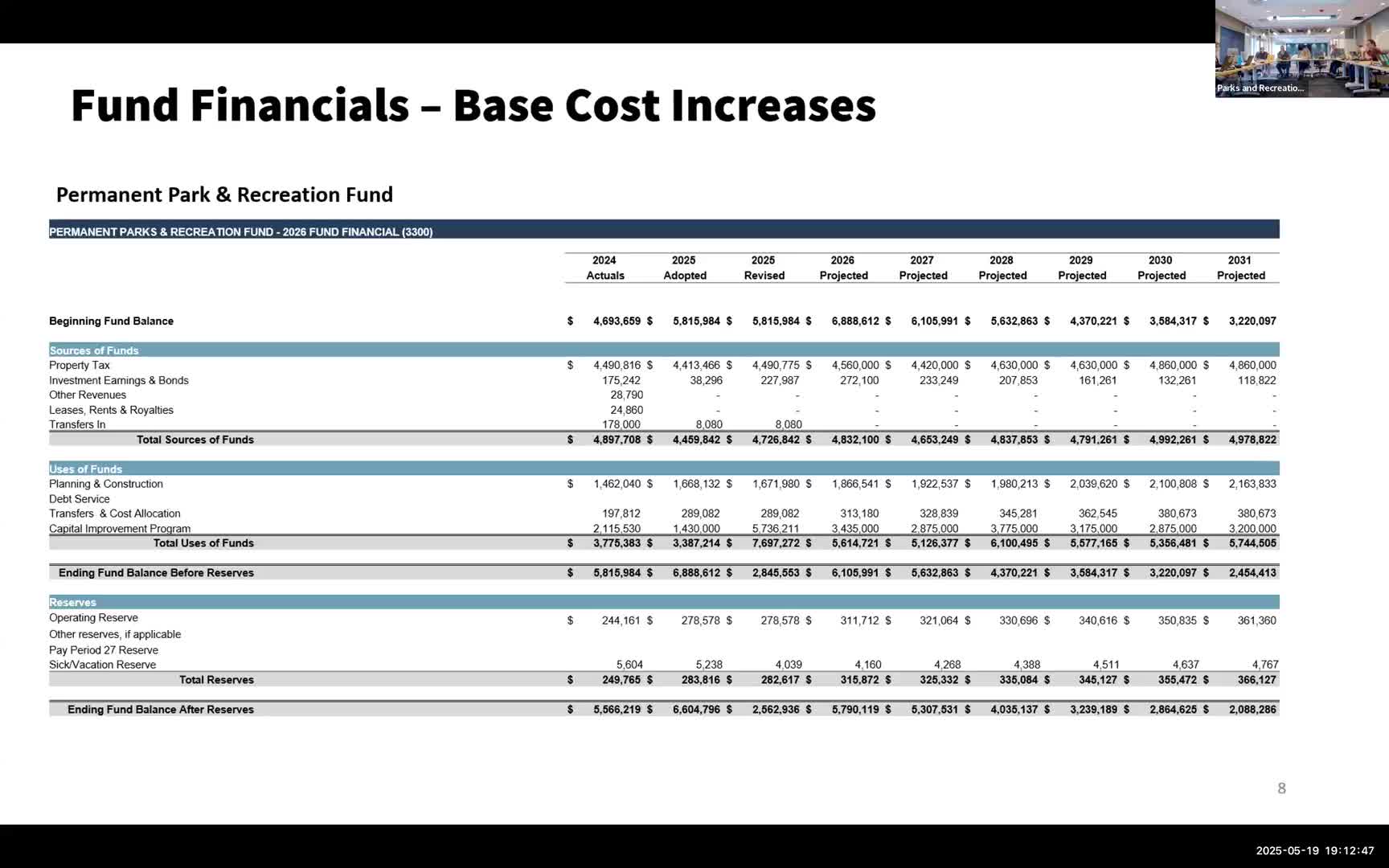
City staff told the Parks and Recreation Advisory Board that a proposal under study would expand the use of the city’s permanent parks and recreation property tax and substantially increase the tax levy’s size, a move intended to fund a broader set of public-realm projects across the city.
Jackson Knight, business services manager, described the fund currently as dedicated to buying land or making permanent park improvements and said the council financial strategy committee is considering two proposals. Staff said one proposal would expand the definition of eligible uses and increase the levy from the current 0.9 mills to a larger levy (discussions referenced a potential increase to about 3 mills during packet remarks) so the fund could support a broader set of projects across the public realm rather than only parks and recreation.
Knight and colleagues noted trade-offs. Expanding the funding pool would increase the total funds available, staff said, but would remove the guaranteed, narrowly dedicated share parks and recreation currently receives each year. “The hope is that by making the pie bigger and broader that there's more opportunity to address unmet needs across the system,” a staff presenter said, adding that council will take up the matter and that polling is underway; staff told the board that council would follow up on the topic June 26.
Board members asked whether the change would amount to an effective undedication of parks funds and how the department would be protected; staff responded that the change would be a political and policy trade-off and that the intent is to prioritize highest-and-best use for the public realm while acknowledging there are no absolute guarantees if allocation decisions are later made by council.
Staff framed the proposal as a potential tool to support large capital needs such as park renovations, infrastructure and long-term projects. They pointed to precedence: staff said parks and recreation previously received about half of the money from the 2021 Community Culture Resilience and Safety (CCRS) tax for capital projects, and that a larger, flexible public-realm fund could similarly shift how dollars are allocated.
No formal action was taken by the board at the meeting; staff indicated council will continue the conversation and that any change would require council approval and likely voter approval for a tax change.
Jackson Knight, business services manager, described the fund currently as dedicated to buying land or making permanent park improvements and said the council financial strategy committee is considering two proposals. Staff said one proposal would expand the definition of eligible uses and increase the levy from the current 0.9 mills to a larger levy (discussions referenced a potential increase to about 3 mills during packet remarks) so the fund could support a broader set of projects across the public realm rather than only parks and recreation.
Knight and colleagues noted trade-offs. Expanding the funding pool would increase the total funds available, staff said, but would remove the guaranteed, narrowly dedicated share parks and recreation currently receives each year. “The hope is that by making the pie bigger and broader that there's more opportunity to address unmet needs across the system,” a staff presenter said, adding that council will take up the matter and that polling is underway; staff told the board that council would follow up on the topic June 26.
Board members asked whether the change would amount to an effective undedication of parks funds and how the department would be protected; staff responded that the change would be a political and policy trade-off and that the intent is to prioritize highest-and-best use for the public realm while acknowledging there are no absolute guarantees if allocation decisions are later made by council.
Staff framed the proposal as a potential tool to support large capital needs such as park renovations, infrastructure and long-term projects. They pointed to precedence: staff said parks and recreation previously received about half of the money from the 2021 Community Culture Resilience and Safety (CCRS) tax for capital projects, and that a larger, flexible public-realm fund could similarly shift how dollars are allocated.
No formal action was taken by the board at the meeting; staff indicated council will continue the conversation and that any change would require council approval and likely voter approval for a tax change.
Don't Miss a Word: See the Full Meeting!
Go beyond summaries. Unlock every video, transcript, and key insight with a Founder Membership.
✓
Get instant access to full meeting videos
✓
Search and clip any phrase from complete transcripts
✓
Receive AI-powered summaries & custom alerts
✓
Enjoy lifetime, unrestricted access to government data
30-day money-back guarantee
