Legislative leadership division reviews post‑session budget and fiscal trends
June 25, 2025 | Legislative, North Dakota
This article was created by AI summarizing key points discussed. AI makes mistakes, so for full details and context, please refer to the video of the full meeting. Please report any errors so we can fix them. Report an error »
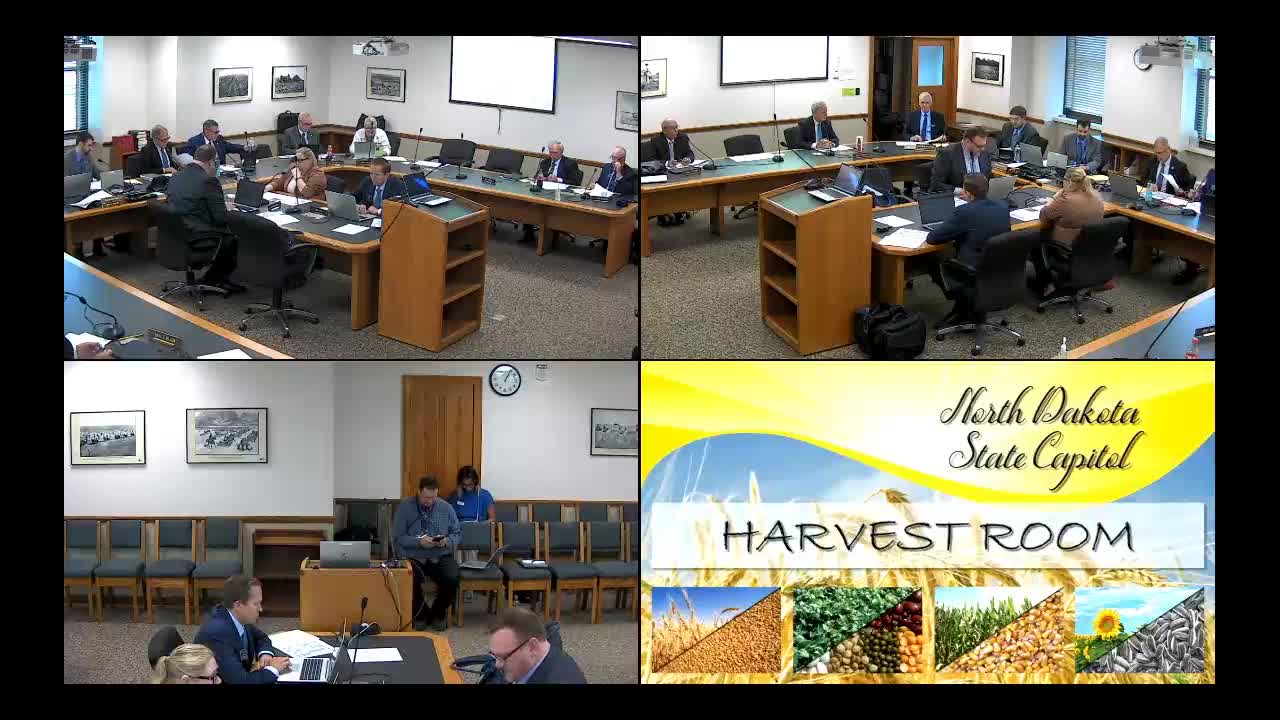
Alan Knudson, a Legislative Council fiscal analyst, briefed the Leadership Division of the Budget Section 2 Committee on statewide budget and fiscal trends following the 2025 legislative session.
Knudson told the panel the total state budget for the 2025–27 biennium is about $20.3 billion, excluding amounts still in dispute after executive vetoes. He said ongoing general‑fund appropriations increased roughly 4.6 percent while total general‑fund appropriations rose about 2 percent, and that federal funds in the budget decline primarily because pandemic‑era federal assistance is ending.
The memo Knudson walked through showed general fund beginning balances were lower going into 2025–27 than the prior biennium despite earlier strong balances. “Primarily that’s a result of lower beginning balance,” he said, noting transfers and one‑time receipts changed year to year. He identified interest income as a driver of variation in the forecast and said projected interest receipts decline compared with the previous biennium.
Committee members asked for follow‑up data. Vice Chair Hoch noted April receipts exceeded the March revised forecast by roughly $100 million and asked whether that reflected individual or corporate income taxes; Knudson said the April variance was about evenly split between individual and corporate receipts but detailed causes were not yet known. Representative Roseanne Bosch asked for the methodology behind the interest‑income projection; Knudson said the executive budget’s estimates underlie the forecast and staff can provide more fund‑level detail.
On revenue composition, Knudson highlighted that major general‑fund tax sources (sales, motor‑vehicle excise and income taxes) have grown unevenly; oil taxes have fluctuated sharply over several bienniums and are projected lower for 2025–27 in part because of price assumptions. He also reviewed major spending categories: health and human services, K‑12, higher education and corrections, noting corrections showed a steep increase in the current budget cycle and health and human services remain the largest appropriation.
Committee members directed staff to pursue additional briefings and analysis. Members asked Legislative Council to invite the Bank of North Dakota to present on cash‑management returns and to coordinate with the state treasurer to compare approaches. Knudson said staff would request that presentation and also provide further breakdowns on Medicaid enrollment trends, teacher/student counts and the new/ vacant FTE pool once final accounting is complete.
The committee did not take formal votes on budget changes at the meeting; the session was a staff briefing and request‑for‑follow‑up items.
Knudson told the panel the total state budget for the 2025–27 biennium is about $20.3 billion, excluding amounts still in dispute after executive vetoes. He said ongoing general‑fund appropriations increased roughly 4.6 percent while total general‑fund appropriations rose about 2 percent, and that federal funds in the budget decline primarily because pandemic‑era federal assistance is ending.
The memo Knudson walked through showed general fund beginning balances were lower going into 2025–27 than the prior biennium despite earlier strong balances. “Primarily that’s a result of lower beginning balance,” he said, noting transfers and one‑time receipts changed year to year. He identified interest income as a driver of variation in the forecast and said projected interest receipts decline compared with the previous biennium.
Committee members asked for follow‑up data. Vice Chair Hoch noted April receipts exceeded the March revised forecast by roughly $100 million and asked whether that reflected individual or corporate income taxes; Knudson said the April variance was about evenly split between individual and corporate receipts but detailed causes were not yet known. Representative Roseanne Bosch asked for the methodology behind the interest‑income projection; Knudson said the executive budget’s estimates underlie the forecast and staff can provide more fund‑level detail.
On revenue composition, Knudson highlighted that major general‑fund tax sources (sales, motor‑vehicle excise and income taxes) have grown unevenly; oil taxes have fluctuated sharply over several bienniums and are projected lower for 2025–27 in part because of price assumptions. He also reviewed major spending categories: health and human services, K‑12, higher education and corrections, noting corrections showed a steep increase in the current budget cycle and health and human services remain the largest appropriation.
Committee members directed staff to pursue additional briefings and analysis. Members asked Legislative Council to invite the Bank of North Dakota to present on cash‑management returns and to coordinate with the state treasurer to compare approaches. Knudson said staff would request that presentation and also provide further breakdowns on Medicaid enrollment trends, teacher/student counts and the new/ vacant FTE pool once final accounting is complete.
The committee did not take formal votes on budget changes at the meeting; the session was a staff briefing and request‑for‑follow‑up items.
Don't Miss a Word: See the Full Meeting!
Go beyond summaries. Unlock every video, transcript, and key insight with a Founder Membership.
✓
Get instant access to full meeting videos
✓
Search and clip any phrase from complete transcripts
✓
Receive AI-powered summaries & custom alerts
✓
Enjoy lifetime, unrestricted access to government data
30-day money-back guarantee
