OMB says June close could boost ending balance; budget section approves three emergency spending requests
June 25, 2025 | Budget Section, Interim, Legislative, North Dakota
This article was created by AI summarizing key points discussed. AI makes mistakes, so for full details and context, please refer to the video of the full meeting. Please report any errors so we can fix them. Report an error »
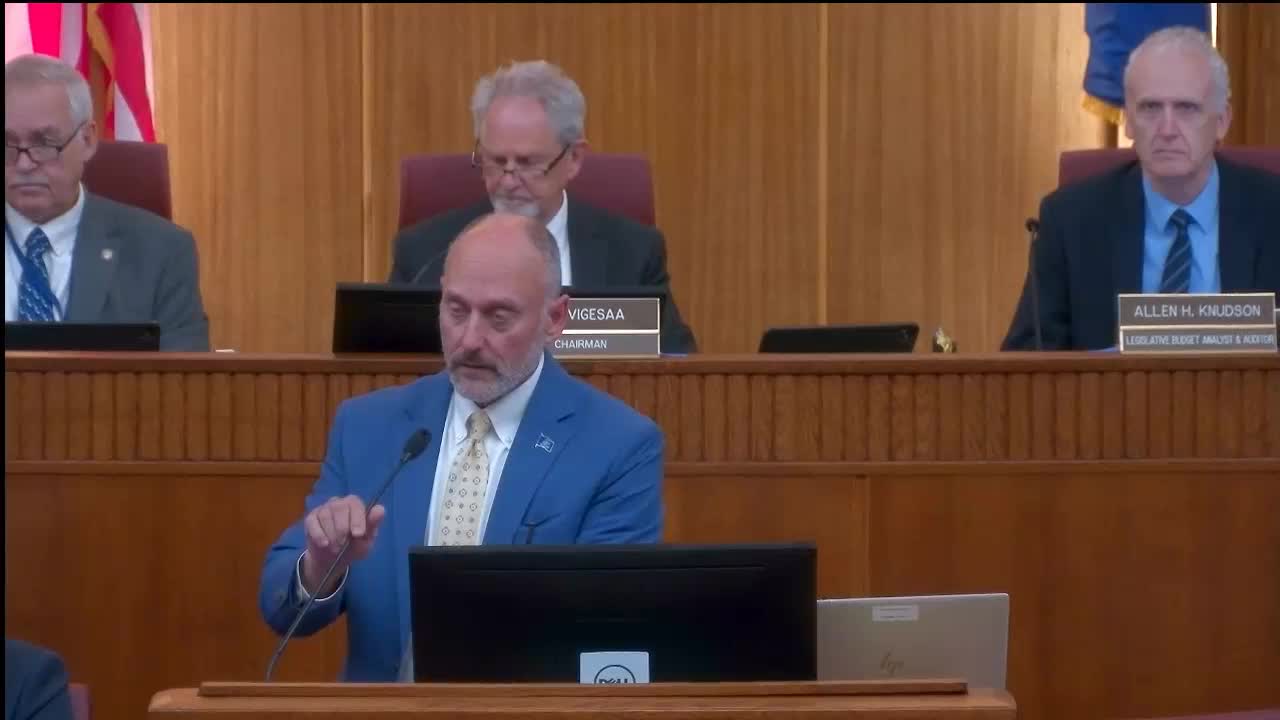
Joe Morrissette of the Office of Management and Budget told the Budget Section the estimated general fund ending balance for the biennium on June 30, 2025, is $1,154,000,000 and that revenue collections through May totaled $5,160,000,000 under the adopted forecast. "The estimated ending balance for this biennium for June 30 of 2025 of 1,154,000,000... closely aligns with what you had expected when you adjourned in May," Morrissette said.
The update matters because the final amounts available for transfers and spending will not be known until agencies complete the June close and the books are finalized. Morrissette told members the month of June typically brings significant transactions — including a biennial Bank of North Dakota dividend and interest on the budget stabilization fund — and that the final figures may not be available until the July close or later. He said the office expects to exceed the adopted forecast but is sticking with the adopted numbers until June is closed.
During questions, Morrissette confirmed the budget stabilization fund balance reported through March was about $966 million and that, under the new biennium’s calculations, a revised threshold near $938 million would create roughly $30 million of excess earnings eligible for transfer to the general fund. He told the committee the transfer will be set when the June financial statement is prepared and may occur after close of the biennium (likely in August).
OMB also reviewed special funds, the Strategic Investment and Improvements Fund, and oil-related revenues. Morrissette said oil revenue for the biennium was tracking above forecast overall, producing an overage of roughly $520 million through May, and reviewed the North Dakota price assumptions used in the adopted forecast ($62 for the remainder of the fiscal year, then $59 and $57 for the two years of the next biennium).
The committee heard several routine reports Morrissette summarized: tobacco settlement receipts (about $631 million received to date), required federal-grant notifications (agencies must report grants in excess of $25,000), fiscal irregularities (pay adjustments and retroactive payroll entries are reported as irregularities by statute), and vacancy-savings reporting. Morrissette said cumulative vacancy savings across funding sources totaled about $130 million for the first fiscal year of the biennium and that OMB had distributed roughly $36 million from a roughly $40 million general‑fund new-and-vacant FTE pool, leaving about $4 million unallocated; a $3 million deficiency authorized in session may not be needed.
Emergency commission requests forwarded to the Budget Section were acted on. The Department of Public Instruction had requested increased federal spending authority; OMB staff identified a math error in the aggregate amount approved by the emergency commission and asked the Budget Section to amend the DPI request downward by $944 to keep it within the emergency commission’s biennial aggregate authority. Senator Mathern moved the amendment; Representative Nelson seconded. The committee approved the amendment by voice vote.
The committee then considered all three requests from the emergency commission together and approved them on a roll-call vote. Morrissette explained one of the requests was an internal OMB transfer of $189,750 from the state contingencies line to cover payments the state made as fiscal agent on a COVID-related federal grant that later was canceled at the federal level; OMB has sought federal reimbursement but had not yet obtained it. Morrissette asked that, if the federal government later reimburses the state, the funds would be returned to the general fund.
Brady and OMB staff answered members’ procedural and reporting questions, and senators asked OMB to track the effects of recent oil tax exemptions on the effective tax rate and to compile a list of federal grant cancellations so the Budget Section can assess potential impacts if a special session becomes necessary.
The Budget Section recessed with its next scheduled meeting set for Sept. 24.
The update matters because the final amounts available for transfers and spending will not be known until agencies complete the June close and the books are finalized. Morrissette told members the month of June typically brings significant transactions — including a biennial Bank of North Dakota dividend and interest on the budget stabilization fund — and that the final figures may not be available until the July close or later. He said the office expects to exceed the adopted forecast but is sticking with the adopted numbers until June is closed.
During questions, Morrissette confirmed the budget stabilization fund balance reported through March was about $966 million and that, under the new biennium’s calculations, a revised threshold near $938 million would create roughly $30 million of excess earnings eligible for transfer to the general fund. He told the committee the transfer will be set when the June financial statement is prepared and may occur after close of the biennium (likely in August).
OMB also reviewed special funds, the Strategic Investment and Improvements Fund, and oil-related revenues. Morrissette said oil revenue for the biennium was tracking above forecast overall, producing an overage of roughly $520 million through May, and reviewed the North Dakota price assumptions used in the adopted forecast ($62 for the remainder of the fiscal year, then $59 and $57 for the two years of the next biennium).
The committee heard several routine reports Morrissette summarized: tobacco settlement receipts (about $631 million received to date), required federal-grant notifications (agencies must report grants in excess of $25,000), fiscal irregularities (pay adjustments and retroactive payroll entries are reported as irregularities by statute), and vacancy-savings reporting. Morrissette said cumulative vacancy savings across funding sources totaled about $130 million for the first fiscal year of the biennium and that OMB had distributed roughly $36 million from a roughly $40 million general‑fund new-and-vacant FTE pool, leaving about $4 million unallocated; a $3 million deficiency authorized in session may not be needed.
Emergency commission requests forwarded to the Budget Section were acted on. The Department of Public Instruction had requested increased federal spending authority; OMB staff identified a math error in the aggregate amount approved by the emergency commission and asked the Budget Section to amend the DPI request downward by $944 to keep it within the emergency commission’s biennial aggregate authority. Senator Mathern moved the amendment; Representative Nelson seconded. The committee approved the amendment by voice vote.
The committee then considered all three requests from the emergency commission together and approved them on a roll-call vote. Morrissette explained one of the requests was an internal OMB transfer of $189,750 from the state contingencies line to cover payments the state made as fiscal agent on a COVID-related federal grant that later was canceled at the federal level; OMB has sought federal reimbursement but had not yet obtained it. Morrissette asked that, if the federal government later reimburses the state, the funds would be returned to the general fund.
Brady and OMB staff answered members’ procedural and reporting questions, and senators asked OMB to track the effects of recent oil tax exemptions on the effective tax rate and to compile a list of federal grant cancellations so the Budget Section can assess potential impacts if a special session becomes necessary.
The Budget Section recessed with its next scheduled meeting set for Sept. 24.
Don't Miss a Word: See the Full Meeting!
Go beyond summaries. Unlock every video, transcript, and key insight with a Founder Membership.
✓
Get instant access to full meeting videos
✓
Search and clip any phrase from complete transcripts
✓
Receive AI-powered summaries & custom alerts
✓
Enjoy lifetime, unrestricted access to government data
30-day money-back guarantee
