Department of Mineral Resources reports steady production, higher lateral footage and new drilling techniques
June 25, 2025 | Budget Section, Interim, Legislative, North Dakota
This article was created by AI summarizing key points discussed. AI makes mistakes, so for full details and context, please refer to the video of the full meeting. Please report any errors so we can fix them. Report an error »
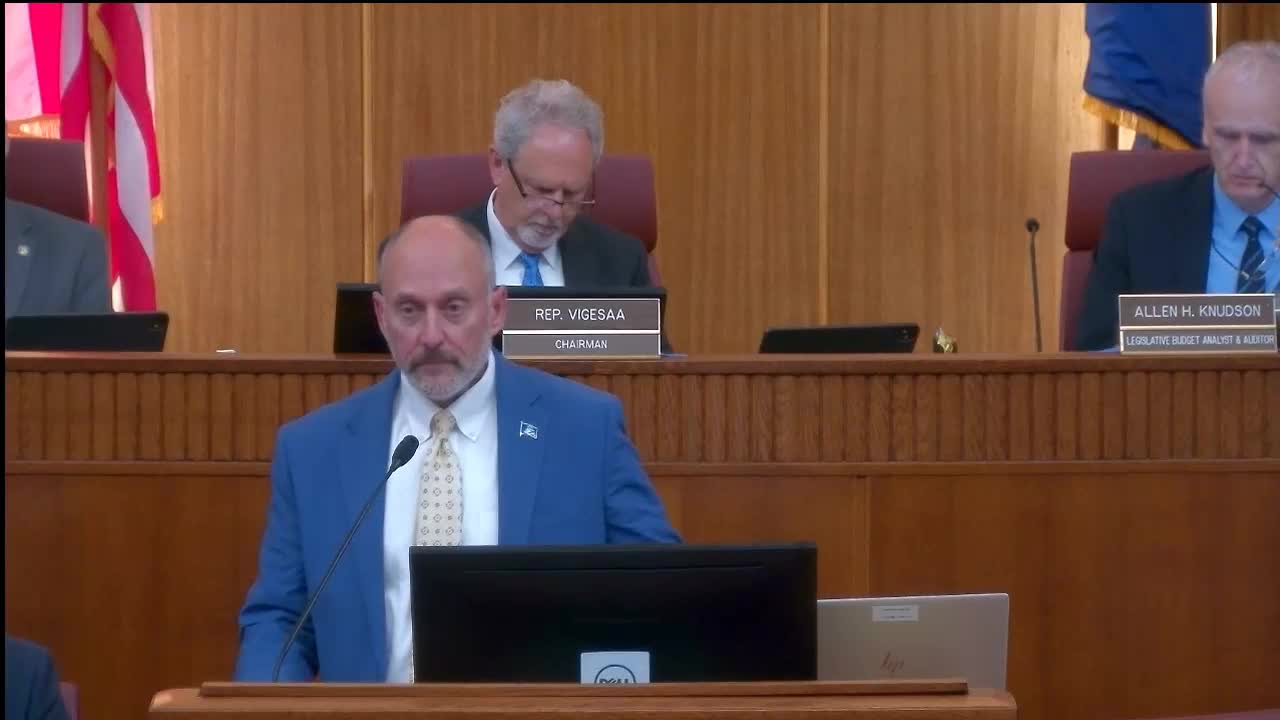
Nathan Anderson, director of the Department of Mineral Resources, briefed the Budget Section on oil and gas activity in the Williston Basin, emerging drilling technologies and the status of the Oil and Gas Production and Restoration (OPSRF) fund.
Anderson said North Dakota production for the month was about 1.17 million barrels per day, with 97.3% of that coming from the Bakken/Three Forks formation. He reported a gas capture rate of roughly 95.7%, and daily gas flows near 3.47 billion cubic feet. "North Dakota production for the month came in at 1.17," Anderson said, adding that month‑to‑month fluctuations are normal.
The department highlighted a multi‑year trend toward longer completed laterals. Anderson said 2024 saw about 10.6 million feet of lateral completed statewide and an average lateral length in 2024 of about 10,149 feet. He noted that increasing lateral length can raise capital efficiency: "Even with a slight rig-count reduction, capital efficiencies are up, and they're doing that through longer laterals."
Anderson described a developing technology — so‑called U‑shaped or horseshoe wells — that has been permitted in other basins and now has been used in North Dakota. He said the department had issued permits for several such wells, including some that would permit 4‑mile total lateral footage by drilling down and out then back. He and staff said the technique could make otherwise stranded or underdeveloped areas in the northern basin more economic.
The OPSRF fund balance was estimated at about $40.7 million currently, with a projected June 2027 balance of about $53 million under the forecast shared with the committee. Anderson reviewed program goals including using drone technology to reduce physical inspections, evaluating in‑place restoration methods and planning for long‑term plugging and reclamation liabilities.
On activity and rigs, Anderson said North Dakota’s rig count was roughly 30 to 32 rigs and completion crews numbered about 13. He cautioned that geopolitical events have produced price volatility and that several larger operators were signaling modest CapEx reductions; that environment could lead to slight decreases in activity if prices remain in the low‑to‑mid $60s per barrel.
Anderson also flagged that well counts continue to grow, highlighting the management challenge of increased reclamation workload and the need to staff and implement the department’s reclamation program.
Anderson said North Dakota production for the month was about 1.17 million barrels per day, with 97.3% of that coming from the Bakken/Three Forks formation. He reported a gas capture rate of roughly 95.7%, and daily gas flows near 3.47 billion cubic feet. "North Dakota production for the month came in at 1.17," Anderson said, adding that month‑to‑month fluctuations are normal.
The department highlighted a multi‑year trend toward longer completed laterals. Anderson said 2024 saw about 10.6 million feet of lateral completed statewide and an average lateral length in 2024 of about 10,149 feet. He noted that increasing lateral length can raise capital efficiency: "Even with a slight rig-count reduction, capital efficiencies are up, and they're doing that through longer laterals."
Anderson described a developing technology — so‑called U‑shaped or horseshoe wells — that has been permitted in other basins and now has been used in North Dakota. He said the department had issued permits for several such wells, including some that would permit 4‑mile total lateral footage by drilling down and out then back. He and staff said the technique could make otherwise stranded or underdeveloped areas in the northern basin more economic.
The OPSRF fund balance was estimated at about $40.7 million currently, with a projected June 2027 balance of about $53 million under the forecast shared with the committee. Anderson reviewed program goals including using drone technology to reduce physical inspections, evaluating in‑place restoration methods and planning for long‑term plugging and reclamation liabilities.
On activity and rigs, Anderson said North Dakota’s rig count was roughly 30 to 32 rigs and completion crews numbered about 13. He cautioned that geopolitical events have produced price volatility and that several larger operators were signaling modest CapEx reductions; that environment could lead to slight decreases in activity if prices remain in the low‑to‑mid $60s per barrel.
Anderson also flagged that well counts continue to grow, highlighting the management challenge of increased reclamation workload and the need to staff and implement the department’s reclamation program.
View the Full Meeting & All Its Details
This article offers just a summary. Unlock complete video, transcripts, and insights as a Founder Member.
✓
Watch full, unedited meeting videos
✓
Search every word spoken in unlimited transcripts
✓
AI summaries & real-time alerts (all government levels)
✓
Permanent access to expanding government content
30-day money-back guarantee
