Planning commission backs city-initiated rezoning for data center with conditions after resident concerns on power and traffic
July 17, 2025 | South Fulton, Fulton County, Georgia
This article was created by AI summarizing key points discussed. AI makes mistakes, so for full details and context, please refer to the video of the full meeting. Please report any errors so we can fix them. Report an error »
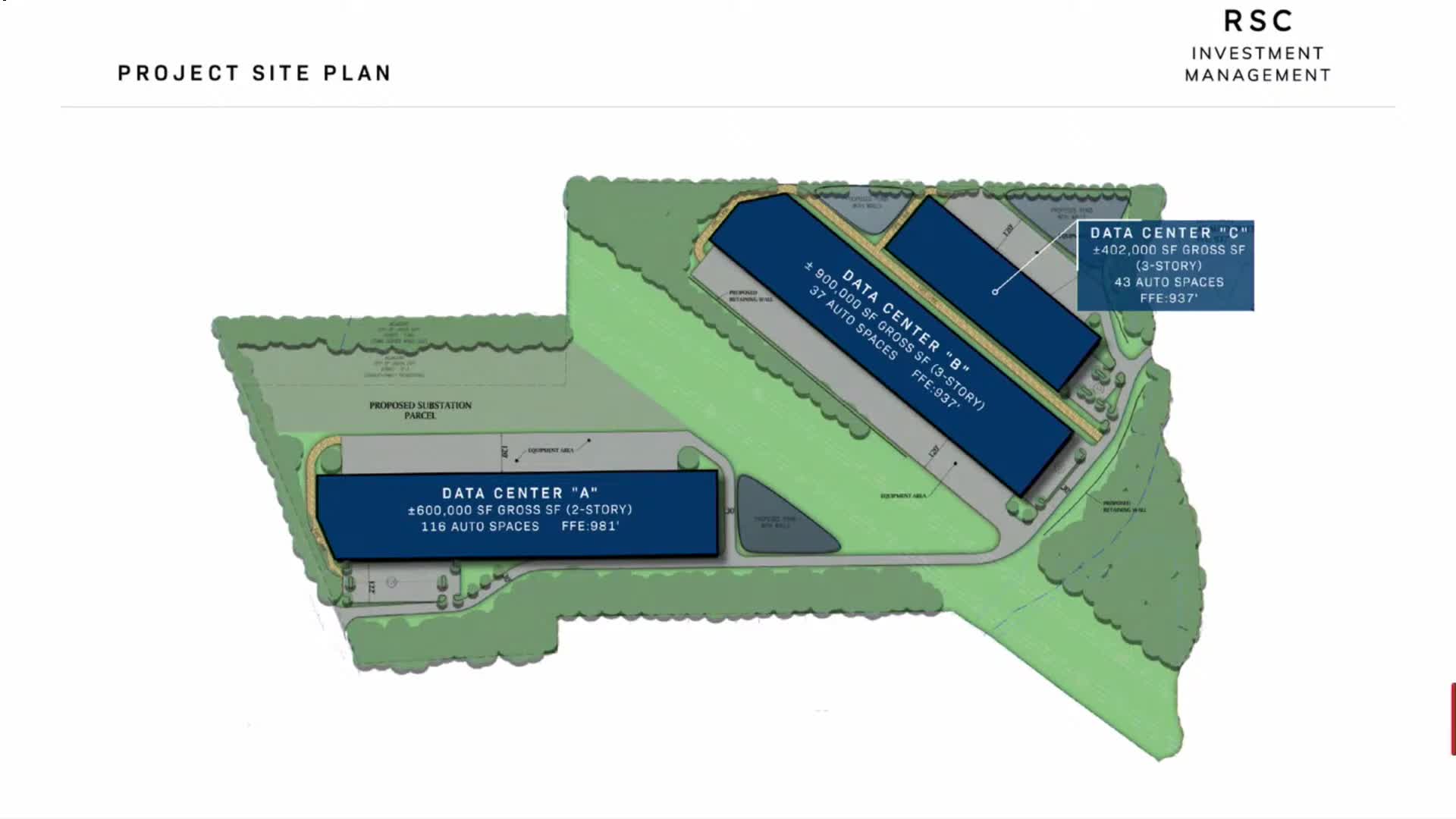
The City of South Fulton Planning Commission on July 16 recommended approval of a city‑initiated rezoning and related land‑use applications to allow a data center in the southeast quadrant of South Fulton Parkway and Stonewall Tell Road.
The commission’s vote followed presentations from Reggie McClint, managing director of community development and regulatory affairs for the city, and Woody Galloway, an attorney representing RSC Investment Management and TA Digital. The staff report and applicant materials framed the proposal as a light‑industrial/data‑center campus on roughly 60 acres in South Fulton with additional adjacent acreage providing access via Mason Road.
Why it matters: the project is large enough to affect city revenues, utilities and nearby neighborhoods. The applicant and city told commissioners the development would bring significant annual property tax revenue and that the buildings and equipment would be subject to a new data‑center ordinance passed by the city council. That ordinance sets site standards including landscaping, screening, lighting limits and noise caps at 65 decibels during daytime hours and 55 decibels at night.
Commissioners pressed the applicant on public‑resource impacts. Commissioner Perry asked specifically about water and electrical demands; McClint and Galloway said the applicant agreed to a closed‑loop cooling system to avoid continuous water withdrawal and that power allocation for the site has been secured through the regional utility, Georgia Power. Galloway told the commission the closed‑loop system “means that, once it’s filled up, there is no additional demand on the water system.” He also told the commission the applicant agreed to a 150‑foot southern buffer (larger than the 100‑foot base standard) and to construction hour restrictions.
A nearby resident, James Hall Jr., 4775 Stonewall Veil Road, opposed the rezoning in public comment, saying traffic along Stonewall Hill Road is already heavy and that the area has experienced intermittent power outages. “There’s been times as a resident… it’s the middle of the day, no storms, it’s brightest day outside, and the power just cuts off,” Hall said. He asked the commission to consider grid impacts on residents.
The commission approved staff’s findings of fact and then voted to recommend approval of the rezoning (Z25‑002), the special‑use permit (U25‑005) and the comprehensive development plan amendment (CDP25‑001) with the staff‑listed conditions. The staff conditions include the increased buffer, compliance with the city’s data‑center ordinance (landscaping, lighting and noise controls), and DRI‑related requirements discussed in the staff report. The applications will be considered by the mayor and city council at their Aug. 12 public hearing.
What’s next: the project will proceed to the mayor and council on Aug. 12; the commission noted that utility impacts and coordination with Georgia Power are regional matters but recommended the city use DRI findings to track and mitigate any infrastructure needs raised by the proposal.
Ending: The commission’s recommendation was unanimous on the final votes. City staff and the applicant said they will continue community outreach and coordinate with the utility and neighboring jurisdictions as the application advances.
The commission’s vote followed presentations from Reggie McClint, managing director of community development and regulatory affairs for the city, and Woody Galloway, an attorney representing RSC Investment Management and TA Digital. The staff report and applicant materials framed the proposal as a light‑industrial/data‑center campus on roughly 60 acres in South Fulton with additional adjacent acreage providing access via Mason Road.
Why it matters: the project is large enough to affect city revenues, utilities and nearby neighborhoods. The applicant and city told commissioners the development would bring significant annual property tax revenue and that the buildings and equipment would be subject to a new data‑center ordinance passed by the city council. That ordinance sets site standards including landscaping, screening, lighting limits and noise caps at 65 decibels during daytime hours and 55 decibels at night.
Commissioners pressed the applicant on public‑resource impacts. Commissioner Perry asked specifically about water and electrical demands; McClint and Galloway said the applicant agreed to a closed‑loop cooling system to avoid continuous water withdrawal and that power allocation for the site has been secured through the regional utility, Georgia Power. Galloway told the commission the closed‑loop system “means that, once it’s filled up, there is no additional demand on the water system.” He also told the commission the applicant agreed to a 150‑foot southern buffer (larger than the 100‑foot base standard) and to construction hour restrictions.
A nearby resident, James Hall Jr., 4775 Stonewall Veil Road, opposed the rezoning in public comment, saying traffic along Stonewall Hill Road is already heavy and that the area has experienced intermittent power outages. “There’s been times as a resident… it’s the middle of the day, no storms, it’s brightest day outside, and the power just cuts off,” Hall said. He asked the commission to consider grid impacts on residents.
The commission approved staff’s findings of fact and then voted to recommend approval of the rezoning (Z25‑002), the special‑use permit (U25‑005) and the comprehensive development plan amendment (CDP25‑001) with the staff‑listed conditions. The staff conditions include the increased buffer, compliance with the city’s data‑center ordinance (landscaping, lighting and noise controls), and DRI‑related requirements discussed in the staff report. The applications will be considered by the mayor and city council at their Aug. 12 public hearing.
What’s next: the project will proceed to the mayor and council on Aug. 12; the commission noted that utility impacts and coordination with Georgia Power are regional matters but recommended the city use DRI findings to track and mitigate any infrastructure needs raised by the proposal.
Ending: The commission’s recommendation was unanimous on the final votes. City staff and the applicant said they will continue community outreach and coordinate with the utility and neighboring jurisdictions as the application advances.
Don't Miss a Word: See the Full Meeting!
Go beyond summaries. Unlock every video, transcript, and key insight with a Founder Membership.
✓
Get instant access to full meeting videos
✓
Search and clip any phrase from complete transcripts
✓
Receive AI-powered summaries & custom alerts
✓
Enjoy lifetime, unrestricted access to government data
30-day money-back guarantee
