Fargo consultants test ‘community center’ and neighborhood‑center patterns for greenfield growth
June 17, 2025 | Fargo , Cass County, North Dakota
This article was created by AI summarizing key points discussed. AI makes mistakes, so for full details and context, please refer to the video of the full meeting. Please report any errors so we can fix them. Report an error »
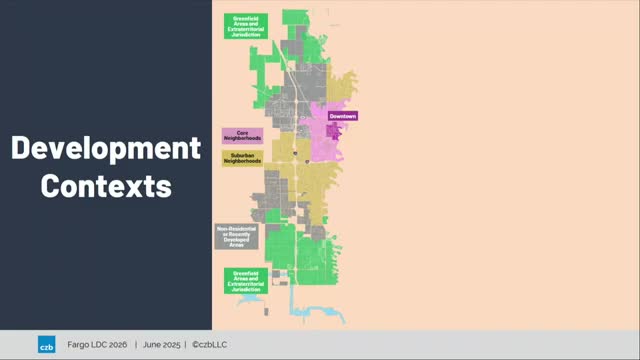
Consultants presented two code‑testing illustrations for Fargo's greenfield growth areas to show how mixed housing types and commercial uses might be arranged to better match the city's Growth Plan vision.
The presentation framed the tests as tools to compare current development patterns with alternatives that prioritize walkable community centers, a mix of housing types and better internal connectivity. Project materials used the Woodhaven neighborhood as an example of recent greenfield patterns and then showed an alternative layout that places a walkable community center adjacent to a mixture of single‑family, townhouse and multifamily housing. The team noted the Growth Plan calls for up to 66% of future household and population growth to be absorbed in greenfield areas.
Why it matters: Fargo's future greenfield development will absorb a large share of growth, and building it to be walkable and mixed use could change long‑term travel, tax and infrastructure patterns.
Details and debate: The first test illustrated a larger community center combining vertical and horizontal mixed uses, internal pedestrian connections and parks; the second focused on a smaller neighborhood center along an arterial such as Veterans Boulevard. Consultants included alleys in some illustrations to reduce curb cuts and garage prominence on narrow lots; one commissioner asked for paired diagrams showing identical densities with and without alleys so the public can compare outcomes.
Several commissioners asked how the city's expectations will align with market feasibility and developers' need to make projects "pencil out." Presenters responded that incentives such as predictable rules and faster approvals can help, and that the testing can be expanded to show how larger retailers or grocery stores could be accommodated alongside walkable centers. Commissioners also raised concerns about major arterials (for example, 40th/50th Street corridors) creating barriers to walkability and the need to internalize mixed commercial centers so crossings across high‑speed roads are not required.
No formal decisions were taken; the tests will be shown at public workshops and online for comment and may be refined based on feedback before code drafting begins.
The presentation framed the tests as tools to compare current development patterns with alternatives that prioritize walkable community centers, a mix of housing types and better internal connectivity. Project materials used the Woodhaven neighborhood as an example of recent greenfield patterns and then showed an alternative layout that places a walkable community center adjacent to a mixture of single‑family, townhouse and multifamily housing. The team noted the Growth Plan calls for up to 66% of future household and population growth to be absorbed in greenfield areas.
Why it matters: Fargo's future greenfield development will absorb a large share of growth, and building it to be walkable and mixed use could change long‑term travel, tax and infrastructure patterns.
Details and debate: The first test illustrated a larger community center combining vertical and horizontal mixed uses, internal pedestrian connections and parks; the second focused on a smaller neighborhood center along an arterial such as Veterans Boulevard. Consultants included alleys in some illustrations to reduce curb cuts and garage prominence on narrow lots; one commissioner asked for paired diagrams showing identical densities with and without alleys so the public can compare outcomes.
Several commissioners asked how the city's expectations will align with market feasibility and developers' need to make projects "pencil out." Presenters responded that incentives such as predictable rules and faster approvals can help, and that the testing can be expanded to show how larger retailers or grocery stores could be accommodated alongside walkable centers. Commissioners also raised concerns about major arterials (for example, 40th/50th Street corridors) creating barriers to walkability and the need to internalize mixed commercial centers so crossings across high‑speed roads are not required.
No formal decisions were taken; the tests will be shown at public workshops and online for comment and may be refined based on feedback before code drafting begins.
View the Full Meeting & All Its Details
This article offers just a summary. Unlock complete video, transcripts, and insights as a Founder Member.
✓
Watch full, unedited meeting videos
✓
Search every word spoken in unlimited transcripts
✓
AI summaries & real-time alerts (all government levels)
✓
Permanent access to expanding government content
30-day money-back guarantee
