Presenter tells Denver committee Front Range was Indigenous homeland for millennia; urges cultural center, dedicated funding
June 25, 2025 | Denver (Consolidated County and City), Colorado
This article was created by AI summarizing key points discussed. AI makes mistakes, so for full details and context, please refer to the video of the full meeting. Please report any errors so we can fix them. Report an error »
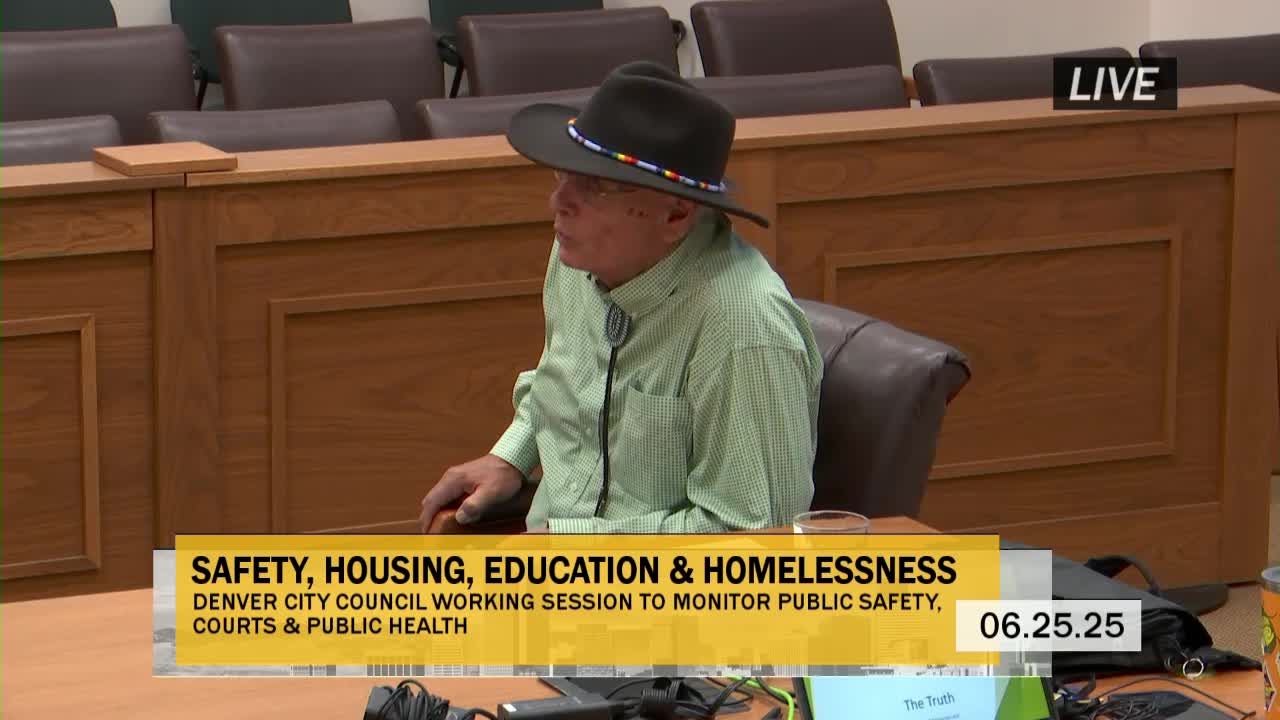
Rick Williams (Lakota name Tall Bull), an enrolled member of the Oglala Lakota Nation, told the Denver City Council Safety, Housing, Education and Homelessness Committee on June 25 that Indigenous people used the South Platte–Cherry Creek confluence for “at least 11,000 years” and that 19th‑century treaties, Congressional actions and illegal settlement removed Indigenous occupancy from the Front Range.
Williams summarized historical treaties and federal actions he said were improperly ratified or altered, described the events that led to the Sand Creek massacre, and urged the city and state to take tangible steps to acknowledge and begin repairing historical harms. He told the committee the historical record shows “fraudulently altered” documents and cited congressional grants and legislative actions in the 1860s as central to how Denver’s land title was cleared.
The briefing’s nut graf: Williams urged that Denver make programmatic and financial commitments now — including a cultural center and an “embassy” for tribes whose ancestral lands include present‑day Colorado — so that the city can offer concrete reparative measures rather than only symbolic recognition.
Williams walked committee members through maps showing shifting boundaries from 1851 and 1861 treaties and said that some lands near the South Platte were never lawfully extinguished by treaty. He described how federal surveyors, territorial officials and town companies treated those lands as open for settlement and how an 1864 congressional grant conveyed land to Denver without evidence Williams said showed payment to tribes. He said the state’s early actions and later proclamations contributed to the displacement and killing of Indigenous people on the plains.
On policy and program suggestions, Williams proposed multiple, concurrent actions: a cultural center with distinct wings for urban Indigenous communities, religious/ceremonial space and an “embassy” for tribes whose homelands include Colorado; a dedicated funding mechanism he described as “what if ... every time there was a real estate transaction, 1 and a half percent of that real estate transaction was put into a pool to help rebuild our native communities in the state”; and state and local changes such as updated historic markers and expanded access to state parks for American Indian ceremonial use.
Council members responded with questions about maps, boundaries and concrete next steps. Councilman Kevin Flynn (Southwest Denver, District 2) asked about how the maps evolve from natural watershed boundaries to section‑line plats. Councilwoman Stacy Gilmore (District 11) and Councilwoman Amanda Sandoval (Council President, in attendance) and Councilwoman Jimmy Torres (West Denver, District 3) discussed programmatic ideas already underway — for example, changes to the March powwow and potential bond funding for facilities — and pressed for tangible, near‑term actions the city could take. Torres said she has asked the state to update the Camp Weld historic marker to correct language she described as inaccurate.
Williams also identified education and funding inequities. He noted that when Colorado became a state it set aside land to fund public schools but, he said, “not a dime has ever gone to Indian education,” and he urged a state Department of Indian Education or similar mechanism to direct resources to Indigenous students. He also cited specific historical figures and program counts during the presentation — for example, a referenced congressional minimum price of $1.25 per acre in 1861 and a historical school‑fund acreage he put at about 3,800,000 acres that now generates roughly $150 million annually in revenue — and he said those resources should be part of any reparative conversation.
Committee Chair Serena Gonzalez Gutierrez opened and closed the session and noted there were six consent items on the committee agenda that “will move forward, seeing that nobody has called those off to the full council.” The committee adjourned after the briefing and questions.
The presentation spurred discussion rather than immediate policy votes; committee members asked Williams for follow‑up and acknowledged that the city has a role to play in creating sites and funding mechanisms to support Indigenous communities and culture. Williams and council members described interest in multiple concurrent efforts — cultural center, embassy, marker corrections and funding pools — with the understanding that some actions would require state or federal cooperation or appropriations.
“We began a path for the next 50 years so that when we celebrate 50 years from now, we have something to show,” Williams said, summarizing his view that both symbolic and material steps are needed to support the Indigenous communities tied to Denver’s lands.
Williams summarized historical treaties and federal actions he said were improperly ratified or altered, described the events that led to the Sand Creek massacre, and urged the city and state to take tangible steps to acknowledge and begin repairing historical harms. He told the committee the historical record shows “fraudulently altered” documents and cited congressional grants and legislative actions in the 1860s as central to how Denver’s land title was cleared.
The briefing’s nut graf: Williams urged that Denver make programmatic and financial commitments now — including a cultural center and an “embassy” for tribes whose ancestral lands include present‑day Colorado — so that the city can offer concrete reparative measures rather than only symbolic recognition.
Williams walked committee members through maps showing shifting boundaries from 1851 and 1861 treaties and said that some lands near the South Platte were never lawfully extinguished by treaty. He described how federal surveyors, territorial officials and town companies treated those lands as open for settlement and how an 1864 congressional grant conveyed land to Denver without evidence Williams said showed payment to tribes. He said the state’s early actions and later proclamations contributed to the displacement and killing of Indigenous people on the plains.
On policy and program suggestions, Williams proposed multiple, concurrent actions: a cultural center with distinct wings for urban Indigenous communities, religious/ceremonial space and an “embassy” for tribes whose homelands include Colorado; a dedicated funding mechanism he described as “what if ... every time there was a real estate transaction, 1 and a half percent of that real estate transaction was put into a pool to help rebuild our native communities in the state”; and state and local changes such as updated historic markers and expanded access to state parks for American Indian ceremonial use.
Council members responded with questions about maps, boundaries and concrete next steps. Councilman Kevin Flynn (Southwest Denver, District 2) asked about how the maps evolve from natural watershed boundaries to section‑line plats. Councilwoman Stacy Gilmore (District 11) and Councilwoman Amanda Sandoval (Council President, in attendance) and Councilwoman Jimmy Torres (West Denver, District 3) discussed programmatic ideas already underway — for example, changes to the March powwow and potential bond funding for facilities — and pressed for tangible, near‑term actions the city could take. Torres said she has asked the state to update the Camp Weld historic marker to correct language she described as inaccurate.
Williams also identified education and funding inequities. He noted that when Colorado became a state it set aside land to fund public schools but, he said, “not a dime has ever gone to Indian education,” and he urged a state Department of Indian Education or similar mechanism to direct resources to Indigenous students. He also cited specific historical figures and program counts during the presentation — for example, a referenced congressional minimum price of $1.25 per acre in 1861 and a historical school‑fund acreage he put at about 3,800,000 acres that now generates roughly $150 million annually in revenue — and he said those resources should be part of any reparative conversation.
Committee Chair Serena Gonzalez Gutierrez opened and closed the session and noted there were six consent items on the committee agenda that “will move forward, seeing that nobody has called those off to the full council.” The committee adjourned after the briefing and questions.
The presentation spurred discussion rather than immediate policy votes; committee members asked Williams for follow‑up and acknowledged that the city has a role to play in creating sites and funding mechanisms to support Indigenous communities and culture. Williams and council members described interest in multiple concurrent efforts — cultural center, embassy, marker corrections and funding pools — with the understanding that some actions would require state or federal cooperation or appropriations.
“We began a path for the next 50 years so that when we celebrate 50 years from now, we have something to show,” Williams said, summarizing his view that both symbolic and material steps are needed to support the Indigenous communities tied to Denver’s lands.
View the Full Meeting & All Its Details
This article offers just a summary. Unlock complete video, transcripts, and insights as a Founder Member.
✓
Watch full, unedited meeting videos
✓
Search every word spoken in unlimited transcripts
✓
AI summaries & real-time alerts (all government levels)
✓
Permanent access to expanding government content
30-day money-back guarantee
