Trustees get detailed school finance briefing; officials outline tax options, efficiency audit and potential TRE
July 18, 2025 | NORTHSIDE ISD, School Districts, Texas
This article was created by AI summarizing key points discussed. AI makes mistakes, so for full details and context, please refer to the video of the full meeting. Please report any errors so we can fix them. Report an error »
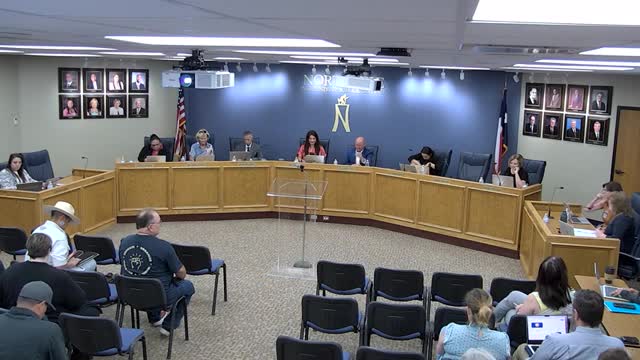
Deputy Superintendent Megan Bradley and other administrators briefed the Northside Board of Trustees on the district’s revenue structure, state and local funding mechanics, and options trustees may consider to address budget shortfalls.
Bradley told trustees that the district’s operating revenue derives roughly 50% from local property taxes and 50% from state funding. She said the district adopts three budgets annually — the general (maintenance and operations), the child nutrition fund and the debt service fund — and that the Texas Education Agency’s Financial Integrity Rating System of Texas (FIRST) is a recurring compliance report the board receives. Bradley and other presenters emphasized that state aid is tied to student attendance while district staffing is based on enrollment, creating a structural mismatch.
Administrators explained the tiered tax structure used by TEA and how the board might increase local revenue. Bradley and Superintendent allies described three ‘‘golden pennies’’ trustees could seek by voter-approved TRE; Bradley said each golden penny currently yields roughly $15,000,000 for Northside, so three additional golden pennies would yield approximately $45,000,000. Copper pennies were described as roughly half the yield of a golden penny (about $49.72 per WADA in the current calculation). Bradley said the board received a notice the district falls into an “access local revenue” category this year and would continue annual recapture/access calculations.
Trustees discussed the legal and procedural steps needed to place a TRE on the ballot. Bradley summarized the process that must precede a TRE: an efficiency audit (a statutory requirement under recent legislation), board action to adopt a tax rate above the current compressed rate, and then voter approval. Trustees discussed timing: administrators suggested a campaign and voter education effort to prepare for fall 2026 if the board pursues additional golden pennies.
Officials also flagged federal funding uncertainty tied to Title programs and said the district is managing temporary holds by moving some costs to flexible local grant funds while awaiting congressional action. Bradley and other speakers said the district will be conservative in budgeting while continuing to monitor federal and state guidance.
Trustees and staff also discussed facilities and enrollment: administrators said the district is reviewing small campuses, pointed out five campuses could fall below 300 students, and indicated consolidations could yield operational savings but require community planning. Superintendent and staff said rebuilding the aging Holmes High School may be more cost-effective than renovating the existing facility; the board will discuss options in upcoming building-committee meetings.
Bradley and trustees emphasized fund balance and cash flow: the district’s recommended reserve is three months of operating expenditures, fund balance should not be used for recurring costs, and the district will continue to report fund-balance and FIRST metrics to the board.
Bradley told trustees that the district’s operating revenue derives roughly 50% from local property taxes and 50% from state funding. She said the district adopts three budgets annually — the general (maintenance and operations), the child nutrition fund and the debt service fund — and that the Texas Education Agency’s Financial Integrity Rating System of Texas (FIRST) is a recurring compliance report the board receives. Bradley and other presenters emphasized that state aid is tied to student attendance while district staffing is based on enrollment, creating a structural mismatch.
Administrators explained the tiered tax structure used by TEA and how the board might increase local revenue. Bradley and Superintendent allies described three ‘‘golden pennies’’ trustees could seek by voter-approved TRE; Bradley said each golden penny currently yields roughly $15,000,000 for Northside, so three additional golden pennies would yield approximately $45,000,000. Copper pennies were described as roughly half the yield of a golden penny (about $49.72 per WADA in the current calculation). Bradley said the board received a notice the district falls into an “access local revenue” category this year and would continue annual recapture/access calculations.
Trustees discussed the legal and procedural steps needed to place a TRE on the ballot. Bradley summarized the process that must precede a TRE: an efficiency audit (a statutory requirement under recent legislation), board action to adopt a tax rate above the current compressed rate, and then voter approval. Trustees discussed timing: administrators suggested a campaign and voter education effort to prepare for fall 2026 if the board pursues additional golden pennies.
Officials also flagged federal funding uncertainty tied to Title programs and said the district is managing temporary holds by moving some costs to flexible local grant funds while awaiting congressional action. Bradley and other speakers said the district will be conservative in budgeting while continuing to monitor federal and state guidance.
Trustees and staff also discussed facilities and enrollment: administrators said the district is reviewing small campuses, pointed out five campuses could fall below 300 students, and indicated consolidations could yield operational savings but require community planning. Superintendent and staff said rebuilding the aging Holmes High School may be more cost-effective than renovating the existing facility; the board will discuss options in upcoming building-committee meetings.
Bradley and trustees emphasized fund balance and cash flow: the district’s recommended reserve is three months of operating expenditures, fund balance should not be used for recurring costs, and the district will continue to report fund-balance and FIRST metrics to the board.
View the Full Meeting & All Its Details
This article offers just a summary. Unlock complete video, transcripts, and insights as a Founder Member.
✓
Watch full, unedited meeting videos
✓
Search every word spoken in unlimited transcripts
✓
AI summaries & real-time alerts (all government levels)
✓
Permanent access to expanding government content
30-day money-back guarantee
