Healy announces statewide anti-hunger task force in Medford as SNAP cuts loom
July 18, 2025 | Office of the Governor, Executive , Massachusetts
This article was created by AI summarizing key points discussed. AI makes mistakes, so for full details and context, please refer to the video of the full meeting. Please report any errors so we can fix them. Report an error »
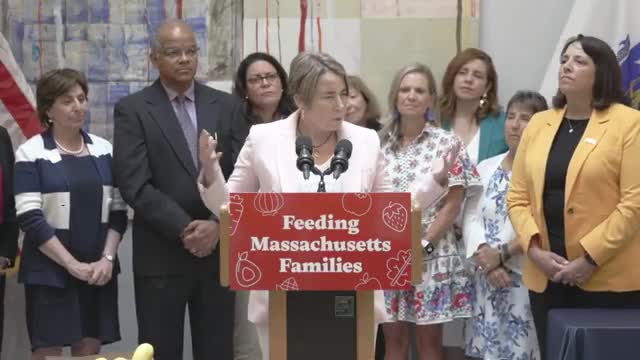
Governor Maury Healy announced a statewide anti-hunger task force at the Mystic Community Market in Medford, saying the group will produce a plan within six months to fill gaps before federal cuts to food supports take effect.
Healy, speaking at the Walnut Street Center, said the task force will coordinate state agencies, local governments, nonprofits and philanthropic partners to “feed people” and prioritize listening sessions and working groups focused on populations at highest risk. “That’s what this is, a hunger fighting strike force, so to speak,” Healy said.
The announcement drew leaders from food banks, the YMCA network, Project Bread and other hunger-relief organizations. Catherine D’Amato, president and CEO of the Greater Boston Food Bank, said the scale of need is rising and called the situation “a wake up call.” Erin McLaren, president and CEO of Project Bread, called hunger a systemic problem and said the new task force is a “bold next step.” Steve Libowitz, a member of the Make Hunger History Advisory Council who described himself as a senior SNAP participant, urged public engagement and pointed attendees to makehungerhistoryma.org.
Healy and presenters framed the task force as a response to federal budget changes they said will reduce food support nationally. The governor repeated figures used at the event, saying Congress had cut about $200,000,000,000 in food support and that roughly 1,000,000 people in Massachusetts who use SNAP could be affected. He said SNAP contributes about $3,000,000,000 annually to the Massachusetts economy and warned that reduced benefits would increase pressure on food pantries, retailers and local farms.
Speakers described existing programs and recent state efforts they said the task force will build on: school meals (noted as about 900,000 children receiving free breakfast and lunch), Summer Eats (estimated to deliver more than 2,000,000 meals in July), and a network of roughly 900 food programs statewide. The Mystic Community Market and the Mystic Community YMCA were described as local examples: Debbie Amaral, who runs the market and represents the YMCAs of Massachusetts, said the market distributes roughly 2,600,000 pounds of food annually to about 12,300 individuals a month and more than 15,000 bags monthly.
Organizers said the task force will host listening sessions, form work groups focused on specific populations, and provide Healy a short-term plan in the first six months followed by a longer-term blueprint for sustainable food-system changes. No formal vote or legislative action was recorded at the event; the announcement described an administrative initiative by the governor’s office.
Next steps described at the event include statewide listening sessions and the creation of targeted working groups. Speakers repeatedly encouraged public support for local food pantries and philanthropy, and urged residents to donate or volunteer as demand grows.
The event included multiple partners and elected officials present but did not record formal commitments of new state funding or specific statutory changes; organizers said the task force will identify gaps and propose actions for the administration and its partners to pursue.
Healy, speaking at the Walnut Street Center, said the task force will coordinate state agencies, local governments, nonprofits and philanthropic partners to “feed people” and prioritize listening sessions and working groups focused on populations at highest risk. “That’s what this is, a hunger fighting strike force, so to speak,” Healy said.
The announcement drew leaders from food banks, the YMCA network, Project Bread and other hunger-relief organizations. Catherine D’Amato, president and CEO of the Greater Boston Food Bank, said the scale of need is rising and called the situation “a wake up call.” Erin McLaren, president and CEO of Project Bread, called hunger a systemic problem and said the new task force is a “bold next step.” Steve Libowitz, a member of the Make Hunger History Advisory Council who described himself as a senior SNAP participant, urged public engagement and pointed attendees to makehungerhistoryma.org.
Healy and presenters framed the task force as a response to federal budget changes they said will reduce food support nationally. The governor repeated figures used at the event, saying Congress had cut about $200,000,000,000 in food support and that roughly 1,000,000 people in Massachusetts who use SNAP could be affected. He said SNAP contributes about $3,000,000,000 annually to the Massachusetts economy and warned that reduced benefits would increase pressure on food pantries, retailers and local farms.
Speakers described existing programs and recent state efforts they said the task force will build on: school meals (noted as about 900,000 children receiving free breakfast and lunch), Summer Eats (estimated to deliver more than 2,000,000 meals in July), and a network of roughly 900 food programs statewide. The Mystic Community Market and the Mystic Community YMCA were described as local examples: Debbie Amaral, who runs the market and represents the YMCAs of Massachusetts, said the market distributes roughly 2,600,000 pounds of food annually to about 12,300 individuals a month and more than 15,000 bags monthly.
Organizers said the task force will host listening sessions, form work groups focused on specific populations, and provide Healy a short-term plan in the first six months followed by a longer-term blueprint for sustainable food-system changes. No formal vote or legislative action was recorded at the event; the announcement described an administrative initiative by the governor’s office.
Next steps described at the event include statewide listening sessions and the creation of targeted working groups. Speakers repeatedly encouraged public support for local food pantries and philanthropy, and urged residents to donate or volunteer as demand grows.
The event included multiple partners and elected officials present but did not record formal commitments of new state funding or specific statutory changes; organizers said the task force will identify gaps and propose actions for the administration and its partners to pursue.
Don't Miss a Word: See the Full Meeting!
Go beyond summaries. Unlock every video, transcript, and key insight with a Founder Membership.
✓
Get instant access to full meeting videos
✓
Search and clip any phrase from complete transcripts
✓
Receive AI-powered summaries & custom alerts
✓
Enjoy lifetime, unrestricted access to government data
30-day money-back guarantee
