School board asks administration for school-by-school suspension data amid concerns over racial disproportionality
July 18, 2025 | NORFOLK CITY PBLC SCHS, School Districts, Virginia
This article was created by AI summarizing key points discussed. AI makes mistakes, so for full details and context, please refer to the video of the full meeting. Please report any errors so we can fix them. Report an error »
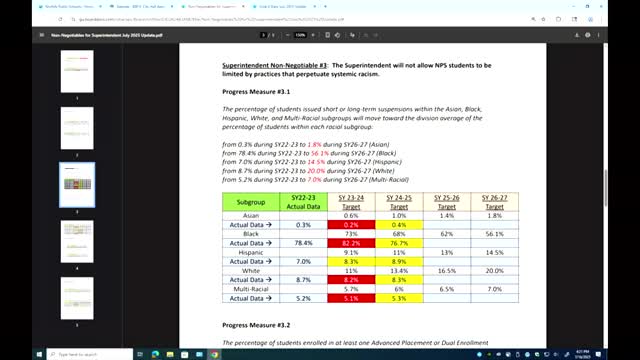
The Norfolk School Board on Tuesday directed administration to prepare school-level reports on short- and long-term suspensions by student subgroup after several board members raised concerns about racial disproportionality in disciplinary actions.
Board members asked whether the division can provide a breakdown of suspensions by school and by demographic subgroup so the board can assess whether disciplinary practices align with school demographics and whether resources are equitably allocated. Interim Superintendent Dr. James Pohl said the data can be pulled from the division's student information system, Synergy, and offered a near-term timeline: "I could have it at some point next week," he told the board.
Why it matters: public commenters and board members highlighted that African American and other students of color have been overrepresented in suspensions in past reports, and they said school-level trends are needed to determine whether practices, resources, or supports vary by school.
Discussion highlights: board members noted the measurement challenge of comparing suspension counts and percentages across schools with different demographic makeups. Several members recommended comparing each school's suspension demographics with that school's enrollment to spot disproportionality rather than relying solely on raw counts.
The superintendent described the division's existing supports that could be relevant to the analysis, including Positive Behavioral Interventions and Supports (PBIS) and a divisionwide Multi-Tiered System of Supports (MTSS), which the administration implemented fully last year. Pohl said the division has seen a decline in total suspensions recently and that MTSS and PBIS may be contributing factors.
Next steps and direction: the board asked administration to provide a divisionwide and school-level discipline report in the first quarter that includes short- and long-term suspensions and demographic enrollment comparisons. The superintendent and staff said the report will also identify supports in place at high-discipline schools and any resource needs; the administration proposed convening a work session rather than simply distributing data.
Public comments at the meeting echoed board concerns, with speakers urging transparency, the use of equity committees, and targeted supports (counseling, deans, or mental-health services) rather than punitive measures.
No formal policy vote was taken; the board authorized the superintendent and staff to produce the requested data and return with an evidence-based plan and work session.
Board members asked whether the division can provide a breakdown of suspensions by school and by demographic subgroup so the board can assess whether disciplinary practices align with school demographics and whether resources are equitably allocated. Interim Superintendent Dr. James Pohl said the data can be pulled from the division's student information system, Synergy, and offered a near-term timeline: "I could have it at some point next week," he told the board.
Why it matters: public commenters and board members highlighted that African American and other students of color have been overrepresented in suspensions in past reports, and they said school-level trends are needed to determine whether practices, resources, or supports vary by school.
Discussion highlights: board members noted the measurement challenge of comparing suspension counts and percentages across schools with different demographic makeups. Several members recommended comparing each school's suspension demographics with that school's enrollment to spot disproportionality rather than relying solely on raw counts.
The superintendent described the division's existing supports that could be relevant to the analysis, including Positive Behavioral Interventions and Supports (PBIS) and a divisionwide Multi-Tiered System of Supports (MTSS), which the administration implemented fully last year. Pohl said the division has seen a decline in total suspensions recently and that MTSS and PBIS may be contributing factors.
Next steps and direction: the board asked administration to provide a divisionwide and school-level discipline report in the first quarter that includes short- and long-term suspensions and demographic enrollment comparisons. The superintendent and staff said the report will also identify supports in place at high-discipline schools and any resource needs; the administration proposed convening a work session rather than simply distributing data.
Public comments at the meeting echoed board concerns, with speakers urging transparency, the use of equity committees, and targeted supports (counseling, deans, or mental-health services) rather than punitive measures.
No formal policy vote was taken; the board authorized the superintendent and staff to produce the requested data and return with an evidence-based plan and work session.
Don't Miss a Word: See the Full Meeting!
Go beyond summaries. Unlock every video, transcript, and key insight with a Founder Membership.
✓
Get instant access to full meeting videos
✓
Search and clip any phrase from complete transcripts
✓
Receive AI-powered summaries & custom alerts
✓
Enjoy lifetime, unrestricted access to government data
30-day money-back guarantee
