AI pioneers say foundation models can speed better forecasts but need public data safeguards
July 18, 2025 | Science, Space, and Technology: House Committee, Standing Committees - House & Senate, Congressional Hearings Compilation, Legislative, Federal
This article was created by AI summarizing key points discussed. AI makes mistakes, so for full details and context, please refer to the video of the full meeting. Please report any errors so we can fix them. Report an error »
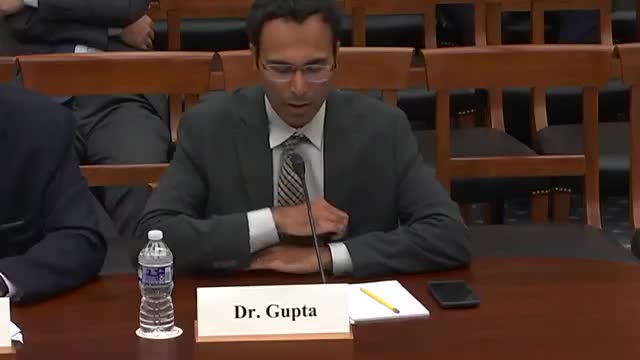
Dr. Jayesh Gupta, founder and CEO of Solurin AI, told the House Science subcommittee that large-scale AI foundation models are delivering faster forecasts and can embed infrastructure impacts directly into decision tools.
Gupta said decades of publicly available weather data from NASA and NOAA are "priceless" and "the bedrock of the AI revolution in weather." He warned that reductions in public data streams "is a direct threat to American innovation and our leadership in this field."
Why it matters: Gupta and other witnesses argued that AI systems can cut computational cost and provide rapid improvements in accuracy if they are trained on high-quality, long-term archives of environmental data. He proposed three pillars for federal action: faster on-ramps for small companies, a national model test bed to evaluate new models, and protections and modernization for the national data infrastructure.
Committee exchange: Members questioned whether AI-only approaches should supplant physics-based modeling. Dr. Gupta and others said AI is rapidly improving operational performance but that physics-based research remains important for understanding and interpretability. Several members urged a hybrid approach and noted federal supercomputing investments may need reevaluation to support both AI and physics-based methods.
Ending: Witnesses asked Congress to ensure open, long-term access to federal environmental archives and to create standardized evaluation frameworks so the government can validate emerging AI forecast models before operational adoption.
Gupta said decades of publicly available weather data from NASA and NOAA are "priceless" and "the bedrock of the AI revolution in weather." He warned that reductions in public data streams "is a direct threat to American innovation and our leadership in this field."
Why it matters: Gupta and other witnesses argued that AI systems can cut computational cost and provide rapid improvements in accuracy if they are trained on high-quality, long-term archives of environmental data. He proposed three pillars for federal action: faster on-ramps for small companies, a national model test bed to evaluate new models, and protections and modernization for the national data infrastructure.
Committee exchange: Members questioned whether AI-only approaches should supplant physics-based modeling. Dr. Gupta and others said AI is rapidly improving operational performance but that physics-based research remains important for understanding and interpretability. Several members urged a hybrid approach and noted federal supercomputing investments may need reevaluation to support both AI and physics-based methods.
Ending: Witnesses asked Congress to ensure open, long-term access to federal environmental archives and to create standardized evaluation frameworks so the government can validate emerging AI forecast models before operational adoption.
Don't Miss a Word: See the Full Meeting!
Go beyond summaries. Unlock every video, transcript, and key insight with a Founder Membership.
✓
Get instant access to full meeting videos
✓
Search and clip any phrase from complete transcripts
✓
Receive AI-powered summaries & custom alerts
✓
Enjoy lifetime, unrestricted access to government data
30-day money-back guarantee
