Phoenix training explains water cycle, drought vs. shortage, and city’s Stage 1 alert and education efforts
July 18, 2025 | Events, Phoenix, Maricopa County, Arizona
This article was created by AI summarizing key points discussed. AI makes mistakes, so for full details and context, please refer to the video of the full meeting. Please report any errors so we can fix them. Report an error »
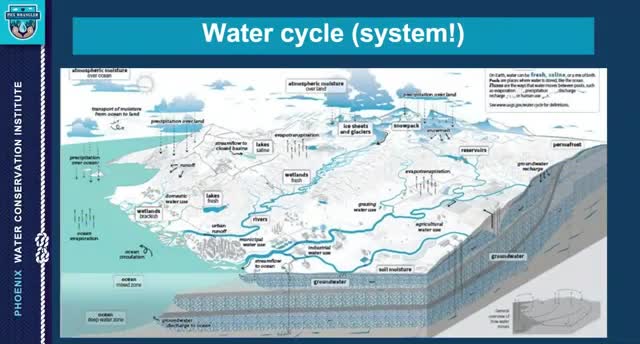
Lara Van Lyth, volunteer coordinator and water resource specialist for the City of Phoenix Water Services Department, used Lesson 1 to review the water cycle and explain drought, shortage and the city’s response.
Van Lyth described the water cycle as a complex system that includes evaporation, condensation, precipitation, runoff and infiltration; she used examples such as snowpack melt, rivers, reservoirs and groundwater recharge to explain how water moves through landscapes and cities.
She defined drought and shortage clearly: "A drought is defined as an extended period of below average precipitation. Drought is purely abiotic, meaning it's driven by non living conditions, like weather, time, or the natural cycles of our environment," Van Lyth said. "Shortages, however, are both biotic and abiotic. A shortage occurs when the demand for water is greater than the current supply, And our current shortage is caused by humans and environmental factors."
Van Lyth told trainees that the region is experiencing one of the driest periods in more than 1,200 years and that lower Colorado River flows and inter-state allocation negotiations are reducing Phoenix’s expected Colorado River deliveries. She said the city has declared a Stage 1 water alert and created a drought management plan; the Stage 1 declaration prompted an intensive public-education program to promote voluntary conservation.
The training framed the "desert mindset" as a constructive public message: using water efficiently while planning ahead and avoiding panic. Van Lyth said the desert mindset is not about scarcity or blame but about adopting practices that respect water as a limited resource.
Trainees were advised to communicate the distinction between natural drought cycles and human-driven shortages, to use departmental resources for technical follow-up, and to encourage voluntary conservation under the city’s drought-management guidance.
Van Lyth described the water cycle as a complex system that includes evaporation, condensation, precipitation, runoff and infiltration; she used examples such as snowpack melt, rivers, reservoirs and groundwater recharge to explain how water moves through landscapes and cities.
She defined drought and shortage clearly: "A drought is defined as an extended period of below average precipitation. Drought is purely abiotic, meaning it's driven by non living conditions, like weather, time, or the natural cycles of our environment," Van Lyth said. "Shortages, however, are both biotic and abiotic. A shortage occurs when the demand for water is greater than the current supply, And our current shortage is caused by humans and environmental factors."
Van Lyth told trainees that the region is experiencing one of the driest periods in more than 1,200 years and that lower Colorado River flows and inter-state allocation negotiations are reducing Phoenix’s expected Colorado River deliveries. She said the city has declared a Stage 1 water alert and created a drought management plan; the Stage 1 declaration prompted an intensive public-education program to promote voluntary conservation.
The training framed the "desert mindset" as a constructive public message: using water efficiently while planning ahead and avoiding panic. Van Lyth said the desert mindset is not about scarcity or blame but about adopting practices that respect water as a limited resource.
Trainees were advised to communicate the distinction between natural drought cycles and human-driven shortages, to use departmental resources for technical follow-up, and to encourage voluntary conservation under the city’s drought-management guidance.
Don't Miss a Word: See the Full Meeting!
Go beyond summaries. Unlock every video, transcript, and key insight with a Founder Membership.
✓
Get instant access to full meeting videos
✓
Search and clip any phrase from complete transcripts
✓
Receive AI-powered summaries & custom alerts
✓
Enjoy lifetime, unrestricted access to government data
30-day money-back guarantee
