Dunn County staff present DNR-vetted septage fact sheet as groundwater concerns resurface
July 18, 2025 | Dunn County, Wisconsin
This article was created by AI summarizing key points discussed. AI makes mistakes, so for full details and context, please refer to the video of the full meeting. Please report any errors so we can fix them. Report an error »
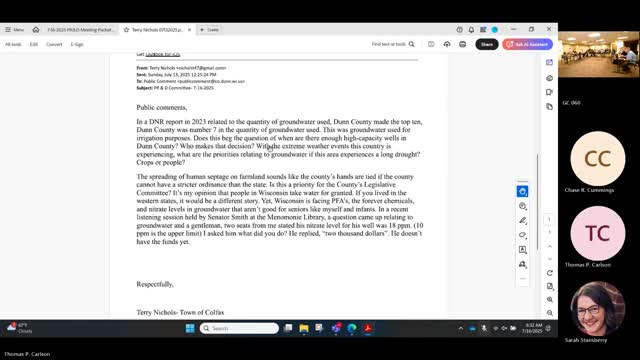
Public comment and staff discussion at the July 16 Dunn County Planning, Resource and Development Committee meeting focused on land application of human septage, the regulatory limits local governments face and the county’s groundwater monitoring work.
Committee chair and staff opened the item after a public commenter raised groundwater contamination concerns and cited a state report showing high county groundwater use. The county then presented a two‑page fact sheet about septage land application that staff said they had reviewed with the Wisconsin Department of Natural Resources (DNR) and the county’s Healthy Environment Action Team.
Why it matters: County staff said the fact sheet seeks to clarify how sites are approved and what local authorities can — and cannot — require. The topic has been raised repeatedly in public comment and connects to ongoing county efforts including nutrient management planning, private well monitoring and producer‑led watershed projects.
What staff told the committee: Heather Woods, Land and Water office staff, said the county has about 130 DNR‑approved land application sites and that in 2024 only 19 sites were actually used. Woods said some summary numbers in the fact sheet came directly from the DNR staff who approve sites and that a larger dataset of roughly 5,700 septic or holding sites in the county is maintained by state records. She described how NR 113, NR 114 and Chapter 281 of state administrative code govern site approvals and that NR 151 (the agricultural prohibitions and standards) does not treat human septage differently than other nutrient sources under the county’s nutrient management standard 590.
Chase, a county conservation staff member, told the committee the county is tracking nutrient management plan submissions and private well monitoring results alongside septage questions. He said large cost‑share grants continue to be worked through; one notice‑of‑discharge grant discussed in staff reports would cover roughly 70% of project costs (about $880,000 total in the example discussed), leaving the landowner responsible for about 30%.
Public engagement and data: County staff said they invited DNR approval staff to a prior meeting and shared draft materials with local advocates including Neil Cook, a county resident who has raised concerns publicly. The fact sheet was described as a plain‑language summary, not a new local rule; staff said state law prevents counties from imposing restrictions that are more restrictive than state regulations for land application of septage.
Monitoring and nutrient management: Staff emphasized that nutrient management plans and annual checklists are required for farmland and that soil testing is expected every four years; county records show about 65,000–68,000 acres worth of nutrient management documentation are submitted to the office each year. Staff cautioned that national soil datasets used for map displays have limited scale and that percolation rates on a map are not a substitute for site‑specific field testing used by the DNR when approving a land application site.
Next steps and committee direction: Staff indicated the fact sheet has been vetted with the DNR and the county’s Healthy Environment Action Team and is intended to be publicly posted. Committee members and staff noted that if the community wants restrictions beyond state rules, change would require legislative action at the state level. Committee members invited public comment and said staff should continue coordinating with the DNR and keep the committee informed about monitoring results and any legislative developments.
Ending: The committee did not adopt new local rules during the meeting; staff called the fact sheet a written summary to help the public understand current rules and the county’s oversight role and said they would continue to collect data and report back if more action were requested.
Committee chair and staff opened the item after a public commenter raised groundwater contamination concerns and cited a state report showing high county groundwater use. The county then presented a two‑page fact sheet about septage land application that staff said they had reviewed with the Wisconsin Department of Natural Resources (DNR) and the county’s Healthy Environment Action Team.
Why it matters: County staff said the fact sheet seeks to clarify how sites are approved and what local authorities can — and cannot — require. The topic has been raised repeatedly in public comment and connects to ongoing county efforts including nutrient management planning, private well monitoring and producer‑led watershed projects.
What staff told the committee: Heather Woods, Land and Water office staff, said the county has about 130 DNR‑approved land application sites and that in 2024 only 19 sites were actually used. Woods said some summary numbers in the fact sheet came directly from the DNR staff who approve sites and that a larger dataset of roughly 5,700 septic or holding sites in the county is maintained by state records. She described how NR 113, NR 114 and Chapter 281 of state administrative code govern site approvals and that NR 151 (the agricultural prohibitions and standards) does not treat human septage differently than other nutrient sources under the county’s nutrient management standard 590.
Chase, a county conservation staff member, told the committee the county is tracking nutrient management plan submissions and private well monitoring results alongside septage questions. He said large cost‑share grants continue to be worked through; one notice‑of‑discharge grant discussed in staff reports would cover roughly 70% of project costs (about $880,000 total in the example discussed), leaving the landowner responsible for about 30%.
Public engagement and data: County staff said they invited DNR approval staff to a prior meeting and shared draft materials with local advocates including Neil Cook, a county resident who has raised concerns publicly. The fact sheet was described as a plain‑language summary, not a new local rule; staff said state law prevents counties from imposing restrictions that are more restrictive than state regulations for land application of septage.
Monitoring and nutrient management: Staff emphasized that nutrient management plans and annual checklists are required for farmland and that soil testing is expected every four years; county records show about 65,000–68,000 acres worth of nutrient management documentation are submitted to the office each year. Staff cautioned that national soil datasets used for map displays have limited scale and that percolation rates on a map are not a substitute for site‑specific field testing used by the DNR when approving a land application site.
Next steps and committee direction: Staff indicated the fact sheet has been vetted with the DNR and the county’s Healthy Environment Action Team and is intended to be publicly posted. Committee members and staff noted that if the community wants restrictions beyond state rules, change would require legislative action at the state level. Committee members invited public comment and said staff should continue coordinating with the DNR and keep the committee informed about monitoring results and any legislative developments.
Ending: The committee did not adopt new local rules during the meeting; staff called the fact sheet a written summary to help the public understand current rules and the county’s oversight role and said they would continue to collect data and report back if more action were requested.
Don't Miss a Word: See the Full Meeting!
Go beyond summaries. Unlock every video, transcript, and key insight with a Founder Membership.
✓
Get instant access to full meeting videos
✓
Search and clip any phrase from complete transcripts
✓
Receive AI-powered summaries & custom alerts
✓
Enjoy lifetime, unrestricted access to government data
30-day money-back guarantee
