Dunn County economic development director outlines housing, business and large‑site plans; annexation discussion raises farmland concerns
July 18, 2025 | Dunn County, Wisconsin
This article was created by AI summarizing key points discussed. AI makes mistakes, so for full details and context, please refer to the video of the full meeting. Please report any errors so we can fix them. Report an error »
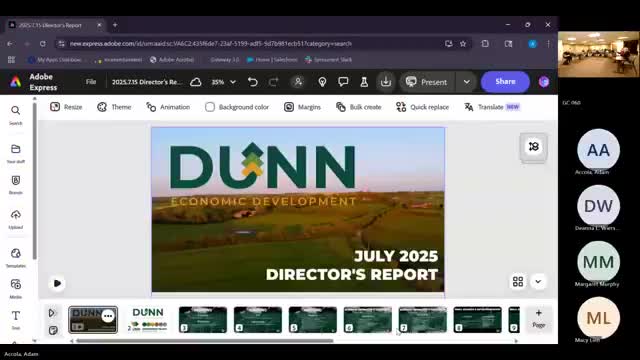
Adam Akelai, director of economic development for Dunn County, presented an annual update to the Community Resources and Tourism Committee describing four focus areas: housing, business retention and expansion (BRE), small business and entrepreneurship, and business attraction.
On housing, Akelai said the consortium is developing a “development‑friendly municipality” certification to help small townships and villages in the county prepare for residential development. He described a recent internal county housing summit attended by about 25 people, a pilot manufactured‑housing tour in Chippewa Falls and work with state resources such as the Wisconsin Economic Development Corporation (WEDC) and the Wisconsin Economic Development Association on housing incentives and program access.
In business retention and expansion, Akelai said the county has launched a BRE program that includes a data collection database and planned on‑site visits; he described cooperative work with Downtown Menomonie, the Chamber and utilities to avoid duplicating outreach. He reported a new $250,000 WEDC small‑business pass‑through grant for Dunn County — funding that will go directly to local businesses — and said the county is awaiting WEDC’s public announcement before distributing the funds.
On business attraction, Akelai said county staff are fielding requests for very large sites from companies seeking 125–450 acres. He described a current proposal under consideration involving multiple property owners who have petitioned to be annexed into the City of Menomonie and said the immediate action before the city and county is annexation and zoning. Akelai cautioned that annexation does not commit the city to any particular end user; incentive or development decisions would follow later in a multi‑step municipal process (rezoning, potential tax increment district formation, development agreement) when the end user is known.
Committee members asked about farmland loss and local control. Supervisor Gwen asked how the county balances the opportunity for industrial expansion with potential losses of agricultural land. Akelai said annexation petitions come from property owners (not the city) and that municipal review — including the plan commission and public process — will evaluate consistency with comprehensive plans. He said county staff will work with the town of Red Cedar and surrounding municipalities to identify complementary development opportunities (for example, residential or other land uses) and to ensure municipal staff have the capacity and information to evaluate large projects.
Other projects Akelai detailed included branding and a consolidated Dunn Economic Development website, a revolving loan fund at the Greater Menomonie Development Corporation for housing and childcare gap financing, coordination with Venture Home Menomonie and Renew Towns for downtown entrepreneurship pilots, and pursuit of a HUBZone designation for federal contracting advantage.
Ending: Akelai said the consortium will continue capacity building for municipalities, maintain BRE outreach and move to publicly launch branding and a fundraising campaign in September. No formal committee action was taken on these reports; the items were presented for information and follow‑up.
On housing, Akelai said the consortium is developing a “development‑friendly municipality” certification to help small townships and villages in the county prepare for residential development. He described a recent internal county housing summit attended by about 25 people, a pilot manufactured‑housing tour in Chippewa Falls and work with state resources such as the Wisconsin Economic Development Corporation (WEDC) and the Wisconsin Economic Development Association on housing incentives and program access.
In business retention and expansion, Akelai said the county has launched a BRE program that includes a data collection database and planned on‑site visits; he described cooperative work with Downtown Menomonie, the Chamber and utilities to avoid duplicating outreach. He reported a new $250,000 WEDC small‑business pass‑through grant for Dunn County — funding that will go directly to local businesses — and said the county is awaiting WEDC’s public announcement before distributing the funds.
On business attraction, Akelai said county staff are fielding requests for very large sites from companies seeking 125–450 acres. He described a current proposal under consideration involving multiple property owners who have petitioned to be annexed into the City of Menomonie and said the immediate action before the city and county is annexation and zoning. Akelai cautioned that annexation does not commit the city to any particular end user; incentive or development decisions would follow later in a multi‑step municipal process (rezoning, potential tax increment district formation, development agreement) when the end user is known.
Committee members asked about farmland loss and local control. Supervisor Gwen asked how the county balances the opportunity for industrial expansion with potential losses of agricultural land. Akelai said annexation petitions come from property owners (not the city) and that municipal review — including the plan commission and public process — will evaluate consistency with comprehensive plans. He said county staff will work with the town of Red Cedar and surrounding municipalities to identify complementary development opportunities (for example, residential or other land uses) and to ensure municipal staff have the capacity and information to evaluate large projects.
Other projects Akelai detailed included branding and a consolidated Dunn Economic Development website, a revolving loan fund at the Greater Menomonie Development Corporation for housing and childcare gap financing, coordination with Venture Home Menomonie and Renew Towns for downtown entrepreneurship pilots, and pursuit of a HUBZone designation for federal contracting advantage.
Ending: Akelai said the consortium will continue capacity building for municipalities, maintain BRE outreach and move to publicly launch branding and a fundraising campaign in September. No formal committee action was taken on these reports; the items were presented for information and follow‑up.
Don't Miss a Word: See the Full Meeting!
Go beyond summaries. Unlock every video, transcript, and key insight with a Founder Membership.
✓
Get instant access to full meeting videos
✓
Search and clip any phrase from complete transcripts
✓
Receive AI-powered summaries & custom alerts
✓
Enjoy lifetime, unrestricted access to government data
30-day money-back guarantee
