Public‑health staff report measles slowdown, WIC benefit cuts and renewed lead‑testing outreach
July 18, 2025 | Dunn County, Wisconsin
This article was created by AI summarizing key points discussed. AI makes mistakes, so for full details and context, please refer to the video of the full meeting. Please report any errors so we can fix them. Report an error »
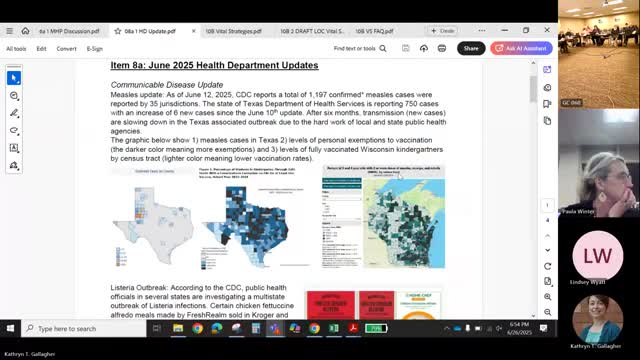
Dunn County public‑health staff on June 26 reported a slowdown in a recent regional measles outbreak, outlined plans for targeted immunization outreach, warned of cuts to federal nutrition benefits that will reduce farmers‑market sales, and discussed lead‑testing and food‑safety inspection work.
KT said county data show kindergarten and early‑childhood MMR coverage at roughly 70–75 percent countywide but with some private‑school pockets as low as about 45 percent; public‑health nurses will begin a quality‑improvement outreach project to work with private schools and inform families of exposure and quarantine protocols.
KT also summarized national food‑safety news: a recent Listeria outbreak led to multiple hospitalizations and deaths and underscored safe‑cooking guidance. On nutrition supports, staff said federal changes are reducing per‑participant allowances for fresh produce in some programs; meeting participants noted reported decreases such as childhood fruit‑and‑vegetable benefits dropping from about $26 to $10, and larger reductions for pregnant, postpartum and breastfeeding participants discussed in the meeting.
Public‑health staff announced a lead‑testing outreach campaign tied to the state’s “2 by 2” DHS initiative and noted that approximately 46 percent of Dunn County housing stock was built before 1978, a factor that raises lead‑exposure risk for young children. The county has started outreach to increase lead testing among young children who missed routine well‑child care during the COVID era.
On restaurant inspections, staff reported progress on food‑safety licensing (DACAP) with 100 percent of required inspections completed and about 70 percent of high‑complexity establishments inspected twice this year under voluntary FDA standards.
No formal board action was taken; these updates were presented as staff reports and flagged for follow up where applicable.
KT said county data show kindergarten and early‑childhood MMR coverage at roughly 70–75 percent countywide but with some private‑school pockets as low as about 45 percent; public‑health nurses will begin a quality‑improvement outreach project to work with private schools and inform families of exposure and quarantine protocols.
KT also summarized national food‑safety news: a recent Listeria outbreak led to multiple hospitalizations and deaths and underscored safe‑cooking guidance. On nutrition supports, staff said federal changes are reducing per‑participant allowances for fresh produce in some programs; meeting participants noted reported decreases such as childhood fruit‑and‑vegetable benefits dropping from about $26 to $10, and larger reductions for pregnant, postpartum and breastfeeding participants discussed in the meeting.
Public‑health staff announced a lead‑testing outreach campaign tied to the state’s “2 by 2” DHS initiative and noted that approximately 46 percent of Dunn County housing stock was built before 1978, a factor that raises lead‑exposure risk for young children. The county has started outreach to increase lead testing among young children who missed routine well‑child care during the COVID era.
On restaurant inspections, staff reported progress on food‑safety licensing (DACAP) with 100 percent of required inspections completed and about 70 percent of high‑complexity establishments inspected twice this year under voluntary FDA standards.
No formal board action was taken; these updates were presented as staff reports and flagged for follow up where applicable.
View the Full Meeting & All Its Details
This article offers just a summary. Unlock complete video, transcripts, and insights as a Founder Member.
✓
Watch full, unedited meeting videos
✓
Search every word spoken in unlimited transcripts
✓
AI summaries & real-time alerts (all government levels)
✓
Permanent access to expanding government content
30-day money-back guarantee
