Effingham County board approves consent agenda including opioid fund disbursement, enterprise zone annexation and bridge contract
July 23, 2025 | Effingham County, Illinois
This article was created by AI summarizing key points discussed. AI makes mistakes, so for full details and context, please refer to the video of the full meeting. Please report any errors so we can fix them. Report an error »
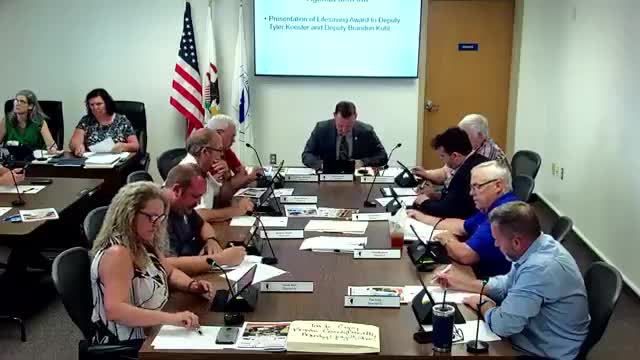
At its July regular meeting the Effingham County Board approved a consent agenda that included disbursement of opioid settlement funds, several ARPA-funded purchases for the historic courthouse pavilion and courtyard, approval of the county fiscal‑year 2024 audit, a joint enterprise‑zone annexation ordinance with the City of Effingham and an award for bridge construction in Union Township.
The board approved the consent agenda on a roll‑call vote after no members asked to pull additional items. Chris Keller moved to approve the consent agenda; Sandy Rich seconded. The clerk recorded affirmative votes from Jeremy Daters, Norbert Saltwheedle, Tim Ellis, Dave Campbell, Chris Keller, Mike Buzzard, Doug McCain and Sandy Rich; the chair declared the motion carried.
Key items approved on the consent agenda included:
- A disbursement of $43,042.28 in opioid‑settlement funds to CEAD Council, doing business as Our House, as listed in the board packet.
- Authorization to use ARPA funds to purchase four benches for the pavilion and two pet‑waste stations for the historic courthouse courtyard; the board also approved a disbursement of up to $1,200 in ARPA funds for landscaping rocks around the historic courthouse.
- Approval of the fiscal‑year 2024 audit and acceptance of related reports.
- A joint ordinance with the City of Effingham for a proposed enterprise‑zone annexation, recorded in the consent materials.
- Road and bridge approvals, including a resolution to award the responsible bidder for construction of a new bridge along 220 Fifth Avenue in Union Township and two minor subdivision approvals (Ambrosia Subdivision and R & J Warman Subdivision).
The board also approved continuing employee‑assistance program eligibility for all full‑time county employees, excluding county board members, as recommended by the health and insurance committee; and it approved several committee actions recorded in the board packet, including appointments and ordinance referrals noted by committee chairs.
Several items were listed in the written consent materials but required separate or follow‑up action outside the meeting record (for example, release of certain closed‑session minutes and requests for contractor quotes). The board did not discuss funding formulas or program details for the opioid disbursement during the public meeting; the motion and roll‑call vote implemented the approvals listed in the agenda packet.
The consent agenda vote was the meeting’s primary business and was approved without substantive floor debate.
The board approved the consent agenda on a roll‑call vote after no members asked to pull additional items. Chris Keller moved to approve the consent agenda; Sandy Rich seconded. The clerk recorded affirmative votes from Jeremy Daters, Norbert Saltwheedle, Tim Ellis, Dave Campbell, Chris Keller, Mike Buzzard, Doug McCain and Sandy Rich; the chair declared the motion carried.
Key items approved on the consent agenda included:
- A disbursement of $43,042.28 in opioid‑settlement funds to CEAD Council, doing business as Our House, as listed in the board packet.
- Authorization to use ARPA funds to purchase four benches for the pavilion and two pet‑waste stations for the historic courthouse courtyard; the board also approved a disbursement of up to $1,200 in ARPA funds for landscaping rocks around the historic courthouse.
- Approval of the fiscal‑year 2024 audit and acceptance of related reports.
- A joint ordinance with the City of Effingham for a proposed enterprise‑zone annexation, recorded in the consent materials.
- Road and bridge approvals, including a resolution to award the responsible bidder for construction of a new bridge along 220 Fifth Avenue in Union Township and two minor subdivision approvals (Ambrosia Subdivision and R & J Warman Subdivision).
The board also approved continuing employee‑assistance program eligibility for all full‑time county employees, excluding county board members, as recommended by the health and insurance committee; and it approved several committee actions recorded in the board packet, including appointments and ordinance referrals noted by committee chairs.
Several items were listed in the written consent materials but required separate or follow‑up action outside the meeting record (for example, release of certain closed‑session minutes and requests for contractor quotes). The board did not discuss funding formulas or program details for the opioid disbursement during the public meeting; the motion and roll‑call vote implemented the approvals listed in the agenda packet.
The consent agenda vote was the meeting’s primary business and was approved without substantive floor debate.
View the Full Meeting & All Its Details
This article offers just a summary. Unlock complete video, transcripts, and insights as a Founder Member.
✓
Watch full, unedited meeting videos
✓
Search every word spoken in unlimited transcripts
✓
AI summaries & real-time alerts (all government levels)
✓
Permanent access to expanding government content
30-day money-back guarantee
