Central Regional Juvenile Center presents 2026 budget; Clay County’s share mostly stable but non‑secure needs push levy higher
July 23, 2025 | Clay County, Minnesota
This article was created by AI summarizing key points discussed. AI makes mistakes, so for full details and context, please refer to the video of the full meeting. Please report any errors so we can fix them. Report an error »
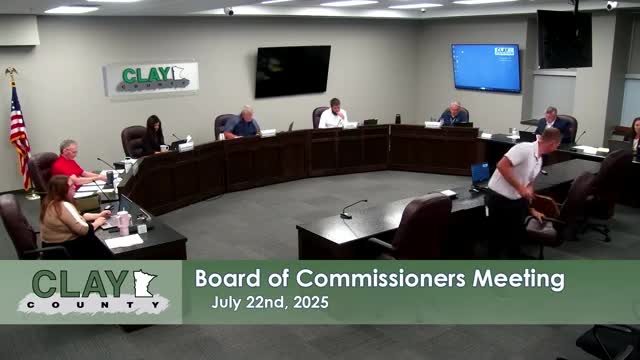
James, director of the Central Regional Juvenile Center, presented the cooperative’s proposed 2026 budgets for both secure and non‑secure programs to the Clay County Board of Commissioners on July 22.
James said Clay County’s share of the secure program will be slightly lower in 2026 than in 2025, driven by the cooperative service agreement’s usage‑based formula and continued revenue from non‑member placements. He said the secure program budget request is “a shade over $800,000” for Clay County’s share and that non‑member income has reduced member counties’ per‑county costs.
James described several expense drivers for the secure budget, including negotiated salary increases, step progressions, and higher employer‑side public retirement rates for corrections staff (PERA employer contribution cited as rising from 6.8% to 10.25%). He said the center reduced a large professional services contract by hiring its own nursing staff, which lowered contract costs but increased salary and benefits lines.
On the non‑secure side, James said placement pressure has increased because of a statewide shortage of out‑of‑home placement options. He said projected usage for Clay County is about $2.2 million and non‑member usage about $1.6 million, with total non‑secure expenditures of roughly $3,000,010. After grant and reimbursement offsets, James said the non‑secure program would require a levy of about $2,000,002.25 — up from roughly $1,850,000 in 2025.
James also described a recent expansion: the center opened a female transitional program and hired four full‑time staff for that unit. He said the transitional components are eight beds for males and a licensing capacity for 12 for females (designed for eight). James said the First Floor north non‑secure area has a theoretical maximum of 17 beds but that operationally 13 residents strains capacity.
James said the cooperative raised non‑member daily rates from $3.75 to $4.50 for 2026, which should increase revenue while remaining competitive with nearby providers. He told the board that his advisory board and the regional member counties had reviewed and endorsed the budget request.
Commissioners asked clarifying questions about Clay County’s share calculations, how non‑member revenue lowers member cost, and circumstances that would require sending a youth out of county (for example, more appropriate higher‑level placements or licensing differences). The board did not take a formal levy vote at the meeting; James and commissioners discussed next steps and the center’s fiscal pressures going into 2026.
James said Clay County’s share of the secure program will be slightly lower in 2026 than in 2025, driven by the cooperative service agreement’s usage‑based formula and continued revenue from non‑member placements. He said the secure program budget request is “a shade over $800,000” for Clay County’s share and that non‑member income has reduced member counties’ per‑county costs.
James described several expense drivers for the secure budget, including negotiated salary increases, step progressions, and higher employer‑side public retirement rates for corrections staff (PERA employer contribution cited as rising from 6.8% to 10.25%). He said the center reduced a large professional services contract by hiring its own nursing staff, which lowered contract costs but increased salary and benefits lines.
On the non‑secure side, James said placement pressure has increased because of a statewide shortage of out‑of‑home placement options. He said projected usage for Clay County is about $2.2 million and non‑member usage about $1.6 million, with total non‑secure expenditures of roughly $3,000,010. After grant and reimbursement offsets, James said the non‑secure program would require a levy of about $2,000,002.25 — up from roughly $1,850,000 in 2025.
James also described a recent expansion: the center opened a female transitional program and hired four full‑time staff for that unit. He said the transitional components are eight beds for males and a licensing capacity for 12 for females (designed for eight). James said the First Floor north non‑secure area has a theoretical maximum of 17 beds but that operationally 13 residents strains capacity.
James said the cooperative raised non‑member daily rates from $3.75 to $4.50 for 2026, which should increase revenue while remaining competitive with nearby providers. He told the board that his advisory board and the regional member counties had reviewed and endorsed the budget request.
Commissioners asked clarifying questions about Clay County’s share calculations, how non‑member revenue lowers member cost, and circumstances that would require sending a youth out of county (for example, more appropriate higher‑level placements or licensing differences). The board did not take a formal levy vote at the meeting; James and commissioners discussed next steps and the center’s fiscal pressures going into 2026.
View the Full Meeting & All Its Details
This article offers just a summary. Unlock complete video, transcripts, and insights as a Founder Member.
✓
Watch full, unedited meeting videos
✓
Search every word spoken in unlimited transcripts
✓
AI summaries & real-time alerts (all government levels)
✓
Permanent access to expanding government content
30-day money-back guarantee
