Knightscope pitches autonomous security robots to federal agencies, cites cost savings and data controls
July 23, 2025 | Oversight and Reform: House Committee, Standing Committees - House & Senate, Congressional Hearings Compilation, Legislative, Federal
This article was created by AI summarizing key points discussed. AI makes mistakes, so for full details and context, please refer to the video of the full meeting. Please report any errors so we can fix them. Report an error »
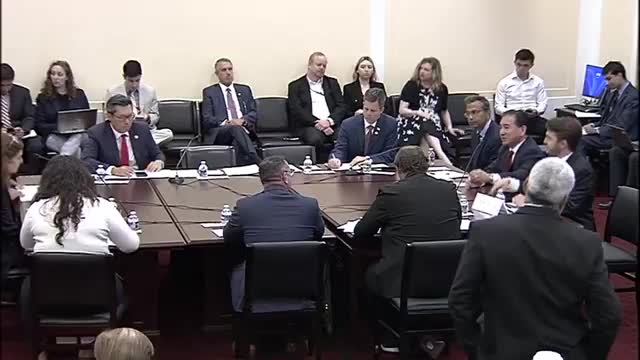
William Santana Lee, chairman and CEO of Knightscope, demonstrated an autonomous security robot at a House Oversight roundtable and urged federal adoption, citing commercial deployments and a FedRAMP Authority to Operate for government use.
Lee described the company’s patrol robots as hardware+software systems that generate large volumes of sensor data and can deter, detect and report incidents. "The public safety infrastructure in The United States Of America is crumbling," Lee said, calling physical AI part of a solution that could give officers "unprecedented capabilities." He said Knightscope machines generate "over 90 terabytes of data a year," retain 30 days of onboard data before overwriting, and upload short clips to the cloud only when a client requests an incident review.
Lee told the committee Knightscope uses AWS GovCloud for government deployments, has a FedRAMP moderate Authority to Operate and said a new partnership with Palantir would enable FedRAMP High and DOD Impact Level 5 handling. He also said the company charges roughly the equivalent of "$11 per hour" in operating cost to clients and estimates about $60,000 to build one unit.
Lawmakers pressed Knightscope on privacy and aggregation. Members asked whether the system records mobile‑device identifiers, license plates and faces; Lee said older devices can expose MAC addresses that can be treated like a "license plate," and machines can read "several hundred license plates a minute." He said client data is owned by clients and that data is stored on the machine, then sent to the cloud only on request; he said Knightscope could use aggregated data with client permission but said data is overwritten every 30 days.
Lee proposed a nonbinding procurement idea: allocate 1% of maintenance, operations and support budgets across agencies for autonomous systems to catalyze deployment. The proposal drew questions but no formal committee action.
Less critical details: Lee promoted future products (a larger K‑7 model for border and critical‑infrastructure use), claimed commercial success stories (reduced thefts in client sites) and suggested wide potential savings if the government automated routine monitoring tasks.
Lee described the company’s patrol robots as hardware+software systems that generate large volumes of sensor data and can deter, detect and report incidents. "The public safety infrastructure in The United States Of America is crumbling," Lee said, calling physical AI part of a solution that could give officers "unprecedented capabilities." He said Knightscope machines generate "over 90 terabytes of data a year," retain 30 days of onboard data before overwriting, and upload short clips to the cloud only when a client requests an incident review.
Lee told the committee Knightscope uses AWS GovCloud for government deployments, has a FedRAMP moderate Authority to Operate and said a new partnership with Palantir would enable FedRAMP High and DOD Impact Level 5 handling. He also said the company charges roughly the equivalent of "$11 per hour" in operating cost to clients and estimates about $60,000 to build one unit.
Lawmakers pressed Knightscope on privacy and aggregation. Members asked whether the system records mobile‑device identifiers, license plates and faces; Lee said older devices can expose MAC addresses that can be treated like a "license plate," and machines can read "several hundred license plates a minute." He said client data is owned by clients and that data is stored on the machine, then sent to the cloud only on request; he said Knightscope could use aggregated data with client permission but said data is overwritten every 30 days.
Lee proposed a nonbinding procurement idea: allocate 1% of maintenance, operations and support budgets across agencies for autonomous systems to catalyze deployment. The proposal drew questions but no formal committee action.
Less critical details: Lee promoted future products (a larger K‑7 model for border and critical‑infrastructure use), claimed commercial success stories (reduced thefts in client sites) and suggested wide potential savings if the government automated routine monitoring tasks.
Don't Miss a Word: See the Full Meeting!
Go beyond summaries. Unlock every video, transcript, and key insight with a Founder Membership.
✓
Get instant access to full meeting videos
✓
Search and clip any phrase from complete transcripts
✓
Receive AI-powered summaries & custom alerts
✓
Enjoy lifetime, unrestricted access to government data
30-day money-back guarantee
