Lancaster County presents 'Simplified Zoning' tool to Columbia Borough; emphasizes impact-based rules and 18 proposed districts
July 23, 2025 | Columbia, Lancaster County, Pennsylvania
This article was created by AI summarizing key points discussed. AI makes mistakes, so for full details and context, please refer to the video of the full meeting. Please report any errors so we can fix them. Report an error »
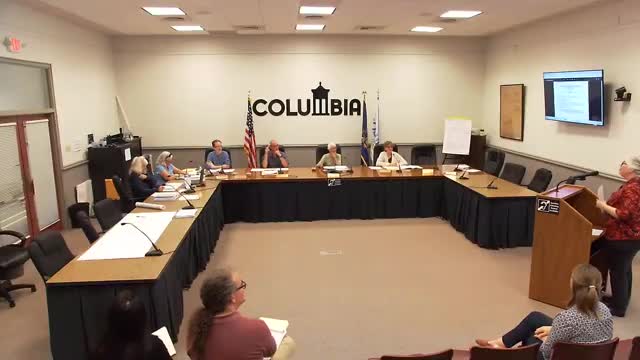
Gwen Newell, a planner with the Lancaster County Planning Department, on Wednesday presented the county's draft "Simplified Zoning" toolkit to Columbia Borough council during a workshop, outlining five coordinated documents that recommend 18 countywide zoning districts and a shift from listing every land use to regulating land-use impacts.
Newell told council members the toolkit is intended to "help provide greater regulation and consistency efficiently and effectively across municipal line" and to streamline approvals and reduce costs for building projects. She said the county package is a set of coordinated pieces rather than a single plug-and-play ordinance.
The nut of the county's pitch is scale and simplification: Lancaster County's planners said the county contains about 60 municipalities and more than 500 separate zoning districts, and the Simplified Zoning tool reduces that complexity by recommending an 18-district countywide palette from rural to urban. "We are actually recommending currently 18 zoning districts for the entire county along with their stated purposes and characteristics," Newell said. She added that municipalities are not expected to adopt all 18 districts wholesale and that the county will update the proposals after municipal feedback.
The county presented five linked documents: (1) a "big fixes" list of about 15 broad changes municipalities could implement across zoning ordinances; (2) the proposed list and descriptions of 18 simplified zoning districts; (3) bulk regulations that would apply once a municipality chooses which district(s) to use; (4) an assessment spreadsheet for land-use impacts; and (5) a short definitions document intended to standardize housing and other terms across municipal lines. Newell said the county's materials are posted online at lancastercountyplanning.org/publications and that each document will include a revision date.
A key conceptual shift in the county draft is to regulate impacts rather than exhaustively enumerate every conceivable land use. Newell explained that instead of listing every individual use (for example, many varieties of retail or new technologies such as data centers), the draft shows the expected impacts in each district (noise, water demand, traffic, lighting) and then regulates the intensity of those impacts. "What you'll find is a list of impacts," Newell said. "Regulating this way enables to adapt more easily to each community needs, because they do keep changing." The county also proposes a separate list of greater impacts that would trigger conditional use or special exception review.
County staff acknowledged this approach is novel and will require additional work to make impact categories objective and administrable. Newell said the assessment spreadsheet (the land-use impacts worksheet) is likely to be amended frequently and that the county has not yet assigned numeric thresholds to descriptors such as "high," "medium," and "low." "One of the phase 2 things to work on is in the impacts assessment of land use impacts. This chart that says high, medium, and low, we didn't put any numbers with that," she said.
Council members raised practical concerns that surfaced repeatedly in the discussion, including parking standards and short-term rentals. Newell said parking is on the county's follow-up list but that staff lacked standardized numbers to put in the draft; municipalities will need to provide local input. On short-term rentals, Newell noted a common drafting practice is to define short- versus long-term rentals using a 30-day threshold: "Short term is 30 days or less. And then anything else is long term. It seems very common that that's the number."
Newell also said the county worked with housing stakeholders to produce consistent, simplified definitions for housing types (single-family detached, single-family semi-detached, multifamily) because no countywide standard exists. She urged borough staff and neighboring municipalities to coordinate on definitions and on which of the 18 zoning districts would best match local future land-use maps.
On legal review and implementation limits, Newell said the county has had input from a land-use attorney but has not yet formally run the draft past the county solicitor. She cautioned that municipal solicitors and case law could affect how broadly a borough could reduce enumerated uses. "We have had input from a land use lawyer who was in support of this document as drafted. But we have not officially taken it to the county solicitor," she said.
The presentation closed with procedural next steps rather than formal local actions: staff offered to map Columbia Borough's existing zones to the proposed simplified districts to give the borough a narrower starting point, and Newell asked that the county send materials to the borough liaison Christine so they could schedule follow-up meetings. No ordinance amendments were proposed or adopted at the workshop.
Ending: The workshop adjourned on a motion by Justin, seconded by Deb; council members signaled the motion carried by voice and the meeting ended at 6:55 p.m. The county's Simplified Zoning materials and future revisions will be posted at lancastercountyplanning.org/publications and Newell encouraged municipal officials to review the May 2025-dated drafts and send feedback.
Newell told council members the toolkit is intended to "help provide greater regulation and consistency efficiently and effectively across municipal line" and to streamline approvals and reduce costs for building projects. She said the county package is a set of coordinated pieces rather than a single plug-and-play ordinance.
The nut of the county's pitch is scale and simplification: Lancaster County's planners said the county contains about 60 municipalities and more than 500 separate zoning districts, and the Simplified Zoning tool reduces that complexity by recommending an 18-district countywide palette from rural to urban. "We are actually recommending currently 18 zoning districts for the entire county along with their stated purposes and characteristics," Newell said. She added that municipalities are not expected to adopt all 18 districts wholesale and that the county will update the proposals after municipal feedback.
The county presented five linked documents: (1) a "big fixes" list of about 15 broad changes municipalities could implement across zoning ordinances; (2) the proposed list and descriptions of 18 simplified zoning districts; (3) bulk regulations that would apply once a municipality chooses which district(s) to use; (4) an assessment spreadsheet for land-use impacts; and (5) a short definitions document intended to standardize housing and other terms across municipal lines. Newell said the county's materials are posted online at lancastercountyplanning.org/publications and that each document will include a revision date.
A key conceptual shift in the county draft is to regulate impacts rather than exhaustively enumerate every conceivable land use. Newell explained that instead of listing every individual use (for example, many varieties of retail or new technologies such as data centers), the draft shows the expected impacts in each district (noise, water demand, traffic, lighting) and then regulates the intensity of those impacts. "What you'll find is a list of impacts," Newell said. "Regulating this way enables to adapt more easily to each community needs, because they do keep changing." The county also proposes a separate list of greater impacts that would trigger conditional use or special exception review.
County staff acknowledged this approach is novel and will require additional work to make impact categories objective and administrable. Newell said the assessment spreadsheet (the land-use impacts worksheet) is likely to be amended frequently and that the county has not yet assigned numeric thresholds to descriptors such as "high," "medium," and "low." "One of the phase 2 things to work on is in the impacts assessment of land use impacts. This chart that says high, medium, and low, we didn't put any numbers with that," she said.
Council members raised practical concerns that surfaced repeatedly in the discussion, including parking standards and short-term rentals. Newell said parking is on the county's follow-up list but that staff lacked standardized numbers to put in the draft; municipalities will need to provide local input. On short-term rentals, Newell noted a common drafting practice is to define short- versus long-term rentals using a 30-day threshold: "Short term is 30 days or less. And then anything else is long term. It seems very common that that's the number."
Newell also said the county worked with housing stakeholders to produce consistent, simplified definitions for housing types (single-family detached, single-family semi-detached, multifamily) because no countywide standard exists. She urged borough staff and neighboring municipalities to coordinate on definitions and on which of the 18 zoning districts would best match local future land-use maps.
On legal review and implementation limits, Newell said the county has had input from a land-use attorney but has not yet formally run the draft past the county solicitor. She cautioned that municipal solicitors and case law could affect how broadly a borough could reduce enumerated uses. "We have had input from a land use lawyer who was in support of this document as drafted. But we have not officially taken it to the county solicitor," she said.
The presentation closed with procedural next steps rather than formal local actions: staff offered to map Columbia Borough's existing zones to the proposed simplified districts to give the borough a narrower starting point, and Newell asked that the county send materials to the borough liaison Christine so they could schedule follow-up meetings. No ordinance amendments were proposed or adopted at the workshop.
Ending: The workshop adjourned on a motion by Justin, seconded by Deb; council members signaled the motion carried by voice and the meeting ended at 6:55 p.m. The county's Simplified Zoning materials and future revisions will be posted at lancastercountyplanning.org/publications and Newell encouraged municipal officials to review the May 2025-dated drafts and send feedback.
Don't Miss a Word: See the Full Meeting!
Go beyond summaries. Unlock every video, transcript, and key insight with a Founder Membership.
✓
Get instant access to full meeting videos
✓
Search and clip any phrase from complete transcripts
✓
Receive AI-powered summaries & custom alerts
✓
Enjoy lifetime, unrestricted access to government data
30-day money-back guarantee
