Jones County commissioners approve project list, direct intergovernmental agreement with city
July 23, 2025 | Jones County, Georgia
This article was created by AI summarizing key points discussed. AI makes mistakes, so for full details and context, please refer to the video of the full meeting. Please report any errors so we can fix them. Report an error »
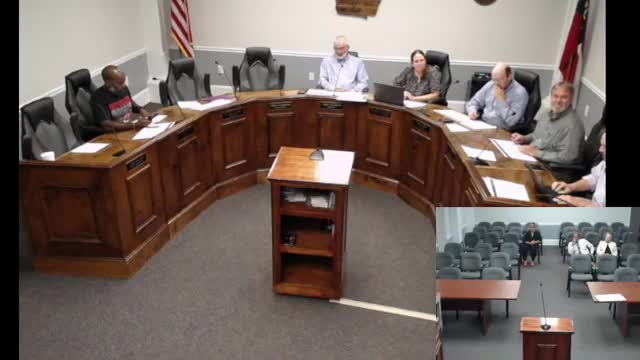
Jones County commissioners on July 21 approved a prioritized list of capital projects and voted to include those projects in an intergovernmental agreement with the City of Gray as part of planning for a proposed sales-tax referendum ("splash"). The board directed staff to take the list to the county attorney to draft the intergovernmental agreement for formal approval at a future meeting.
The decision matters because the project list will form the basis for ballot language and bonding decisions tied to the county's proposed special-purpose local option sales tax (referred to in the meeting as "splash"). Commissioners debated which items to fund outright, which to bond, and which to treat as debt-service-only to preserve capacity for other priorities.
Commissioners and staff removed two items they said already had separate funding or prior agreement: a $5 million allocation intended for the development authority (to be funded from excess collections) and the courthouse project, which county leaders want to treat as a separate level-1 priority rather than include in the 1-to-10 ranking used for other projects. The meeting record shows the courthouse had a pre-COVID space-needs estimate of $10 million to $12 million; staff said recent planning doubled earlier figures and the current working estimate used in the packet was about $25 million. A staff estimate presented to commissioners indicated roughly six years of debt service on a $25 million bond would total about $9 million; the transcript records that as the basis for treating the courthouse as a separately funded level-1 project.
Commissioners discussed two large water projects (identified in the packet as projects from 2022 and 2023) that together had been estimated at roughly $5.5 million if paid up front. Multiple participants recommended treating those water projects as debt-service-only; the board heard one calculation that debt service on those two projects would reduce the near-term cash requirement to about $2 million, freeing roughly $3.5 million of splash proceeds for other items. Staff and commissioners stressed that those figures were working estimates and that Justin (staff) and other staff would verify precise numbers before final documents were prepared.
Dirt roads, maintenance and local priorities drew sustained attention from commissioners. A commissioner representing District 4 said the countywide project list did not reflect several high-need local dirt-road repairs and asked that the county set aside a recurring allotment for dirt-road improvements and better training for motor-grader operators. Several commissioners urged a placeholder or nominal allocation (examples discussed included $100,000 to $500,000 or a proposed $1 million) for dirt-road work and smaller matching funds for Community Development Block Grant (CDBG) projects so the county could respond to local grant matches and emerging matches, such as rails-to-trails planning.
Other specific line items discussed included: approximately $2.5 million (of $2.8 million requested) for fire apparatus and about $2.5 million (of roughly $3.0 million requested) for sheriff's vehicles, a combined ~$700,000 request for elections office and 4-H renovation/space needs, and unspecified estimates for a parking-lot project at the Recreation Complex. Commissioners also discussed using courthouse design to create revenue-generating commercial space in a future build-out, and the potential to bond some projects immediately if the board wanted funds available once the referendum were approved.
On procedure and timing, staff said they used current revenue projections escalated by an annual CPI-like increase (2.5% to 2.9% in the presentation) and that recent state sales-tax law changes and COVID-era spending shifts had driven collections higher than pre-COVID levels. A county attorney and bond counsel will be consulted about how specific projects appear in ballot language; staff explained county practice has been to present broad project categories on the ballot (for example, "public safety," "roads," "technology") with more detailed lists in accompanying documents. The board asked staff to bring a drafted intergovernmental agreement and final packet back within about a week for formal approval.
The board took two formal actions on the item: a motion to include the projects discussed by the board in the intergovernmental agreement with the city, and a motion to approve the project list (both motions were seconded and approved; the transcript records the motion and approval but does not record a roll-call vote or an itemized tally). The county attorney will prepare the IGA language and coordinate with city staff; staff indicated the documents should be ready for formal approval at the next meeting.
The meeting closed with scheduling discussion for a follow-up meeting the following week to consider the drafted documents and finalize ballot and bond-related wording.
The decision matters because the project list will form the basis for ballot language and bonding decisions tied to the county's proposed special-purpose local option sales tax (referred to in the meeting as "splash"). Commissioners debated which items to fund outright, which to bond, and which to treat as debt-service-only to preserve capacity for other priorities.
Commissioners and staff removed two items they said already had separate funding or prior agreement: a $5 million allocation intended for the development authority (to be funded from excess collections) and the courthouse project, which county leaders want to treat as a separate level-1 priority rather than include in the 1-to-10 ranking used for other projects. The meeting record shows the courthouse had a pre-COVID space-needs estimate of $10 million to $12 million; staff said recent planning doubled earlier figures and the current working estimate used in the packet was about $25 million. A staff estimate presented to commissioners indicated roughly six years of debt service on a $25 million bond would total about $9 million; the transcript records that as the basis for treating the courthouse as a separately funded level-1 project.
Commissioners discussed two large water projects (identified in the packet as projects from 2022 and 2023) that together had been estimated at roughly $5.5 million if paid up front. Multiple participants recommended treating those water projects as debt-service-only; the board heard one calculation that debt service on those two projects would reduce the near-term cash requirement to about $2 million, freeing roughly $3.5 million of splash proceeds for other items. Staff and commissioners stressed that those figures were working estimates and that Justin (staff) and other staff would verify precise numbers before final documents were prepared.
Dirt roads, maintenance and local priorities drew sustained attention from commissioners. A commissioner representing District 4 said the countywide project list did not reflect several high-need local dirt-road repairs and asked that the county set aside a recurring allotment for dirt-road improvements and better training for motor-grader operators. Several commissioners urged a placeholder or nominal allocation (examples discussed included $100,000 to $500,000 or a proposed $1 million) for dirt-road work and smaller matching funds for Community Development Block Grant (CDBG) projects so the county could respond to local grant matches and emerging matches, such as rails-to-trails planning.
Other specific line items discussed included: approximately $2.5 million (of $2.8 million requested) for fire apparatus and about $2.5 million (of roughly $3.0 million requested) for sheriff's vehicles, a combined ~$700,000 request for elections office and 4-H renovation/space needs, and unspecified estimates for a parking-lot project at the Recreation Complex. Commissioners also discussed using courthouse design to create revenue-generating commercial space in a future build-out, and the potential to bond some projects immediately if the board wanted funds available once the referendum were approved.
On procedure and timing, staff said they used current revenue projections escalated by an annual CPI-like increase (2.5% to 2.9% in the presentation) and that recent state sales-tax law changes and COVID-era spending shifts had driven collections higher than pre-COVID levels. A county attorney and bond counsel will be consulted about how specific projects appear in ballot language; staff explained county practice has been to present broad project categories on the ballot (for example, "public safety," "roads," "technology") with more detailed lists in accompanying documents. The board asked staff to bring a drafted intergovernmental agreement and final packet back within about a week for formal approval.
The board took two formal actions on the item: a motion to include the projects discussed by the board in the intergovernmental agreement with the city, and a motion to approve the project list (both motions were seconded and approved; the transcript records the motion and approval but does not record a roll-call vote or an itemized tally). The county attorney will prepare the IGA language and coordinate with city staff; staff indicated the documents should be ready for formal approval at the next meeting.
The meeting closed with scheduling discussion for a follow-up meeting the following week to consider the drafted documents and finalize ballot and bond-related wording.
Don't Miss a Word: See the Full Meeting!
Go beyond summaries. Unlock every video, transcript, and key insight with a Founder Membership.
✓
Get instant access to full meeting videos
✓
Search and clip any phrase from complete transcripts
✓
Receive AI-powered summaries & custom alerts
✓
Enjoy lifetime, unrestricted access to government data
30-day money-back guarantee
