Consultants present parks and open-space master plan progress; outreach, definitions, and heat maps highlighted
July 23, 2025 | South Burlington City, Chittenden County, Vermont
This article was created by AI summarizing key points discussed. AI makes mistakes, so for full details and context, please refer to the video of the full meeting. Please report any errors so we can fix them. Report an error »
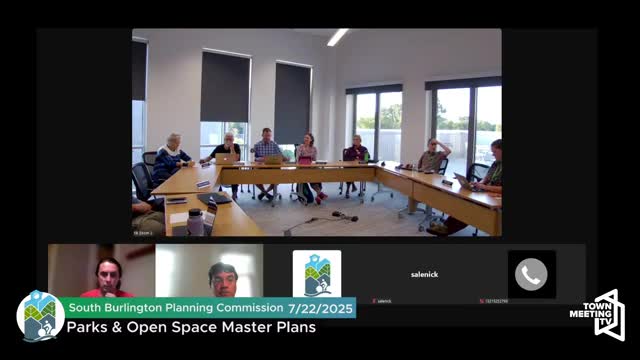
City planning staff and consultants presented early findings of a paired Parks Master Plan and Open Space Master Plan, summarizing public outreach, mapping and definitions the team will use to produce draft recommendations this fall.
"We had about 400 responses to our online, public survey," said a consultant, noting the team also hosted an April 7 open house that drew more than 120 attendees and a "meeting in a box" process used to gather input at community events. The consultants said they are wrapping up an existing-conditions analysis and will move into drafting recommendations and park-by-park concept diagrams in the next month.
The presentation, led by Drew and Carolyn of consultant SiRO with city staff Kelsey and Adam participating, emphasized four themes drawn from a plan audit of 57 prior city planning documents: connectivity (trails and active transportation), accessibility and equity, environmental sustainability and habitat connectivity, and balancing recreation with conservation. The team has been meeting monthly with an advisory group that includes members of the Recreation & Parks Committee, the Natural Resources & Conservation Committee, housing committee representatives and other stakeholders.
Consultants proposed a three-part spectrum to classify land and facilities: active recreation (amenity- or equipment-intensive uses such as soccer or sports courts), passive recreation (trails, green space, low-infrastructure uses) and conservation/preservation (areas where protection of habitat or ecological function restricts recreation). "Passive recreation is more like you just need a trail and a pair of sneakers," one presenter said, while conservation areas "may be there to protect wildlife and ecosystems" and not allow recreation.
Commission discussion focused on how to apply those categories at parcel scale, noting many large properties could include all three uses in separate subareas. Commissioners and consultants discussed how small parcels can be high-intensity destinations (for example, a unique amenity such as a band shell or turf field) and therefore should not be categorized by size alone.
The consultants showed spatial analyses, including population-density "heat maps" overlaid with quarter-mile access circles measured from park entrances; the maps identify neighborhoods with poor walking access to parks or playgrounds. The team said maps also exist showing tree cover, trails and amenity inventories and that school properties and non-city parks were included in the inventory. "We did a heat map analysis with population density and the location, and we have several different maps," a consultant said. They told commissioners they will provide those maps and related materials.
Outreach to non-English-speaking new American communities was flagged as incomplete; staff said they plan additional targeted focus groups and community-champion conversations to broaden participation before the draft recommendations are released.
The presentation also compared volunteer-led Interim System Open-space Parcel (ISOP) recommendations and the Planning Commission's habitat-block overlay (prepared by Arrowood Environmental). Consultants said there is substantial overlap between those layers but that each mapping product had a different method: the volunteer ISOP parcel review emphasized larger parcels, while the Arrowood habitat-block mapping was an expert-driven analysis used for regulatory overlay work.
"We're starting to look at recommendations both at a citywide level and on a park-by-park basis," the consultant said, describing the next stage of the project as producing "bubble diagrams" (concept-level master-plan alternatives) for specific parks and an implementation matrix of actions, estimated costs and possible funding sources.
Commissioners offered technical feedback: consider including quarter-mile access circles around recreation-path entry points as well as park entrances; account for barriers (major roads, rail lines, interstates) where a straight-line radius yields misleading access results; and evaluate sidewalk and actual walking-distance networks where feasible. The consultants agreed to create additional map variants showing trail connectivity and to flag parks where radius access and actual walking routes diverge.
No formal vote was taken; the presentation was an orientation and a request for feedback. Consultants said they will return with draft recommendations and materials the commission can review before the team's next public open house.
"We had about 400 responses to our online, public survey," said a consultant, noting the team also hosted an April 7 open house that drew more than 120 attendees and a "meeting in a box" process used to gather input at community events. The consultants said they are wrapping up an existing-conditions analysis and will move into drafting recommendations and park-by-park concept diagrams in the next month.
The presentation, led by Drew and Carolyn of consultant SiRO with city staff Kelsey and Adam participating, emphasized four themes drawn from a plan audit of 57 prior city planning documents: connectivity (trails and active transportation), accessibility and equity, environmental sustainability and habitat connectivity, and balancing recreation with conservation. The team has been meeting monthly with an advisory group that includes members of the Recreation & Parks Committee, the Natural Resources & Conservation Committee, housing committee representatives and other stakeholders.
Consultants proposed a three-part spectrum to classify land and facilities: active recreation (amenity- or equipment-intensive uses such as soccer or sports courts), passive recreation (trails, green space, low-infrastructure uses) and conservation/preservation (areas where protection of habitat or ecological function restricts recreation). "Passive recreation is more like you just need a trail and a pair of sneakers," one presenter said, while conservation areas "may be there to protect wildlife and ecosystems" and not allow recreation.
Commission discussion focused on how to apply those categories at parcel scale, noting many large properties could include all three uses in separate subareas. Commissioners and consultants discussed how small parcels can be high-intensity destinations (for example, a unique amenity such as a band shell or turf field) and therefore should not be categorized by size alone.
The consultants showed spatial analyses, including population-density "heat maps" overlaid with quarter-mile access circles measured from park entrances; the maps identify neighborhoods with poor walking access to parks or playgrounds. The team said maps also exist showing tree cover, trails and amenity inventories and that school properties and non-city parks were included in the inventory. "We did a heat map analysis with population density and the location, and we have several different maps," a consultant said. They told commissioners they will provide those maps and related materials.
Outreach to non-English-speaking new American communities was flagged as incomplete; staff said they plan additional targeted focus groups and community-champion conversations to broaden participation before the draft recommendations are released.
The presentation also compared volunteer-led Interim System Open-space Parcel (ISOP) recommendations and the Planning Commission's habitat-block overlay (prepared by Arrowood Environmental). Consultants said there is substantial overlap between those layers but that each mapping product had a different method: the volunteer ISOP parcel review emphasized larger parcels, while the Arrowood habitat-block mapping was an expert-driven analysis used for regulatory overlay work.
"We're starting to look at recommendations both at a citywide level and on a park-by-park basis," the consultant said, describing the next stage of the project as producing "bubble diagrams" (concept-level master-plan alternatives) for specific parks and an implementation matrix of actions, estimated costs and possible funding sources.
Commissioners offered technical feedback: consider including quarter-mile access circles around recreation-path entry points as well as park entrances; account for barriers (major roads, rail lines, interstates) where a straight-line radius yields misleading access results; and evaluate sidewalk and actual walking-distance networks where feasible. The consultants agreed to create additional map variants showing trail connectivity and to flag parks where radius access and actual walking routes diverge.
No formal vote was taken; the presentation was an orientation and a request for feedback. Consultants said they will return with draft recommendations and materials the commission can review before the team's next public open house.
View the Full Meeting & All Its Details
This article offers just a summary. Unlock complete video, transcripts, and insights as a Founder Member.
✓
Watch full, unedited meeting videos
✓
Search every word spoken in unlimited transcripts
✓
AI summaries & real-time alerts (all government levels)
✓
Permanent access to expanding government content
30-day money-back guarantee
