Council holds first reading of major land‑development regulation (LDR) package; debate continues over heights and city‑center open space
July 23, 2025 | South Burlington City, Chittenden County, Vermont
This article was created by AI summarizing key points discussed. AI makes mistakes, so for full details and context, please refer to the video of the full meeting. Please report any errors so we can fix them. Report an error »
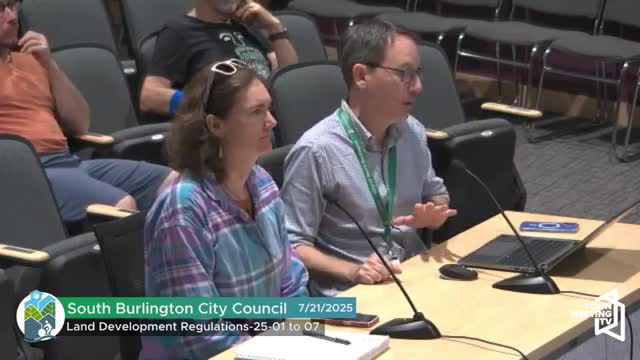
The South Burlington City Council on July 21 received a first reading of proposed amendments to the city’s land development regulations (LDRs), plus changes to the official map and form‑based code for the city center. Staff and the Planning Commission presented a package of edits that cover building form and heights, transect zone map changes, an updated official map showing primary/secondary/tertiary streets, a consolidated table of uses, new rules on bedrock removal during construction, and standards for calculating building height.
Jessica Luisos, Planning Commission chair, and Paul Connor, director of planning and zoning, said the package is intended to add design flexibility in the city center, simplify use categories across the city and provide clearer review paths for new commercial uses. The presentation included visualizations of increased allowable building heights in the transect‑5 and transect‑4 districts: the draft would raise some maximum story counts (T4 up to 12 stories in places; T5 up to 14 stories in core areas) and establish a three‑story minimum in certain transects to encourage denser development where infrastructure is in place. The official map updates add planned street connections and pedestrian links, including a proposed pedestrian bridge over I‑89 and clarified connections between city‑center parcels.
The package also includes a new LDR article addressing bedrock removal and performance standards for construction‑period activities; staff said the aim is to give the Development Review Board more tools to consider methods and schedules for ledge removal and to require geotechnical evaluation when necessary. Connor and Luisos said the Planning Commission plans further work to develop objective noise or decibel standards but recommended bringing the present draft forward rather than waiting indefinitely.
Council discussion focused on two central concerns. Several councilors said the proposed maximum heights — illustrations showing blocks of mid‑rise buildings — were higher than expected and asked staff to consider lower maximums (comments favored eight to twelve stories rather than the higher end shown). Councilors also pressed staff on the official map: some councilors asked that a site being discussed as a future city‑center park be shown on the official map or otherwise noted; staff and the city attorney warned that adding a public‑facility designation to the city’s official (regulatory) map is a legally consequential step that can restrict development rights for specific parcels and therefore recommended additional vetting and, if desired, a formal route through the Planning Commission.
Councilors and members of the public also raised wetlands and habitat overlays that limit where tall buildings could be built; staff noted environmental overlays remain in force and would constrain development regardless of transect designation. Planning staff said the TDR discussion and the city’s housing goals informed the package: higher, more compact buildings can preserve regional open space and better use existing infrastructure, but staff acknowledged the design and height choices will require further public input.
By the end of the meeting the council did not set a public hearing on the full package. Several councilors asked staff to return on Aug. 4 with legal guidance on the official map and a plan to reconcile the map and open‑space objectives; the council postponed further action on the official map to the next meeting while continuing the LDR first reading conversation. Planning staff said the Planning Commission unanimously forwarded the overall package but had split votes on specific height provisions.
The LDR package as presented also proposes use‑table consolidation (grouping many narrowly defined commercial uses under broader, characteristic‑based categories), limited new allowances for “accommodations” in business park areas (described by staff as extended‑stay or small‑scale lodging tied to business‑park needs, capped in scale), and a change to how building height is measured (from average finished grade rather than pre‑construction grade) intended to reduce gaming of grade and to allow modest added first‑floor ceiling heights without forcing flat roofs.
Councilors asked staff for more visualizations, legal advice on the official map and additional detail on bedrock/noise decibel options before setting public hearings. A public hearing on the package was not scheduled; staff will return with clarifications and legal counsel’s advice on mapping and open‑space designations.
Jessica Luisos, Planning Commission chair, and Paul Connor, director of planning and zoning, said the package is intended to add design flexibility in the city center, simplify use categories across the city and provide clearer review paths for new commercial uses. The presentation included visualizations of increased allowable building heights in the transect‑5 and transect‑4 districts: the draft would raise some maximum story counts (T4 up to 12 stories in places; T5 up to 14 stories in core areas) and establish a three‑story minimum in certain transects to encourage denser development where infrastructure is in place. The official map updates add planned street connections and pedestrian links, including a proposed pedestrian bridge over I‑89 and clarified connections between city‑center parcels.
The package also includes a new LDR article addressing bedrock removal and performance standards for construction‑period activities; staff said the aim is to give the Development Review Board more tools to consider methods and schedules for ledge removal and to require geotechnical evaluation when necessary. Connor and Luisos said the Planning Commission plans further work to develop objective noise or decibel standards but recommended bringing the present draft forward rather than waiting indefinitely.
Council discussion focused on two central concerns. Several councilors said the proposed maximum heights — illustrations showing blocks of mid‑rise buildings — were higher than expected and asked staff to consider lower maximums (comments favored eight to twelve stories rather than the higher end shown). Councilors also pressed staff on the official map: some councilors asked that a site being discussed as a future city‑center park be shown on the official map or otherwise noted; staff and the city attorney warned that adding a public‑facility designation to the city’s official (regulatory) map is a legally consequential step that can restrict development rights for specific parcels and therefore recommended additional vetting and, if desired, a formal route through the Planning Commission.
Councilors and members of the public also raised wetlands and habitat overlays that limit where tall buildings could be built; staff noted environmental overlays remain in force and would constrain development regardless of transect designation. Planning staff said the TDR discussion and the city’s housing goals informed the package: higher, more compact buildings can preserve regional open space and better use existing infrastructure, but staff acknowledged the design and height choices will require further public input.
By the end of the meeting the council did not set a public hearing on the full package. Several councilors asked staff to return on Aug. 4 with legal guidance on the official map and a plan to reconcile the map and open‑space objectives; the council postponed further action on the official map to the next meeting while continuing the LDR first reading conversation. Planning staff said the Planning Commission unanimously forwarded the overall package but had split votes on specific height provisions.
The LDR package as presented also proposes use‑table consolidation (grouping many narrowly defined commercial uses under broader, characteristic‑based categories), limited new allowances for “accommodations” in business park areas (described by staff as extended‑stay or small‑scale lodging tied to business‑park needs, capped in scale), and a change to how building height is measured (from average finished grade rather than pre‑construction grade) intended to reduce gaming of grade and to allow modest added first‑floor ceiling heights without forcing flat roofs.
Councilors asked staff for more visualizations, legal advice on the official map and additional detail on bedrock/noise decibel options before setting public hearings. A public hearing on the package was not scheduled; staff will return with clarifications and legal counsel’s advice on mapping and open‑space designations.
Don't Miss a Word: See the Full Meeting!
Go beyond summaries. Unlock every video, transcript, and key insight with a Founder Membership.
✓
Get instant access to full meeting videos
✓
Search and clip any phrase from complete transcripts
✓
Receive AI-powered summaries & custom alerts
✓
Enjoy lifetime, unrestricted access to government data
30-day money-back guarantee
