Detroit Wayne County Port Authority outlines maritime priorities, seeks renewed state support
July 21, 2025 | 2025-2026 House Legislature MI, Michigan
This article was created by AI summarizing key points discussed. AI makes mistakes, so for full details and context, please refer to the video of the full meeting. Please report any errors so we can fix them. Report an error »
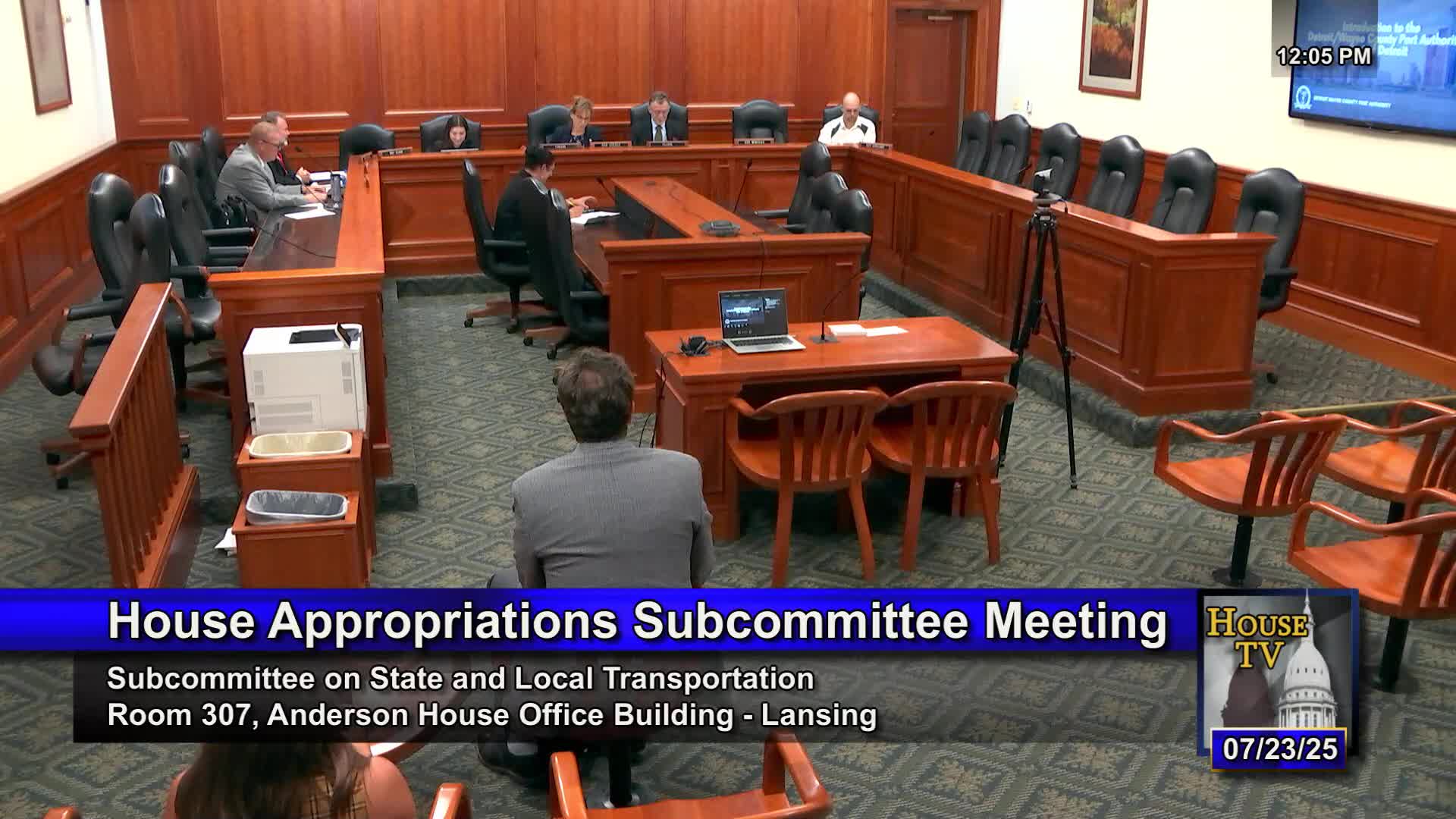
Mark Shrupp, executive director of the Detroit Wayne County Port Authority, told the Michigan House Appropriations Subcommittee on State and Local Transportation that the Port of Detroit handles 8–10 million tons of cargo annually, supports roughly 6,000 jobs and accounts for nearly $1 billion in regional economic activity.
Shrupp gave the presentation after the subcommittee convened without a quorum; the panel proceeded with testimony but was not able to take formal votes or approve minutes. "We're a municipal entity, but we're not a department of either of those entities," Shrupp said, describing the authority's board appointments and funding structure.
The port authority’s pitch centered on three priorities: maintaining and expanding maritime infrastructure and trade; reducing port-related air pollution; and preparing former industrial sites for new investment. The authority said its jurisdiction covers roughly 32 miles of the Detroit and Rouge rivers and that it operates with a lean staff of about six to seven employees.
Why it matters: the Great Lakes maritime system supports manufacturing supply chains and regional trade that state and local officials said merit continued state investment. Shrupp noted comparative investments in other Midwest states — for example, Indiana’s recent $50 million and Illinois's $150 million commitments — and urged continued support for Michigan shipping and terminals.
Funding and grants: Shrupp said the port authority receives an annual state appropriation of $600,000; the City of Detroit and Wayne County each contribute about $300,000, producing a general fund of $1.2 million. He also said the state contributed $1.25 million as local match for a federal EPA ports grant that the authority is implementing. The authority was a beneficiary of the Michigan Maritime Facility Assistance Program in 2024, which received $5 million; Shrupp said that program received no funding in 2025 and asked lawmakers to consider restoring support.
Clean-air and equipment plans: Shrupp described a port planning process funded with state and federal support that identified diesel emissions as the largest near-term source of pollution and recommended a staged transition to cleaner fuels and equipment. "B20 is a 20% biodiesel, and it reduces particulate matter," he said, calling biodiesel a "drop-in fuel" that requires no engine replacement and can reduce emissions more quickly and with lower upfront cost than full electrification. The EPA grant will finance electric equipment purchases, chargers and low- or zero-tailpipe-emission gear; a separate planning grant will study hydrogen and other fuels and a concept for a shore-power barge so ships can shut down on-dock generators.
Economic development and brownfields: Shrupp outlined the port authority’s role in grant writing and pass-through low-interest financing to make contaminated sites viable for redevelopment. He said the authority administers a revolving loan fund (generally for projects under $1 million) that has been used for hospital expansions, affordable housing and a grocery co-op on Detroit's North End. Shrupp cautioned that very large sites such as Zug Island or multiple U.S. Steel properties could exceed the fund’s capacity and would likely involve federal or private-party cleanup responsibilities.
Zug Island and U.S. Steel sites: Shrupp discussed opportunity and urgency around large former steel sites in River Rouge and elsewhere along the river. He said Nippon's recent acquisition of U.S. Steel included an $11 billion investment package, with $1 billion still to be awarded and a possible "mini mill" opportunity that local leaders hope to attract. Shrupp said the authority and downstream communities are engaging the Michigan Economic Development Corporation and private partners to assemble proposals to reuse those parcels.
Trade, ship types and the Jones Act: Representative Steele asked about the Jones Act and cross-border operations. Shrupp clarified that the Jones Act applies to coastwise trade between U.S. ports and does not require Canadian ships bringing cargo from Canada to the U.S. to comply. He described size limitations imposed by the St. Lawrence Seaway locks and noted that many large ocean container ships cannot transit into the Great Lakes because of length and width limits.
Tourism and workforce: Shrupp said the port hosts cruise visits (about 70 visits and 15,000 passengers this summer) and is promoting maritime careers through outreach and a career fair tied to Great Lakes Maritime Academy programming. He also announced a Tall Ships festival planned for August.
Questions and timing: Committee members asked about comparative foreign shipbuilding capacity, terminal practices on stockpiled materials and the status of the EPA grant after early-administration freezes; Shrupp said the grant was announced in October, experienced a short freeze after Jan. 20, was released via court action and is currently secure, though equipment procurement will take time because some items have long lead times.
The subcommittee did not vote on any items and adjourned after questions. The port authority offered tours for members and encouraged lawmakers to consider restoring or increasing state maritime funding and program support.
Shrupp gave the presentation after the subcommittee convened without a quorum; the panel proceeded with testimony but was not able to take formal votes or approve minutes. "We're a municipal entity, but we're not a department of either of those entities," Shrupp said, describing the authority's board appointments and funding structure.
The port authority’s pitch centered on three priorities: maintaining and expanding maritime infrastructure and trade; reducing port-related air pollution; and preparing former industrial sites for new investment. The authority said its jurisdiction covers roughly 32 miles of the Detroit and Rouge rivers and that it operates with a lean staff of about six to seven employees.
Why it matters: the Great Lakes maritime system supports manufacturing supply chains and regional trade that state and local officials said merit continued state investment. Shrupp noted comparative investments in other Midwest states — for example, Indiana’s recent $50 million and Illinois's $150 million commitments — and urged continued support for Michigan shipping and terminals.
Funding and grants: Shrupp said the port authority receives an annual state appropriation of $600,000; the City of Detroit and Wayne County each contribute about $300,000, producing a general fund of $1.2 million. He also said the state contributed $1.25 million as local match for a federal EPA ports grant that the authority is implementing. The authority was a beneficiary of the Michigan Maritime Facility Assistance Program in 2024, which received $5 million; Shrupp said that program received no funding in 2025 and asked lawmakers to consider restoring support.
Clean-air and equipment plans: Shrupp described a port planning process funded with state and federal support that identified diesel emissions as the largest near-term source of pollution and recommended a staged transition to cleaner fuels and equipment. "B20 is a 20% biodiesel, and it reduces particulate matter," he said, calling biodiesel a "drop-in fuel" that requires no engine replacement and can reduce emissions more quickly and with lower upfront cost than full electrification. The EPA grant will finance electric equipment purchases, chargers and low- or zero-tailpipe-emission gear; a separate planning grant will study hydrogen and other fuels and a concept for a shore-power barge so ships can shut down on-dock generators.
Economic development and brownfields: Shrupp outlined the port authority’s role in grant writing and pass-through low-interest financing to make contaminated sites viable for redevelopment. He said the authority administers a revolving loan fund (generally for projects under $1 million) that has been used for hospital expansions, affordable housing and a grocery co-op on Detroit's North End. Shrupp cautioned that very large sites such as Zug Island or multiple U.S. Steel properties could exceed the fund’s capacity and would likely involve federal or private-party cleanup responsibilities.
Zug Island and U.S. Steel sites: Shrupp discussed opportunity and urgency around large former steel sites in River Rouge and elsewhere along the river. He said Nippon's recent acquisition of U.S. Steel included an $11 billion investment package, with $1 billion still to be awarded and a possible "mini mill" opportunity that local leaders hope to attract. Shrupp said the authority and downstream communities are engaging the Michigan Economic Development Corporation and private partners to assemble proposals to reuse those parcels.
Trade, ship types and the Jones Act: Representative Steele asked about the Jones Act and cross-border operations. Shrupp clarified that the Jones Act applies to coastwise trade between U.S. ports and does not require Canadian ships bringing cargo from Canada to the U.S. to comply. He described size limitations imposed by the St. Lawrence Seaway locks and noted that many large ocean container ships cannot transit into the Great Lakes because of length and width limits.
Tourism and workforce: Shrupp said the port hosts cruise visits (about 70 visits and 15,000 passengers this summer) and is promoting maritime careers through outreach and a career fair tied to Great Lakes Maritime Academy programming. He also announced a Tall Ships festival planned for August.
Questions and timing: Committee members asked about comparative foreign shipbuilding capacity, terminal practices on stockpiled materials and the status of the EPA grant after early-administration freezes; Shrupp said the grant was announced in October, experienced a short freeze after Jan. 20, was released via court action and is currently secure, though equipment procurement will take time because some items have long lead times.
The subcommittee did not vote on any items and adjourned after questions. The port authority offered tours for members and encouraged lawmakers to consider restoring or increasing state maritime funding and program support.
View the Full Meeting & All Its Details
This article offers just a summary. Unlock complete video, transcripts, and insights as a Founder Member.
✓
Watch full, unedited meeting videos
✓
Search every word spoken in unlimited transcripts
✓
AI summaries & real-time alerts (all government levels)
✓
Permanent access to expanding government content
30-day money-back guarantee
