Board of Elections outlines ranked-choice voting option, provides draft advisory question
July 24, 2025 | Greenbelt, Prince George's County, Maryland
This article was created by AI summarizing key points discussed. AI makes mistakes, so for full details and context, please refer to the video of the full meeting. Please report any errors so we can fix them. Report an error »
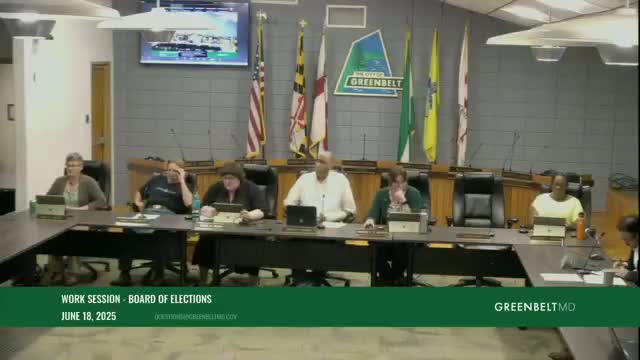
The Greenbelt Board of Elections gave a detailed presentation on ranked‑choice voting (RCV), showed round‑by‑round tabulation examples from other cities and provided draft ballot language for an advisory question. The board asked the council whether to place the question on a future ballot for voter guidance.
Board presenters defined RCV as a method that lets voters "select candidates by order of preference," and explained how votes are redistributed from eliminated candidates or from excess votes when a candidate surpasses the threshold. The board showed examples from Albany, Calif., and Cambridge, Mass., where proportional RCV is used for multiwinner contests.
Why it matters: adopting RCV would change how winners are elected in multiwinner races, could reduce the need for costly runoffs, and may lower the effective threshold for winning a seat — potentially changing council composition.
Costs and administration: the board said RCV requires tabulation software and voter education. "It would increase the base cost per election by about $1,500 because you're adding on this tabulation software for ranked choice voting," a board presenter said. The board also emphasized transparent, round‑by‑round reporting so voters can trace how seats were filled.
Questions and concerns: council members and residents raised potential increases in spoiled ballots during an initial learning period, how to explain "excess vote" transfers to voters and whether RCV's effects differ by municipality size. Resident Michael Hartman urged further study and recommended continuing the Board’s work on the topic and related outreach. Joan Estinson, who said she had experience administering RCV elections, reported that voters typically asked two questions: "Do I have to vote for 3 candidates?" and "Can I vote for the same person?" She said those practical items were simple to answer for voters.
Draft advisory language and next steps: the board circulated sample ballot language that would ask voters whether the city should use RCV and amend the charter’s 40% threshold (Section 31). The board did not vote on a final recommendation; council members asked staff to refine the language, consider public outreach and return with revised wording before any decision about placing the question on the ballot.
Ending: Council and board members agreed to continue study, work on clear ballot wording and allow public feedback prior to any council vote to place an advisory or charter question on a future ballot.
Board presenters defined RCV as a method that lets voters "select candidates by order of preference," and explained how votes are redistributed from eliminated candidates or from excess votes when a candidate surpasses the threshold. The board showed examples from Albany, Calif., and Cambridge, Mass., where proportional RCV is used for multiwinner contests.
Why it matters: adopting RCV would change how winners are elected in multiwinner races, could reduce the need for costly runoffs, and may lower the effective threshold for winning a seat — potentially changing council composition.
Costs and administration: the board said RCV requires tabulation software and voter education. "It would increase the base cost per election by about $1,500 because you're adding on this tabulation software for ranked choice voting," a board presenter said. The board also emphasized transparent, round‑by‑round reporting so voters can trace how seats were filled.
Questions and concerns: council members and residents raised potential increases in spoiled ballots during an initial learning period, how to explain "excess vote" transfers to voters and whether RCV's effects differ by municipality size. Resident Michael Hartman urged further study and recommended continuing the Board’s work on the topic and related outreach. Joan Estinson, who said she had experience administering RCV elections, reported that voters typically asked two questions: "Do I have to vote for 3 candidates?" and "Can I vote for the same person?" She said those practical items were simple to answer for voters.
Draft advisory language and next steps: the board circulated sample ballot language that would ask voters whether the city should use RCV and amend the charter’s 40% threshold (Section 31). The board did not vote on a final recommendation; council members asked staff to refine the language, consider public outreach and return with revised wording before any decision about placing the question on the ballot.
Ending: Council and board members agreed to continue study, work on clear ballot wording and allow public feedback prior to any council vote to place an advisory or charter question on a future ballot.
View the Full Meeting & All Its Details
This article offers just a summary. Unlock complete video, transcripts, and insights as a Founder Member.
✓
Watch full, unedited meeting videos
✓
Search every word spoken in unlimited transcripts
✓
AI summaries & real-time alerts (all government levels)
✓
Permanent access to expanding government content
30-day money-back guarantee
