Council debates pay‑as‑you‑throw rollout and compost pilot; staff to present refined numbers Monday
July 24, 2025 | Greenbelt, Prince George's County, Maryland
This article was created by AI summarizing key points discussed. AI makes mistakes, so for full details and context, please refer to the video of the full meeting. Please report any errors so we can fix them. Report an error »
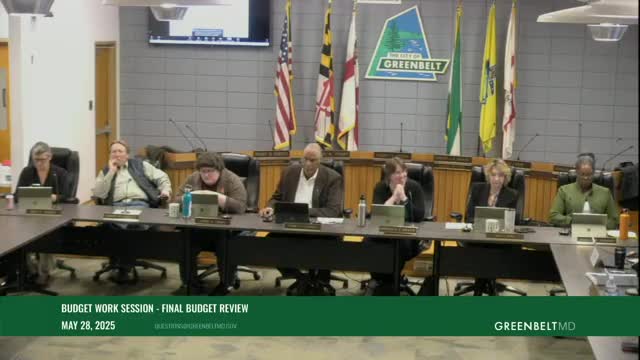
Council members and staff spent substantial time reviewing a proposed pay‑as‑you‑throw (PAYT) solid‑waste program and an associated food‑scraps pilot. The draft budget had assumed a $100,000 increase in collection fee revenue if changes started July 1; staff and council agreed Monday that a January 1 implementation is more realistic, and directed staff to lower the FY2026 assumed additional revenue to $50,000 for budgeting purposes.
Why this matters: solid‑waste collection is a material municipal service. A PAYT program aims to reduce landfill tonnage, encourage composting and make fees more equitable, but rollout timing, resident opt‑in rates and administrative details affect near‑term budget numbers.
GreenAces representatives and other speakers provided modeling scenarios. Staff said the budget currently assumes a $3.36 annual equivalent fee in one model, but GreenAces presented alternative inputs (example figures discussed in the session included a $2.20 base fee with an opt‑out price of $3.66, and a longer‑term target near $3.92). GreenAces and consulting participants said that, based on observed opt‑out rates in other implementations, real net revenue for a full year could generate a modest surplus (GreenAces estimated a net income in the range of $25,000–$40,000 annually under certain opt‑out assumptions). Staff noted that if implementation starts January 1, the half‑year effect would be roughly $12,500–$20,000 in net income, and that the city should budget conservatively for the transition period.
Council asked operational questions about enforcement and implementation (for example, crews marking containers or photographing violations and use of distinct stickers for those who opt out). Staff and GreenAces said enforcement typically relies on visible stickers, crew training, and a warning process; persistent violations can lead to opt‑out enforcement steps. Council also discussed a phased roll‑out (split geography) to allow targeted outreach and vendor readiness for PAYT bags. Members directed staff to present updated, line‑by‑line budget impacts for the Monday meeting and to include options for starting dates and rollout timetables.
Separately, council agreed that the city should fund continued food‑scraps pickup during a pilot year; projected small net revenues from reduced landfill tonnage could partially offset that cost, depending on opt‑in rates and timing. Council did not adopt a program ordinance at the work session; the body will consider the program and any fee ordinance during upcoming meetings.
Why this matters: solid‑waste collection is a material municipal service. A PAYT program aims to reduce landfill tonnage, encourage composting and make fees more equitable, but rollout timing, resident opt‑in rates and administrative details affect near‑term budget numbers.
GreenAces representatives and other speakers provided modeling scenarios. Staff said the budget currently assumes a $3.36 annual equivalent fee in one model, but GreenAces presented alternative inputs (example figures discussed in the session included a $2.20 base fee with an opt‑out price of $3.66, and a longer‑term target near $3.92). GreenAces and consulting participants said that, based on observed opt‑out rates in other implementations, real net revenue for a full year could generate a modest surplus (GreenAces estimated a net income in the range of $25,000–$40,000 annually under certain opt‑out assumptions). Staff noted that if implementation starts January 1, the half‑year effect would be roughly $12,500–$20,000 in net income, and that the city should budget conservatively for the transition period.
Council asked operational questions about enforcement and implementation (for example, crews marking containers or photographing violations and use of distinct stickers for those who opt out). Staff and GreenAces said enforcement typically relies on visible stickers, crew training, and a warning process; persistent violations can lead to opt‑out enforcement steps. Council also discussed a phased roll‑out (split geography) to allow targeted outreach and vendor readiness for PAYT bags. Members directed staff to present updated, line‑by‑line budget impacts for the Monday meeting and to include options for starting dates and rollout timetables.
Separately, council agreed that the city should fund continued food‑scraps pickup during a pilot year; projected small net revenues from reduced landfill tonnage could partially offset that cost, depending on opt‑in rates and timing. Council did not adopt a program ordinance at the work session; the body will consider the program and any fee ordinance during upcoming meetings.
View the Full Meeting & All Its Details
This article offers just a summary. Unlock complete video, transcripts, and insights as a Founder Member.
✓
Watch full, unedited meeting videos
✓
Search every word spoken in unlimited transcripts
✓
AI summaries & real-time alerts (all government levels)
✓
Permanent access to expanding government content
30-day money-back guarantee
