Green Ridge House budget shows shrinking net income though reserves cover planned capital work
July 24, 2025 | Greenbelt, Prince George's County, Maryland
This article was created by AI summarizing key points discussed. AI makes mistakes, so for full details and context, please refer to the video of the full meeting. Please report any errors so we can fix them. Report an error »
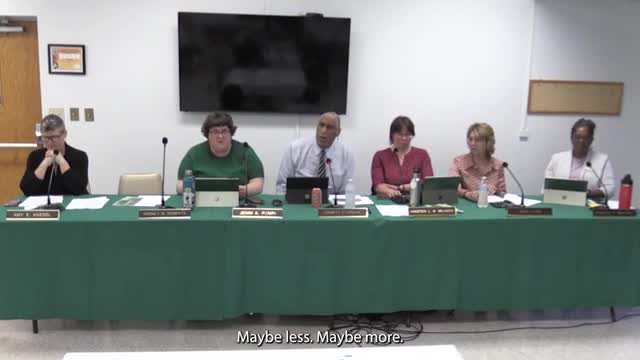
At a Greenbelt City Council budget work session, Mayor Emmett Jordan and staff presented the proposed fiscal 2026 budget for Green Ridge House, the city-owned 101-unit senior residential building, and described revenue sources, projected expenses and upcoming capital work. The council and staff discussed HUD subsidy timing, rent-subsidy mechanics and reserve levels.
Why it matters: Green Ridge House provides long-term affordable housing for seniors in Greenbelt. The property relies chiefly on federal subsidies to keep resident rents affordable; changes to those payments or to rental rate-setting could affect services, capital upkeep and resident costs.
City staff told council that approximately three-quarters of the facility’s revenue comes from the U.S. Department of Housing and Urban Development (HUD). Mayor Emmett Jordan said, "It's HUD money that we use to kinda subsidize the rents." Staff described the resident contribution as a percentage of each household’s income; HUD pays the balance through Housing Assistance Payments (HAP).
Staff and council discussed recent and projected revenue trends. The property has a longstanding waiting list (about 60 names when last reviewed) and averages roughly 14–15 resident turnovers a year, staff said. A small number of residents (about four or five) were “grandfathered” under older occupancy rules that predate a change limiting residency to people 62 and older. City staff explained that HUD reimbursements for some program costs (for example, the HUD-funded service coordinator position) can be delayed by several months because of timing in grant payments.
On reserves and planned projects, staff said the replacement reserves have been funded historically at about $300,000 per year and currently total roughly $1.7 million. That balance is the principal planned source for multi‑year capital work the property will need. Capital items highlighted for fiscal 2026 include a multi‑year program to replace HVAC riser piping (staff estimated that some phases could run to roughly $200,000), building improvements totaling about $318,000 in the proposed budget, and an $82,000 line for exterior painting. Staff said the riser/piping work will be phased to address the worst sections first and will be timed to avoid seasonal heating/cooling conflicts.
Staff projected that net operating income has declined from recent years: council materials cited net income of about $189,000 in 2024, roughly $67,900 in 2023, and projections showing a materially smaller surplus going forward (staff noted a projected net income near the mid‑tens of thousands for 2026). Staff emphasized that the reserve balance is intended to cover capital costs even if operating surpluses shrink.
Council members pressed for clarifications about revenue lines that shift between resident-paid rent and HUD payments. Staff explained that the split changes depending on residents’ incomes and on market‑rate comparability studies HUD uses to set gross potential rents; a market comparability study done in 2023 remains valid through January 2028, the presenters said, and a new market study would be required before renegotiating HUD rates.
Staff noted some timing differences in cash flow: resident rent payments are collected monthly but HUD reimbursements for some line items can lag by months; staff recommended notifying federal representatives if reimbursements are delayed. Councilmember Jenny Pompey suggested contacting the city’s senator and congressional delegation when HUD payments are late so elected officials know local impacts.
Less-critical details: staff said property operations include routine turnover work (painting, cleaning) and that some apparent changes between the adopted and estimated budgets stemmed from coding corrections in the owner’s reports. Replacement reserves remain the intended funding source for capital projects; staff recommended phasing major work to smooth impact on operations.
No formal motions or votes were taken at the work session; council members directed staff to continue planning and to monitor HUD reimbursements and market‑rate studies.
Why it matters: Green Ridge House provides long-term affordable housing for seniors in Greenbelt. The property relies chiefly on federal subsidies to keep resident rents affordable; changes to those payments or to rental rate-setting could affect services, capital upkeep and resident costs.
City staff told council that approximately three-quarters of the facility’s revenue comes from the U.S. Department of Housing and Urban Development (HUD). Mayor Emmett Jordan said, "It's HUD money that we use to kinda subsidize the rents." Staff described the resident contribution as a percentage of each household’s income; HUD pays the balance through Housing Assistance Payments (HAP).
Staff and council discussed recent and projected revenue trends. The property has a longstanding waiting list (about 60 names when last reviewed) and averages roughly 14–15 resident turnovers a year, staff said. A small number of residents (about four or five) were “grandfathered” under older occupancy rules that predate a change limiting residency to people 62 and older. City staff explained that HUD reimbursements for some program costs (for example, the HUD-funded service coordinator position) can be delayed by several months because of timing in grant payments.
On reserves and planned projects, staff said the replacement reserves have been funded historically at about $300,000 per year and currently total roughly $1.7 million. That balance is the principal planned source for multi‑year capital work the property will need. Capital items highlighted for fiscal 2026 include a multi‑year program to replace HVAC riser piping (staff estimated that some phases could run to roughly $200,000), building improvements totaling about $318,000 in the proposed budget, and an $82,000 line for exterior painting. Staff said the riser/piping work will be phased to address the worst sections first and will be timed to avoid seasonal heating/cooling conflicts.
Staff projected that net operating income has declined from recent years: council materials cited net income of about $189,000 in 2024, roughly $67,900 in 2023, and projections showing a materially smaller surplus going forward (staff noted a projected net income near the mid‑tens of thousands for 2026). Staff emphasized that the reserve balance is intended to cover capital costs even if operating surpluses shrink.
Council members pressed for clarifications about revenue lines that shift between resident-paid rent and HUD payments. Staff explained that the split changes depending on residents’ incomes and on market‑rate comparability studies HUD uses to set gross potential rents; a market comparability study done in 2023 remains valid through January 2028, the presenters said, and a new market study would be required before renegotiating HUD rates.
Staff noted some timing differences in cash flow: resident rent payments are collected monthly but HUD reimbursements for some line items can lag by months; staff recommended notifying federal representatives if reimbursements are delayed. Councilmember Jenny Pompey suggested contacting the city’s senator and congressional delegation when HUD payments are late so elected officials know local impacts.
Less-critical details: staff said property operations include routine turnover work (painting, cleaning) and that some apparent changes between the adopted and estimated budgets stemmed from coding corrections in the owner’s reports. Replacement reserves remain the intended funding source for capital projects; staff recommended phasing major work to smooth impact on operations.
No formal motions or votes were taken at the work session; council members directed staff to continue planning and to monitor HUD reimbursements and market‑rate studies.
Don't Miss a Word: See the Full Meeting!
Go beyond summaries. Unlock every video, transcript, and key insight with a Founder Membership.
✓
Get instant access to full meeting videos
✓
Search and clip any phrase from complete transcripts
✓
Receive AI-powered summaries & custom alerts
✓
Enjoy lifetime, unrestricted access to government data
30-day money-back guarantee
