Mass. agriculture commission adopts final report, votes to publish in fall
July 22, 2025 | 2025 Legislature MA, Massachusetts
This article was created by AI summarizing key points discussed. AI makes mistakes, so for full details and context, please refer to the video of the full meeting. Please report any errors so we can fix them. Report an error »
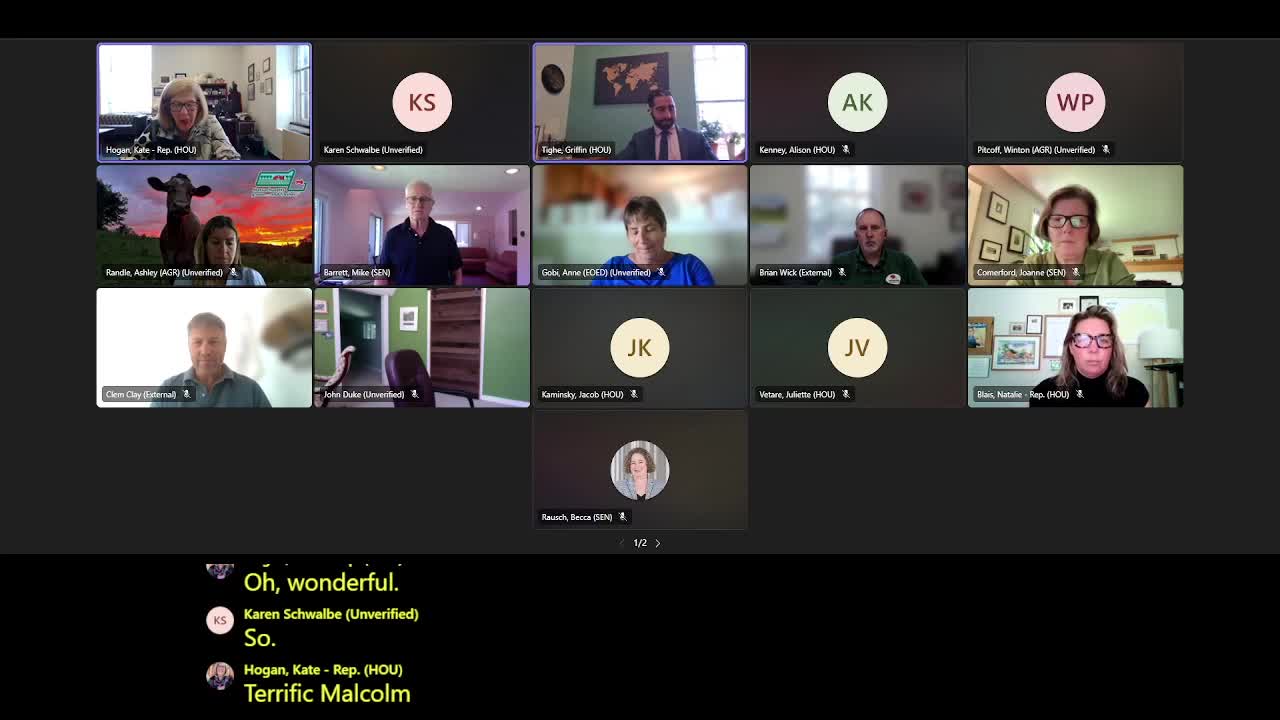
Representative Kate Hogan, chair of the Special Commission on Agriculture in the 21st Century, and co-chair Senator Jo Comerford presided over a roll-call vote that unanimously adopted the commission’s final report and set a timeline to publish a finalized version this fall.
Why it matters: The report compiles findings and recommendations aimed at sustaining Massachusetts agriculture across farmland access, workforce development, climate resilience and other topics. Commissioners said the document will inform legislation already filed and guide state agency outreach.
The commission held nine public hearings, including an in-person hearing and field visit at UMass Amherst, and organized three subject-matter drafting groups that produced the recommendations in the report, Hogan said. “We will now proceed with a roll call vote to adopt the final report of the 20 first century agriculture commission,” Senator Jo Comerford said before the vote.
Several members praised the commission’s work and asked staff to make non-substantive “perfecting edits” before public release. Senator Michael Barrett said he had found “a number of errors and omissions in the text,” including title wording, repeated acronym explanations, and an omission of suburban communities in the draft; he asked that those be corrected in the final document. “If any of the comments … are in error, I want to apologize for those in advance,” Barrett said.
Representative Natalie Blay, House chair of the joint committee on agriculture, and other commissioners thanked the chairs and staff for extensive public engagement. Commissioner Ashley Randall of the Massachusetts Department of Agricultural Resources voted yes and echoed support for the report’s goal that farming remain a viable occupation.
Formal action: The commission voted by roll call to adopt the final report. Recorded yes votes included Representative Natalie Blay; Ian Ward; Anne Gobi (appointed by the secretary of the Executive Office of Housing and Economic Development); Clem Clay; Karen Schwalbe; Senator Becca Rausch; Senator Michael Barrett; Commissioner Ashley Randall; Brian Wick (designee of the Cape Cod Cranberry Growers Association); John Duke (designee of the Massachusetts chapter of NOFA); Senator Jo Comerford; and Representative Kate Hogan. Stephanie Cooper (Undersecretary at the Executive Office of Energy and Environmental Affairs) and Michael Smolak were not present for the vote. The meeting transcript records the outcome as unanimous among those present; votes will be listed in the report appendix.
Post-vote steps and direction: Chairs said staff will incorporate editing corrections, finalize formatting and design elements, and publish an online version on the Legislature’s website. The chairs said they plan a public launch and a media briefing in the fall to highlight findings and any legislation filed that stems from the report. Senator Comerford noted that several members of the Legislature already have filed bills addressing farm support and food security and said she hopes the report will bolster that work.
Policy context flagged during discussion: Senator Barrett noted a pending executive branch energy bill proposing to eliminate the Alternative Portfolio Standard (APS) and urged reconciliation between that bill and commission recommendations supporting state incentives for anaerobic digestion and organic-waste reduction. Members acknowledged that the timing of external proposals (including a governor-filed energy affordability bill) could affect how the report’s recommendations are implemented.
Meeting context and history: Commissioners said the commission’s work began in early 2020 and faced delays during the COVID-19 pandemic; nonetheless, members described sustained engagement and multiple drafting rounds. The chairs thanked subcommittee leaders — including deputy commissioner Wynton Pitkoff, Clem Clay of UMass Extension, and Karen Schwalbe of the Farm Bureau — for their roles drafting recommendations.
What’s next: The finalized report will be posted online, distributed to agency partners and stakeholders, and accompanied by a media briefing this fall. The chairs encouraged questions or corrections to be sent to their communications directors ahead of publication.
Why it matters: The report compiles findings and recommendations aimed at sustaining Massachusetts agriculture across farmland access, workforce development, climate resilience and other topics. Commissioners said the document will inform legislation already filed and guide state agency outreach.
The commission held nine public hearings, including an in-person hearing and field visit at UMass Amherst, and organized three subject-matter drafting groups that produced the recommendations in the report, Hogan said. “We will now proceed with a roll call vote to adopt the final report of the 20 first century agriculture commission,” Senator Jo Comerford said before the vote.
Several members praised the commission’s work and asked staff to make non-substantive “perfecting edits” before public release. Senator Michael Barrett said he had found “a number of errors and omissions in the text,” including title wording, repeated acronym explanations, and an omission of suburban communities in the draft; he asked that those be corrected in the final document. “If any of the comments … are in error, I want to apologize for those in advance,” Barrett said.
Representative Natalie Blay, House chair of the joint committee on agriculture, and other commissioners thanked the chairs and staff for extensive public engagement. Commissioner Ashley Randall of the Massachusetts Department of Agricultural Resources voted yes and echoed support for the report’s goal that farming remain a viable occupation.
Formal action: The commission voted by roll call to adopt the final report. Recorded yes votes included Representative Natalie Blay; Ian Ward; Anne Gobi (appointed by the secretary of the Executive Office of Housing and Economic Development); Clem Clay; Karen Schwalbe; Senator Becca Rausch; Senator Michael Barrett; Commissioner Ashley Randall; Brian Wick (designee of the Cape Cod Cranberry Growers Association); John Duke (designee of the Massachusetts chapter of NOFA); Senator Jo Comerford; and Representative Kate Hogan. Stephanie Cooper (Undersecretary at the Executive Office of Energy and Environmental Affairs) and Michael Smolak were not present for the vote. The meeting transcript records the outcome as unanimous among those present; votes will be listed in the report appendix.
Post-vote steps and direction: Chairs said staff will incorporate editing corrections, finalize formatting and design elements, and publish an online version on the Legislature’s website. The chairs said they plan a public launch and a media briefing in the fall to highlight findings and any legislation filed that stems from the report. Senator Comerford noted that several members of the Legislature already have filed bills addressing farm support and food security and said she hopes the report will bolster that work.
Policy context flagged during discussion: Senator Barrett noted a pending executive branch energy bill proposing to eliminate the Alternative Portfolio Standard (APS) and urged reconciliation between that bill and commission recommendations supporting state incentives for anaerobic digestion and organic-waste reduction. Members acknowledged that the timing of external proposals (including a governor-filed energy affordability bill) could affect how the report’s recommendations are implemented.
Meeting context and history: Commissioners said the commission’s work began in early 2020 and faced delays during the COVID-19 pandemic; nonetheless, members described sustained engagement and multiple drafting rounds. The chairs thanked subcommittee leaders — including deputy commissioner Wynton Pitkoff, Clem Clay of UMass Extension, and Karen Schwalbe of the Farm Bureau — for their roles drafting recommendations.
What’s next: The finalized report will be posted online, distributed to agency partners and stakeholders, and accompanied by a media briefing this fall. The chairs encouraged questions or corrections to be sent to their communications directors ahead of publication.
Don't Miss a Word: See the Full Meeting!
Go beyond summaries. Unlock every video, transcript, and key insight with a Founder Membership.
✓
Get instant access to full meeting videos
✓
Search and clip any phrase from complete transcripts
✓
Receive AI-powered summaries & custom alerts
✓
Enjoy lifetime, unrestricted access to government data
30-day money-back guarantee
